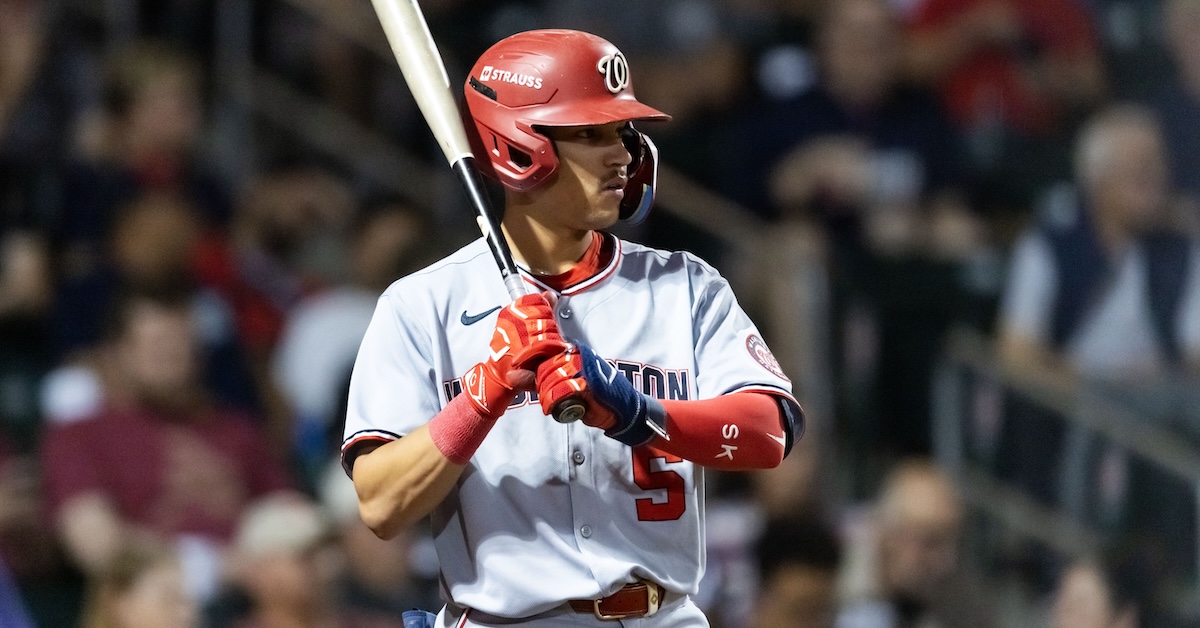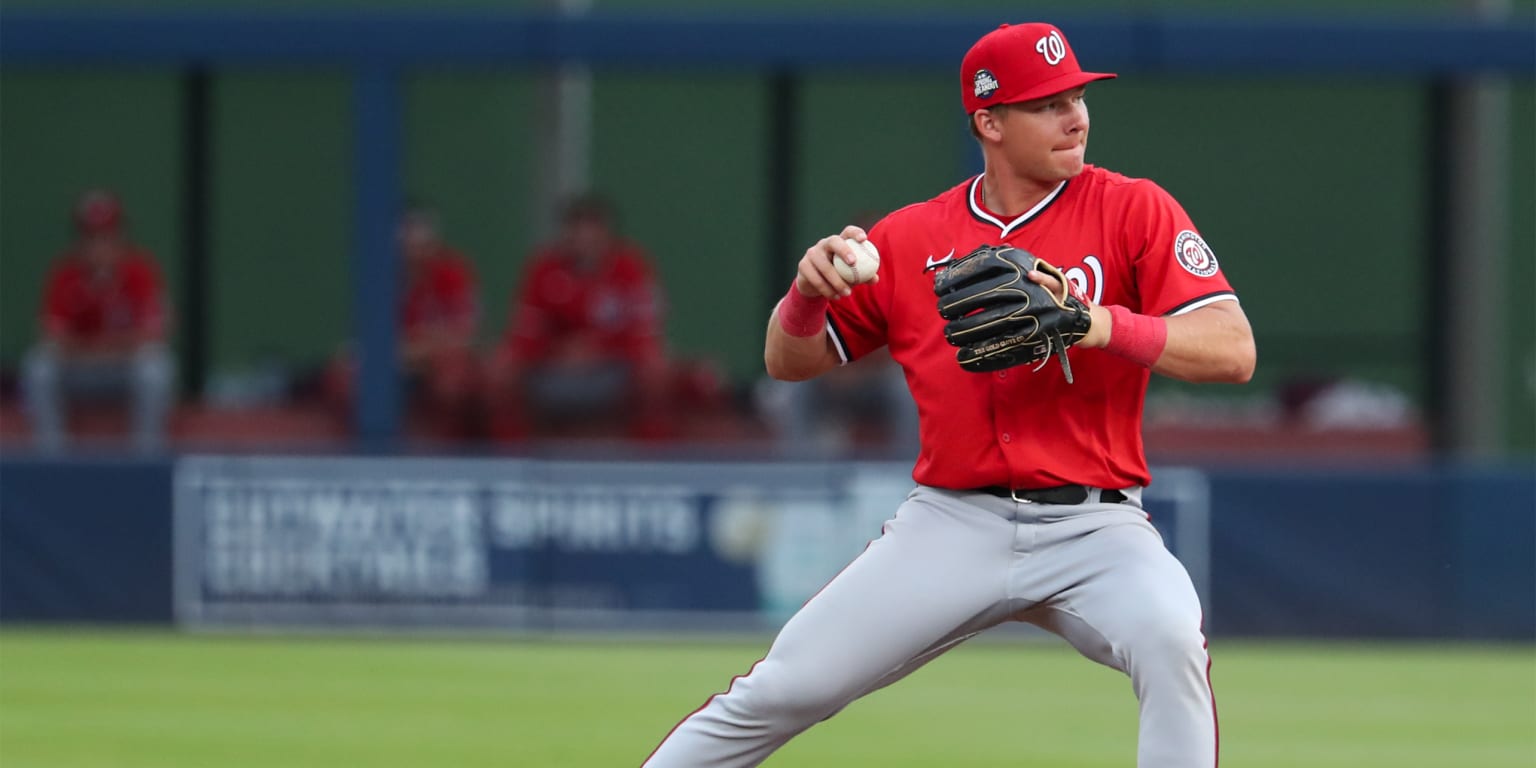
Harry Ford is off the mlbpipeline prospect list for now, but has yet to reach rookie eligibility. Photo via Seattle times
It’s the week apparently for major pundits to do database updates. We had Baseball America earlier this week, we had Fangraphs a day after with their completely whacked board, and today we have the saner MLB Pipeline folks updating our top 30 for Drafted players. As we did with the BA list, here’s a quick analysis of who we added and a few comments on the handful of players they made somewhat large adjustments for mid-season
Here’s the announcement from yesterday, which has links right to our system top 30. Below is a table from my Master Nats Prospect Rank XLS where i’ve pulled out the last few MLB Pipeline ranks to show rank evolution since March for these players. BTW, that Master prospect ranks XLS is one of the things I’m most proud of maintaining; it has nearly 300 sources dating back to Nov 2004’s Baseball America system rank for our system pre move, and its where I pull these tables for these poses. We have now ranked at some point 526 players in a list of some sort since the team moved here.
8/13/26 post draft
7/24/26 post trade, pre dr aft
3/3/26 pre-season
First name
Last Name
Position
1
1
1
Eli
Willits
SS
2
2
2
Travis
Sykora
RHP (Starter)
3
3
4
Jarlin
Susana
RHP (Starter)
4
4
7
Seaver
King
SS
5
6
9
Devin
Fitz-Gerald
SS
6
Pre-Draft
Pre-Draft
Chris
Hacopian
2B
7
5
25
Ronny
Cruz
SS
8
8
5
Gavin
Fein
SS
9
9
14
Jackson
Kent
LHP (Starter)
10
10
16
Miguel
Sime Jr.
RHP (Starter)
11
13
10
Landon
Harmon
RHP (Starter)
12
11
6
Luis
Perales
RHP (Starter)
13
Pre-Draft
Pre-Draft
Chase
Brunson
OF (CF)
14
13
Pre-Trade
Jack
Cebert
RHP (Starter)
15
18
17
Coy
James
SS
16
28
Samil
Serrano
OF (Corner)
17
15
12
Ethan
Petry
1B/OF (Corner)
18
14
11
Alex
Clemmey
LHP (Starter)
19
23
24
Abimelec
Ortiz
1B/OF (Corner)
20
17
15
Alejandro
Rosario
RHP
21
25
Pre-Trade
Ben
Grable
RHP (Reliever)
22
12
8
Luke
Dickerson
SS/CF
23
Pre-Draft
Pre-Draft
Luke
Williams
SS
24
Pre-Draft
Pre-Draft
Cooper
Harris
RHP (Starter)
25
16
13
Yoel
Tejeda Jr.
RHP (Starter)
26
20
21
Marconi
German
SS
27
30
Yovanny
Cruz
RHP (Reliever)
28
19
20
Yeremy
Cabrera
OF (corner)
29
21
22
Sam
Peterson
OF (CF)
30
25
28
Caleb
Lomavita
C
(In majors)
7
3
Harry
Ford
C
(In majors)
30
19
Andrew
Pinckney
OF (Corner)
Traded away
29
18
Christian
Franklin
OF (CF)
Traded away
Traded away
27
Sean Paul
Linan
RHP (Starter)
22
23
Angel
Feliz
SS/3B
24
26
Eriq
Swan
RHP (Starter)
26
29
Yohandy
Morales
3B
27
30
Nauris
De La Cruz
OF (Corner)
29
Pre-Trade
Josh
Hartle
LHP (Starter)
Ok. Here we go
In this list, the 2026 draft netted us 4 additions: Hacopian, Brunson, Williams, and Harris. Same 4 added by BA.
2026 Trade deadline netted us just 2 of the current top 30: Cebert & Grable. Hartle was #29 until we added in the 4 new draftees, so he’s right there.
As of this ranking, Ford (#7) and Pinckney (#30 ish) were in the majors but still have rookie eligibility, so they’re not listed. Kent was probably promoted after this work was done else he’d be missing too under their guidelines for prospect listings.
There’s not a ton of movement from the 7/24 list to the 8/13 list … that’s just 3 weeks of play, but we did see a couple of interesting players making somewhat significant jumps:
Serrano, unraked in March, went from #28 three weeks ago to #16 today. BA has jumped him up a ton as well.
Dickerson has gone from #8 in March to #12 three weeks ago to #22 today. Honestly, having him #12 in July was probably the problem; he should have been well below that level of ranking at that point.
Tejeda has gone from 13->16->25. On the one hand, I think MLB was way high on him in March, but he solved High-A in his 2nd pro season and is in AA as a 23yr old; I would think that would at least keep him somewhat where he was ranked a month ago. Weird.
They dumped both Cabrera and Peterson ten spots for meh 2026 performances so far.
There were five guys on the top 30 now pushed off with addition of draftees: Angel Feliz, Eriq Swan, Yohandy Morales, Nauris De La Cruz, and Josh Hartle.
I’m not going to do a Fangraphs ranking reaction piece. I don’t think any of the other major pundits do updated rankings mid-season due to workloads, so this is it for now.
Hacopian debuts at #7 on BA’s list. Photo via mlb network
Well, we’re past the trade deadline and the 2026 draft, where we got a near top 10 pick added to the system.
How are we looking? The first shop to do a post-trade deadline and post Draft prospect inclusion is the trusty old Baseball America shop; here’s their updated top 30 with some commentary.
Ok, so lets talk about the additions and notable changes.
The Draft netted us 4 new top-30 prospects: Hacopian, Brunson, Harris, and Williams. Our first 4 rounders.
The Trade Deadline also netted us 4 new top-30 prospects: Cebert, Grable, Hartle, Cruz.
As of this ranking, 3 guys were in the MLB and are not included: Ford, Cornelio, Pinckney (though Pinckney would have been pushed off the end of the previous top 30 with all these new names coming in).
No changes in the top 6 from 7/1 to 8/10, even though Susana seems to be on track to miss the entire season with a murky injury that’s never really been disclosed. Update: maybe not; apparently he’s on track to return next week … just in time for the season to be over.
Hacopian slots into his first ranking at #7. Our farm system has come a long way when our first rounder comes in so low. Here’s some comparisons to other top draft picks and where they debuted in our farm system:
Willits: 2025 1st round, 1st overall: Went right in at our #1
King: 2024 1st round, 10th overall: debuted at #7 on BA’s first list post draft
Crews 2023 1st round, 2nd overall: was #2 on Fangraphs (behind Woods), #1 most everywhere else
Greene 2022 1st round 5th overall: was #5 on Fangraphs, #4 on BA’s first list
House 2021 1st round 11th overall: went right to #2 behind Cavalli
Cavalli 2020 1st round 22nd overall: Went to #4 to start
Rutledge 2019 1st round 17th overall: started at #4 in the system.
Denaburg 2018 1st round ?th overall: started at #4 on multiple shops
Romero 2017 1st round ?th overall: Started at #5
Kieboom 2016 1st round-S: 6-7th
Dunning 2016 1st round-S: 7th-8th
As noted elsewhere, Jackson Kent #10 is going to get called up to pitch in the MLB rotation, above Perales.
Samil Serrano is the first player with a significantly improved relative ranking to 5 weeks ago, going from #25 to #11 on this list. No surprise, with him slashing .300/.418/.523 in the DSL in his debut season after signing for $1.9M in January. It would be great to develop someone out of the DSL.
Gavin Fein gets dumped 6 spots for his struggling 2026 season, fair.
Coy James actually moved up a few spots relatively. It pays to play the infield.
Fein: .238/.330/.406 with 9 homers splitting time between CF and RF.
James: .230/.345/.438 with 18 homers playing all around the dirt.
Our highest ranked prospect acquired in trade is AA starter Jack Cebert, ranked #17 here.
Alex Clemmey takes a dive, from #13 to #19. Understandable given his season performance, even if he’s had some decent games lately.
Sam Peterson takes a dive as well, from 16->22. The Nats don’t think so; they just promoted him to AAA and he’s started hot.
The biggest drop has to be Ethan Petry, who was on the cusp of the top 10 in early July and got dropped 14 spots in this ranking. Ouch.
In the same vein, Morales got dropped from 15 to 27 after struggling for the last two months. That seems awfully harsh.
The last two guys on the current top 30 are also hitters who have gotten dropped: Cabrera and Wallace. Cabrera I get; he’s now finishing his 5th pro season and is struggling with the promotion to High-A, but Wallace’s dinging doesn’t make sense. he’s had a really solid season and is now in AAA.
Ford, Cornelio, and Pinckney if they were still on the list probably would come in at around 20, 25, and 30ish respectively. None of the three are graduated yet in terms of ABs or IPs, probably just some BA thing where they don’t rank guys in the majors.
Five guys got pushed out of the top 30 with all this churn: assuming they’re still in the same order:
31: Angel Feliz
32: Caleb Lomavita
33: Jorgelys Mota
34: Marconi German
35: Marlon De la Cruz
In terms of overall farm system rankings, I’ll be super curious to see where we sit now. One week after ranking our top 30 in July, BA put us at the #4 farm system in all of baseball, and that was before adding 8 more guys. The three teams ranked above us (Milwaukee, Tampa, LA Dodgers) are all in first place and were absolutely “buyers” at the trade deadline, meaning the combination of us adding and them all subtracting gives this team a real chance at getting to the #1 spot, which is crazy.
In all the time i’ve tracked prospects and Farm system rankings, going back well before our time in DC, the Nats farm system has been ranked #1 exactly ONCE by any shop: the 2012 Baseball America Handbook release just before we moved a bunch of guys to acquire Gio Gonzalez. Do we have a chance to get there again?
Luke Dickerson is starting to heat up in Low-A. Photo via MLB
Here’s a monthly check in on our 20 prospects plus other notables in the system. Stats are for just July 2026 for the full season shops, the full-season for FCL and DSL, unless otherwise noted.
I’m writing this just after the trade deadline; no stats here for any of the 10 guys we acquired.
All the stats links I use are at my Nats Links page, which I visit every day for various reasons. I won’t repeat all the stats links and transactions pages and what not; just go to the Links page.
Eli Willits SS, High-A: Finally had a bad month, slashing just .190/.388/.222 for July. Still not bad for an 18yr old. Temperature: cooled off for sure
Henry Harry Ford, C AAA: was having the start to a solid month (.292/.486/.542) when he got the callup to cover for Millas’ broken finger. Is just 4-29 since his call-up. Temperature: warm for AAA performance.
Jarlin Susana, RHP (starter) AA: Still on the 60-day DL, and zero injury updates for 6 weeks now. This is now basically a lost season for Susana, certainly not how we thought this season would go. Temperature: still on ice.
Travis Sykora: RHP (starter) AA: out for the season, the injury report lists his return as 2027. No new news for months. Temperature: on ice.
Gavin Fien SS/3B, Low-A: regressed a bit this month from last: .238/.315/.438. So far, he has not lived up to his draft hype, though he is just 19. Temperature: cool.
Alex Clemmey, LHP (Starter) AA: Clemmey had a good month. 6 appearances, 1.98 ERA, 30/17 K/BB in 27 IP and just a .191 BAA. Hopeful this continues… Temperature: a little warm?
Seaver King, SS AAA: Missed basically the entire month with an oblique injury, but he’s off the DL as of 7/30. Let’s hope he has a solid run in August. No Abrams trade, thus no real pressure to call him up in 2026. Temperature: on ice, now off.
Luis Perales, RHP (starter) AAA: Perales was … great! 5 games, 1.46 ERA, .180 BAA. Still too many walks (29/16 k/bb in 24ip), but finally a solid month for the guy. Temperature: Warm.
Devin Fitz-Gerald, 2B/SS, AA: Improved from last month, slashed .250/.333/.306 but then got hurt. On the DL as we speak, unknown what the issues is. Temperature: Hot to get to AA, now on ice for a bit.
Landon Harmon, RHP (starter): Low-A: Finally off the DL after nearly 2 months there. Harmon’s first two starts back off the DL have looked short and effortless: 2 games, 5ip, 2 hits allowed, 0 runs. Bummer he’s missed so much time this season; at least he has August to build up some innings. Temperature: hopefully warming up.
Ronny Cruz: SS High-A. Fell off a cliff in July: .160/.292/.253. After such a torrid start, clearly has not made the jump to High-A and may be there for a bit. Reminder: he’s only 19. Temperature: cold.
Luke Dickerson, SS/CF Low-A: Very solid month for Dickerson: .261/.420/.507. He’s mostly splitting time between SS and CF still, and had 5 homers this month. Temperature: getting a lot warmer.
Ethan Petry, 1B AA: He slashed .221/.293/.441 in July, which is better than June but still not good. Temperature: now pretty cold.
Coy James, SS/3B, Low-A: connected for 6 homers this month, which pushed his slugging and OPS way up: .220/.280/.476 for the month. Would like to see a better BA and OBP. Temperature: warming.
Angel Felix, SS High-A: Treading water from June, slashing .250/.297/.429. Reminder: he’s only 19. Temperature: luke warm.
Yoel Tejeda Jr. RHP (starter) AA: Finally got promoted out of High-A after nearly 2 months of being the leading starter on the rotation. First two AA starts were middling; more to come in August. Temperature: very warm for the promotion.
Jackson Kent, LHP (Starter) AAA: Kent almost matched his June numbers with a 4.66 ERA for July; a quick peek at his advanced numbers shows a 3.85 Fip and a .324 BABIP, so he’s a bit better than appearances. Not good enough yet to be seriously pressing for a promotion, especially since he’s not on the 40-man. Temperature: room temperature.
Miguel Sime Jr. RHP (starter): High-A: 4 starts, just 14 IP. 2.51 ERA, 1.12 whip; ok those are solid. He gave up FIVE hits in the month. Five. 23/11 K/BB in those 14 innings. Ok, so maybe the guy can’t find the plate, but when he does, he mostly strikes people out. .106 BAA. I wrote it elsewhere, but you have to move this guy up again, even though he’s walking nearly a guy an inning and he’s only 19. You have to find a level where they actually hit the guy. Temperature: still hot.
Davian Garcia, RHP (starter) AA; On the full-season DL, hopefully to return in 2027. No new news. Temperature: on ice.
Yeremy Cabrera CF High-A: still struggling 2 months into his High-A promotion: .207/.283/.341. It’s just hard to hit in Wilmington. Temperature: cooled off.
Notables #20 and above by level:
in AAA:
#27 Yohandy Morales 1B/3B in AAA had another poor batting average month, but still had an .843 OPS for the month with the power he’s shown.: .217/.321/.522. Hopefully with the trades of Mead & Garcia this opens up an eventual slot for Morales.
#30 Cayden Wallace finally earned a promotion to AAA and had the typical adjustment month: .210/.242/.306. Great for him to finally push his way to AAA, now sharing middle infield time with Glasser, King, and Lipscomb.
#31 Phillip Glasser 2B in AAA had another great month: .351/.471/.421. Hopefully with the clear-out of players in AAA, he’ll have a clear path to full-time playing time.
#32 Andrew Pinckney, against all odds, got called up after years of solid AAA production.
#33 Albimec Ortiz 1B/DH in AAA hit just .211 but had an OPS > .800, and as a 40-man member got the call-up to replace Garcia upon his trade.
The team parted ways with Hassell, and Weimer continues not to hit and likely is in the lead for “next man to get cut from the 40-man if the team needs a spot,” especially since the team opted to add Pinckney instead of recalling him. Weimer, now as of this writing, is the sole non-pitcher on the 40-man who remains in the minors post trades. Postpublish update; a few hours after writing this, the team put Weimer on release waivers.
Riley Adams is crushing the ball … but needs an injury to get back on the 40-man/back tot he majors. They played him at 1B the other day, interesting.
Former 40-man member Trey Lipscomb is crushing the ball too: .356/.410/ .533 in July as a middle infielder.
In AA:
#21 Sam Peterson continues to struggle, hitting just .229 this month after hitting .221 last month. He’s definitely stalling in 2026.
#26 Caleb Lomavita settled down a bit in July: .264/.316/.396. The team opted to keep him starting in AA when Ford got called up, instead leaving Adams as the starting C in AAA and promoting one of the AA backups. I’m guessing we won’t see a Lomavita promotion this year.
#60 TJ White, showed some power this month with 5 homers in AA but still struggling to a .221 BA.
Brandon Boissiere powered it up in July: .306/.378/.514.
Isaac Lyon, the throw-in player in the Ferrer-Ford trade, has been quietly an assassin this season, earning 2 promotions and now more than holding his own in AA. July numbers: 3-1 with a 1.84 ERA in 5 starts.1.06 whip, .229 BAA.
AA is where most of our Trade deadline acquisitions have initially landed: they’ve added 2 starters, 4 relievers and an OF. We’ll see how things shake out for next month’s version of this and the rotation post.
In High-A:
#40 Kevin Bazzell continues to produce with a .953 OPS figure in July. Nowhere to go though.
#61 Randal Diaz got flipped to Baltimore on 7/1 for a AAA reliever.
Elijah Green had a nice slashline .296/.363/.444 to go with his 40 Ks in 22 games.
Jacob Walsh rebounded in a big way for July, mashing 8 homers for a slugging percentage in the 600s.
Jack Moroknek had his 2nd straight month of hitting in the .125 range post promotion.
Carson Fischer was a 2025 NDFA who had a 3.18 ERA month in the High-A rotation; can’t ask for much more than that from a $10k signing.
In Low-A:
#38 Sir Jamison Jones had another sub .200 batting month.
#39 Rafael Ramirez Jr bounced back with a solid .286/.444/.405 month.
#41 Cristian Vaquero finally got off the DL, and got demoted to Low-A for his troubles. He only hit .229 in F’burg when he got there, and his career seems stalled.
#51 Dashyll Tejeda, took a step back in his second Low-A month, hitting just .204.
Unranked Jordan Williams, a 26yr old NDFA signed earlier this year, continues to hit and needs to be socially promoted.
Unranked Elian Soto continues to hit: .271/.386/.458 for July, though without much power. His brother, he is not, but he’s showing some value.
Note: just as I was getting ready to publish, the first 2026 draftee got moved to a full-season team in CA Cashel Dugger, 9th rounder this year.
In FCL, whose season ended in mid July, here’s seasonal stats for the 25IFA class that moved up from the DSL from 2025. Some good, mostly bad.
#23 MarconiGerman; .246/.425/.486 for the season with some power and improvement from June->July.
#36 Brayan Cortesia: .243/.381/.257 for the season: that’s just 2 XBH in 144 ABs. That’s not good.
#42 Daniel Hernandez: .190/.238/.215 for the season, getting worse as he went along. Ugh.
#46 Browm Martinez: .271/.431/.430; that’s solid, but not a ton of power.
#47 Victor Hurtado .259/.410/.407, really turning it around in July.
Maxim Medina pitched twice at the end of the FCL after dominating DSL this year and got absolutely shelled: 4.2 IP, 10 runs
Juan Lopez‘s K/BB numbers are hilarious: 37ip: 46Ks and 33walks. He’s an older IFA; signed last year but already 21, so that may explain things.
In DSL, here’s the seasonal hitting stats for the four marquee 2026 IFA signings:
Isaias Suarez OF (corner): ..198/.390/.337; struggling to start his career. At least he’s getting BBs.
Angel Ramirez OF (corner): .205/.346/.375; about in line with the first month.
Samil Serrano OF (cf): .297/.413/.517 so far; looking really good.
Juan Duran 1B: .327/.431/.478; came back a bit from a hot July, still a .900 OPS for the season.
In the DSL, the remaining big money 2025IFA signings who are still there:
Ronny Bello SS: .291/.404/.455, adding even more power from June, clearly earning a promotion to FCL in 2027.
Esnaider Vargas: Of/DH: ..292/.355/.458, a solid year so far.
Jonierbis Garces: OF (corner): .266/.408/.316; had a really good July to increase his BA and OBP; little power.
Griffin heading to Cleveland in a deadline deal. photo via CBS Sports
As of 5:45pm, I thought perhaps our all-star starter Foster Griffin may be sticking around, since we hadn’t heard of any moves ahead of (what I thought was the ) 5pm EST deadline for trades. I guess it was 6pm EST, because we jammed in one last trade.
Josh Hartle, LHP AA starter with a 3.86 ERA in 19 starts this season
Will Dion, LHP reliever with some MLB and a solid 25/3 K/BB ratio
Kendeglys Virguez, a RHP reliever with a 14.3 K/9 rate this year who just got moved to AA
Nick Mitchell, a 22yr old OF with decent numbers in AA (.240 with some power, some speed)
The best prospect of course is the AA starter Hartle, who slots just into the back of our top 30 prospects on MLBpipeline.
Is this a great return? No, not really on the face of it. Is it an understandable return? Yes it is. Yes, Griffin was an all-star, one of the best pitchers this season by most measures. He’s also a FA in two months and rebuffed extension talks before getting moved, because of course he did. He toiled in Japan for years to get this shot, now he’s in his age 30 season and he has one big chance in open free agency to get that “one big career deal” that sets him up. He doesn’t want a one-year QO; he wants a 4-5 year deal that sets him up for life.
Should the Nats have kept him, offered him a QO and taken the comp pick instead of what they got? Maybe. As a “large market” team that’s stayed below the luxury tax, under the current system our comp pick would have been just before the 3rd round starts in 2027, somewhere around the 75th overall pick. Would that be better than what we just got? Debatable. Our 3rd rounder this year (Luke Williams, drafted 78th overall) is a prep SS who we probably don’t see until 2030; is that the kind of player you’d rather have instead of the four we got, all of whom are already in AA or higher?
The ship sailed on keeping these guys on Sunday night, so we were going to move him for something, and this sounds like the best deal we could get.
One last side note: the Nats also made an under the radar smart trade, moving the buried AAA outfielder Franklin for another arm.
Clearly there’s a trend here: the bullpen construction project in the off-season of MLFAs and waiver claims just didn’t work. Now they’re going to try building a bullpen from prospects and (hopefully) some strategic FA signings for 2027.
Working on the big board updates and 40-man machinations now.
Btw, I hate that my July rotation piece got buried by these two trade pieces; it takes a significant amount of time to do that post. Bummer 🙂
Good to have another slugging former Hurricane on board in Daniel Cuvet. Photo via UMiami
Despite having a few days to go until the 7/27/26 deadline for signing its 2026 draftees, the Nats have gotten everything done well ahead of schedule, and according to Baseball America’s draft tracker have now signed 18 of their 20 draft picks. Based on the financial accounting, there’s no more bonus money to dole out, so this is the 2026 class.
With this post, I have updated the Nats Draft Tracker main page for the 2026 class, and have finished off the 2026 draft tab, where you can see signing bonuses compared to slot values and the running arithmetic of the entire draft bonus usage. If you’re interested in a players’ college stats, new this year i’ve got direct links to their college stats page to save you some googling. I also have links to their social media pages (X and IG) if you wanted to follow them.
I have also added all 18 draftees and the 7 known NDFAs to the Big Board in the XST section. As they’re assigned we’ll move them to a full season or FCL roster. With these 25 signings, as well as with all the moves we’ve made in recent days, the Minor League roster now sits (as far as I can tell) at exactly 165, or the target limit. Any new signings (MLFA or NDFA) from here on out will require a corresponding minor league move as the system is full (either a move to 60-day, a move to the Dev list, or a release).
Let’s talk about the signing bonuses, and who signed for more or less than predicted. Slot values are on the Draft tracker, and for the whole draft are here. You can go back to my two review posts for my quick predictions on what the players would sign for, which i’ll draw in here.
1st rounder Hacopian took a $433k haircut on his bonus, not surprising and about what one would expect. Most of the 1st rounders, especially in the top 10, don’t sign for slot, as teams basically play their “floors” against where they get picked and enact some savings. Hacopian signed for $5.7M, which is a bit more than the 13th overall slot value, and he probably would have slipped well past 13th overall had he not signed with us (the next three picks after #11 were HS picks, then a college catcher, then more prep picks). So Hacopian probably said, “well I can say yes to $5.7 now, or run the risk of falling into the mid teens where the slots are in the $4.8M-$5.2M range, so might as well say Yes to the Nats’ offer right now.”
2nd rounder Brunson ended up signing for $588k under slot, a big surprise for me since he was drafted #42 overall and sat right in that range on most of the draft boards. I thought this was a slot pick for sure. Nonetheless, big savings here and from Hacopian that then go to the next two kids.
3rd and 4th rounder Prep kids get big over-slot deals as expected: Williams got $2.5M, about $1.5M over slot and the equivalent of a early 2nd round pick. Harris took $1.5M on a slot value of $740k to buy him out of college, about the equivalent of a later 2nd rounder.
This is what you do: we now have a 1st rounder and three 2nd round talents thanks to working the bonus figures properly.
5th rounder Cuvet signed basically for slot as predicted.
6th rounder Allen took about what I thought he’d take for a discount: I predicted $250k savings, he signs for $220k less than slot.
It took more than I thought it would to sign 7th rounder Peterson: I thought he’d go for the $150k standard 11-20th round money, but it took $250k.
Our 8th and 10th rounders both went for the standard Senior sign figure of $10k; honestly I’m happy the Nats do $10k and not the pittance of $1k that other shops do for these guys.
9th rounder Duger signed for exactly slot. I thought we might get $75k of savings here, but they didn’t need it with the big savings on Brunson, and at that point in the draft the team was probably just calling guys on their board and saying, “will you sign for slot right now?” until they got a Yes.
The 11th-20th rounders had some interesting bonus figures; in many years we just give everyone $150k and move on. Not this year.
11th and 12th rounders Moss and Dallas each got $25k more than the standard $150k, as I surmised in the review.
13th rounder Howard, a college grad student whose drafting we all questioned at the time, got $100k. This seems like a graduation gift on behalf of the team for a senior sign who at best should have gone in the 10th round for $10k. Why give him $100K? Something’s amiss here. But hey, its not my money.
14th, 19th, and 20th rounders were all college guys who took the standard $150k. 14th rounder Konstantinovsky makes sense for that figure, but the other two were odd. 19th rounder Brooks was a college senior (ok, technically a redshirt Junior) with a miserable batting average and little leverage; did it really take $150k to sign him, when they could probably get him as an NDFA next year for $20k? Our 20th rounder Siebert was a juco guy with a Tennessee commit who gook the $150kto my surprise; must not have had a great NIL deal on hand.
It ended up taking $250k to get the IFA gambit Rivero, $100k over slot. Whether or not you think Rivero is “good,” this is still a big savings over the $750k he was offered by the Dodgers in the IFA market a year ago. If the Dodgers, who I think are the preeminent player development team in the sport, were willing to pay that much and we got him for a third less, I’ll take that as a win.
The “last guy to sign who gets all the left over bonus money” seemed to be 18th rounder Ortiz, who I thought might be tougher to sign. He ended up getting $215k for an overslot deal, a weird amount that essentially was all the remaining leftover bonus money under the cap.
As expected, once the two upper prep kids signed, the two prep kids drafted in the teens (#16 Murphy and #17 Galason) got cut loose; they’re the only 2 players not to sign in this class.
Bonus pool overall usage: If i have my calculations correct, and If I ignore all the BA reported signing bonuses that seem to be exactly $2,500 off for most of the bonuses, then the Nats left just $1,115 dollars on the table. Perfect usage.
Total slot amount of $12,278,300
plus 5% overage cushion of $613,905
Total amount to spend: 12,892,225
Total bonus dollars spent plus overages on the $150k/player in the 11-20th rounds: 12,891,110
Left over: $1,115
That’s our 2026 class.
One last note: Baseball America released its updated top 100 including 2026 draftees, which included 10 players from the 2026 class …. but not Hacopian, who just missed their top 100. But, to give you an idea of where Hacopian likely fits into our system, there’s 5 Nats in the BA top 100 right now:
15. Willits
39. King
55. Susana
68. Fitz-Gerald
87. Cruz
Outside the top 100 but who have been there before: Sykora, Ford, and Fein.
I’m guessing Hacopian will start at #6 in our system, just ahead of Sykora, Ford, and Fein, and just outside the BA top 100. If he pops immediately upon starting his pro career, he should push into the top 100 quickly.
The Nationals, in addition to their 20 rounds of picks, have generally signed a 1-2 Undrafted Free Agents (NDFAs) at the end of each draft. The last few years it’s been just a couple guys per year, but this year they signed a whole slew of them, some frankly promising, and were incredibly active in the days immediately following the draft. Not since 2022 have we seen this many NDFAs come on board.
This amount of guys is notable, because by and large each additional NDFA means someone has to make way within the organization (either to a dev list, or to the 60-day DL, or to get released altogether). I discussed in a comment on Nationalsprospects.com the below, but it bears repeating and cleaning up.
Farm systems under the latest Collective Bargaining Agreement are capped as to the number of players you can have rostered, both by level and overall. By level, the limits are:
AAA: 28 active, 33 roster-able
AA: 28 active, 33 roster-able
High-A: 30 active, 33 roster-able
Low-A: 30 active, 33 roster-able
FCL: no actual defined limits; up to the total domestic cap roster-able. Target 33 players roster-able.
(Note: there’s no limit or restrictions on DSL: these limits are domestic only)
So, 33 rostered players (either active or on the 7-day DL)*5 domestic levels = a total domestic limit of 165 players. Anyone in the following situation does not count against the 165 limit:
60-Day DL guys
Developmental List guys
40-man Roster guys.
Rehabbing players (who would otherwise get double counted on the big board).
I try to keep track of the running totals per team and for the system via XLS macros on the Big Board. As of this writing and as of the 2026 Draft I have us at 160 ( it was at 161 earlier this week before the Robert Hassell trade).
However, that 161 figure includes 40-man guys who are in the minors, who don’t count against that limit (11 guys in AAA on the 40-man right now before any call-ups post All-Star Break), so we have exactly 149 active players in domestic minors. We just drafted 20 guys, we’re probably going to sign 17-18 of them (which would put us at 167-168, meaning we’d have to shed a couple guys to get under the limit by the end of the month. However, if we have a slew of NDFAs, it’s one in, and one out. So, the more guys we sign, the more room we have to clear.
Now, players on 60 day/full season IL don’t count, nor do restricted list guys. So, it would probably be very easy to move 3 guys to one of these two lists. Just this week Erik Tolman for example moved off of the Developmental list where he’d been sitting for weeks. Hayes in AAA has spent most of the season on that list, pretty typical for backup/bullpen catcher types. There’s 3 catchers on the High-A roster; one of them can go on the dev list. And, there’s 8 guys on the 7-day DL in Low-A, some of whom who have been there since Mid April, so it seems that making space by moving guys to 60-day will be pretty easy.
However, at some point we’ll start to see some releases, since we’re adding the below NDFAs
Back to the NDFAs. Let’s run through them; these guys lasted the entire 20 round draft w/o getting picked, but who can now sign for a $20k bonus figure. I’ll do some stat-analysis and background per what info I can find.
We may add a few more NDFAs to this list, if so I’ll update.
Tony Neubeck, College grad/5th year senior LHP Starter from Indiana: Neubeck was in Indiana’s rotation all year, serving as their Ace/Friday Starter. 3rd team all Big-10. 3.95 ERA with 75 strikeouts to 27 walks over 70.2 innings. He features a Low-to-mid 90s fastball with carry, a slider, a plus-changeup and cutter. I mean, how does a Friday night starter for a major conference team completely fall through the entire draft? He sounds like someone we should have drafted in the mid-teens.
Miles Smith, Redshirt Senior RHP reliever from Kansas State. So, the interesting thing about NDFAs is that they’re lottery tickets for just $20k. Smith’s college numbers were, frankly, awful his entire career. Freshman/Sophomore years in Juco: 8.38 ERA. Jr year: 19.29 ERA. Sr. year 7.01 ERA. So why did we sign him? Because he looked pretty solid in the MLB Draft League going on right now, where he’s had 8 games, 14IP with a 3.21 ERA and 19Ks in 14IP. So what the heck.
Ciaran Caughey, Senior RHP starter from Kent State. Caughey was Kent State’s Saturday starter all year, posting a 8-2 record with a 3.39 ERA and 1.08 whip. 77/23 k/bb in 77ip. That’s solid. He finished his career with a 7ip/2h masterpiece in the MAC tournament, but Kent State fell short of the NCAAs in what many thought was a bit of a snub. Another excellent NDFA pick. He’s another who has been pitching in the Draft League.
Cooper Carlgren, Senior RHP Swingman from Lamar. Made 19 appearances and four starts with a 2-1 record and 4.44 ERA in 48.2 innings pitched with 53 strikeouts this year for Lamar. Had a solid start in the MLB Draft league to bolster his showing. He bounced around during his college career, playing two years of Juco, then one year at Washburn before finishing up at Lamar.
Tyler Papenbrock, College Grad/5th year Sr LHP swing man from Louisiana. He was a 4-year starter in NAIA before trying one year with the Rajun’ Cajuns, where he served as a long-man/spot starter this season. He was 4-0 with a 5.36 ERA, a 1.56 whip. He had 29/25 K/BB ratio in 40ip. Hilariously, on his bio page at Louisiana, his major is listed as “undeclared” despite being a Grad student. That’s code word for, “majoring in baseball.”
Trevor Moore, College Senior RHP reliever (closer) from Stanford. He pitched to a 3.92 ERA with 48 strikeouts to 23 walks over 43.2 innings. Mid-90s with cut-ride and a good slider. The Nats have a good history taking Stanford closers (Drew Storen).
Signed 7/20/26: Kaleb Kantola, a College Grad/6th year RHP reliever from Lipscomb. Kantola ia a big dude 6’7″ who missed most of two full years with injury, so he’s finishing up his 6th collegiate season. He had a 1.95 ERA as a reliever out of Lipscomb’s pen,
Note: D1baseball’s NDFA tracker lists a 7th player to us at this time, but the source has him signing with another team. BA’s NDFA tracker has us with these 6 players for now.
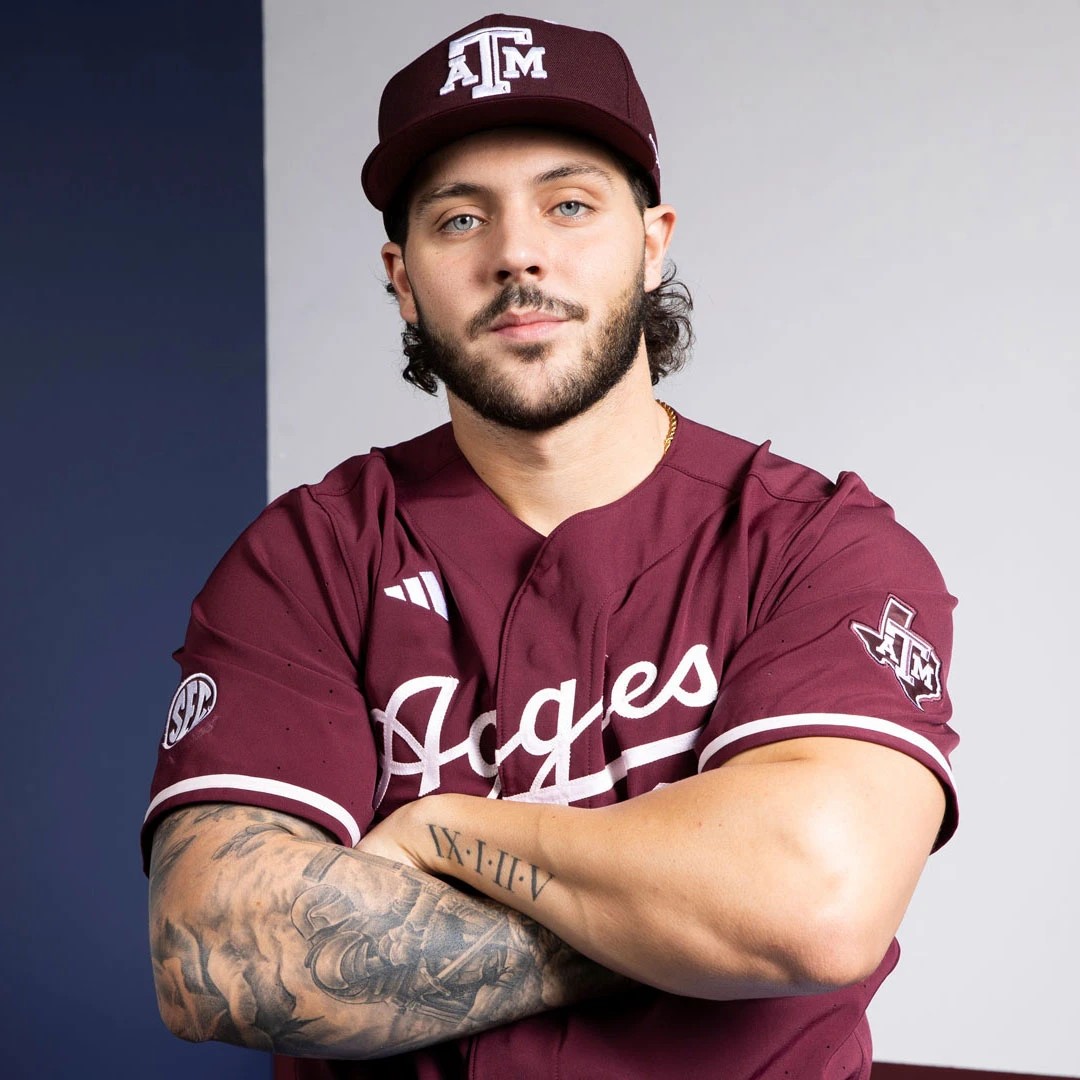
Westin Moss joins the team as our 11th rounder. Photo via TAMU.
Here’s part 2 of my overview of the 2026 Draft class, those players picked 11th -20th.
Here’s the two main draft tracker resources you need.
Nationals Draft Tracker: New for this year in the 2026 tab: links to instagram and twitter for each player (which we can use to verify signing if need be), as well as links to their college stats page directly.
Baseball America Transfer portal: though, none of the 11-20th college players seem to be in the portal, likely a good sign for us to get them signed.
Here’s links to major Prospect Rankings shops that I’ll reference below when assessing the “value” of the pick. Note: it’s quite rare for any of these picks to be ranked, so I’ll only include rankings if they exist.
11th Round, 316th overall: Weston Moss, a College Jr. RHP from Texas A&M
Ranks by major shops: BA=358
Moss was TAMU’s Sunday/#3 starter this season, posting a 5.46 ERA over 14 starts and 64.1 innings. 69/21 k/bb in 64IP. He was a reliever his first two years, then didn’t go drafted as a draft-eligible sophomore last year and moved into their rotation. Fringe average velocity, but he’s got a good frame and size (6’4″). Scouts think he can add velocity thanks to his mechanics, and can stay as a starter. He will sign, as most 11th rounders do, and may get a little extra cash to do so over the $150k standard.
Moss joins a solid group of 11th rounders that we’ve picked over the years, players who generally have had solid careers. 2025’s Moroknek has already been promoted this year, 2024’s Beeker was dominant out of the Low-A pen before getting hurt, 2022’s Luke Young is in the AAA bullpen, just promoted. 2010’s JT Arruda was a 6year org guy with a ton of AAA time, 2018’s Bartow made it to AA, etc.
12th Round, 346th overall: Matthew Dallas, a College Jr. LHP from Wake Forest
Ranks by major shops: none
Dallas was a major prep prospect; he started the gold medal game in 2022 for USA Baseball 18U. After sitting on the bench for Tennesee most of his freshman year he transferred to Wake Forest, where he was a rotation starter as sophomore. He was slotted into the Sunday starter spot for Wake this year, threw two games, then blew out his elbow in late March, requiring elbow surgery. The timing of the surgery is awful for Dallas: he likely cannot get back in time to even compete in the 2027 season, meaning he’d be looking at adding two full years to his college career. Given that timing, it works to the Nats’ favor; he should sign and get under the care of a pro team immediately, and when he’s healthy he’ll slot right into rookie ball instead. Tough break for him, but he can get some bonus money out of it and get on with his pro career.
13th Round, 376th overall: Cody Howard, a College Grad Student RHP from Texas
Ranks by major shops: none
Howard was a little-used RHP reliever by Texas his entire career. He only threw 16IP this season, and had an ERA in the 8s. It’s a weird pick at this juncture, especially for a 5th year senior/grad student. This smells like a pick made because he’s someone’s cousin, or a friend of a scout, and one I wouldn’t expect in the 13th round. I’ll be really curious to see what he signs for.
14th Round, 406th overall: Zack Konstantinovsky, a college Junior LHP from Rutgers
Ranks by major shops: none
Konstantinovsky (lord help me if I have to remember how to spell this guy’s name) was in Rutger’s rotation this season, mostly as their Saturday/#2 starter, and threw to a 4-5 record with a 5.48 ERA. 83/21 k/bb in 70ip, though with a .293 BAA. Not bad for the 14th round. He held his own when Rutgers went up against the likes of UCLA, and pitched admirably in the Big10 tourney before Rutgers went 2-and-out. No scouting report available anywhere; seems like a typical mid-major college starter who could have some value in the bullpen.
15th Round, 436th overall: Francisco Rivero, a Prep C from Canyon del Oro HS (AZ) (Arizona commit)
Ranks by major shops: none
Rivero is an interesting player. He tried an end-around gambit on the draft, moving from Arizona to Venezeula in order to try to establish IFA eligibility. The Dodgers signed him to a reported $700k bonus last year, but then MLB ruled him ineligible for the international draft, so he returned home to Arizona, re-enrolled in school, and here we are. He’s committed to Uof Arizona, but i’m guessing he wants to play pro, else he wouldn’t have tried the Venezeula gambit in the first place. I’d guess he signs for the $150k figure and comes on board.
16th Round, 466th overall: Anthony Murphy, a prep OF from Corona HS (CA) (LSU commit)
Ranks by major shops: BA: 159, MLB: 108, Espn: 146,
So, Murphy is essentially “Luke Williams” insurance; if negotiations with our two top HS picks Williams and/or Harris fall through, we can take that money and throw it at Murphy. He’s a significant prospect; he was the starting CF on the 2026 USA 18U national team, he’s been a starter on the powerhouse Corona HS for four years, and he’s committed to LSU, who have probably the biggest NIL budget in the sport, so you know he’s getting paid. It seems highly unlikely he comes on board. He should have been a 3rd or 4th rounder if he was going to sign; now it seems like LSU gets its leadoff hitter for the next three years as it tries to rebuild after a down 2026.
17th Round, 496th overall: Isaiah Galason, a prep SS from Houston County HS (GA) (Georgia Tech)
Ranks by major shops: BA: 345, Espn: 210
Galason is still a solid prep prospect, but not in the same range as Murphy. He’s still “Luke Williams” insurance though, in that he’s a top prep prospect who could be bought out of college for the right price. He’s an undersized SS with 70 speed but who BA’s scouting reports think may be a 2B longer term. Good hit tool, not a lot of power. He’s defense-first but also has a quick twitch bat that drives the ball, if not out of the park. Seems unlikely that he signs.
18th Round, 526th overall: Avery Ortiz, a college Jr. SS/2B from Oklahoma State.
Ranks by major shops: none
Ortiz was OSU’s starting SS … for 2 games, when he had a “lower body” injury that kept him out for nearly 2 months this season. He got back for 3 games in April, then out again until mid May. He missed a ton of time in 2025 as well, and likely is set to leave OSU unfulfilled; i can’t imagine going back for another season after he’s struggled to stay on the field all this time. He’s a sub-6-foot infielder, likely a SS/2B combo. No scouting report on him anywhere. I’d guess he’s going to sign, give pros a shot, even though he’s got eligibility left.
19th Round, 556th overall: Jack Brooks, a college senior OF (CF) from Oregon.
Ranks by major shops: none
Brooks has no scouting detail anywhere, and his stats don’t offer much promise: he slashed .236/.370/.391 while starting nearly every Oregon game this year in the outfield. He was a SS in high school, and i’d guess his primary skill is plus defense in the outfield. But a .236 hitter as a red-shirt junior seems like this may be a character guy, or a favorite of a local scout.
Siebert looked like he was the closer for his Juco team at Johnson County in Kansas; they went 67-3 this season. He’s been there two years, and has committed in the transfer portal to go to Tennessee. Does he want to skip a shot at the SEC for pro ball and $150K? I’m guessing this is a tougher sign; he may want a shot at better baseball. Plus, its SEC and Tennessee NIL money; probably not as much as a $150k signing bonus but it won’t be nothing. Tougher sign.
So, of the 10 guys we drafted here, i’m guessing:
Six (6) are most likely to sign (Moss, Dallas, Howard, Konstantinovsky, Rivero, Brooks
Two (2) are maybes (Ortiz, Seibert)
Two are no-way signing unless negotiations blow up with our two upper-round Prep kids (Murphy, Galason)
Which would leave us likely with a 17-18 player draft class, about what we’d expect.
Chase Brunson was our 2nd rounder out of TCU. Photo via Yahoo Sports
Here’s a run through the first 10 picks we made this weekend. This post shows the ranks of our players on the various draft boards, plus a summary of any scouting reports/draft analysis I could find from the major pundits/shops.
Here’s the two main draft tracker resources you need and that I’m updating this week in as close to real-time as I can given my current employment status :-):
Nationals Draft Tracker: this is the long-running Google XLS with all our picks dating to 2005. There’s two tabs here: the main page with every pick, then a deeper-dive 2026 Draft pick with slot bonus breakdowns and other information on each pick. New This year: i’m going to embed direct links to college stat pages for easy reference, since i’m looking them up anyway. For Prep kids, just a link to their Perfect Game profile, which will have video clips.
MLB’s Draft Tracker, the best of various options of Draft Trackers out there.
As of this writing, I have updated the Draft Tracker main page for the 2026 class, and have populated the 2026 detailed tab.
Here’s links to major Prospect Rankings shops that I’ll reference below when assessing the “value” of the pick.
1st Round, 11th overall: Chris Hacopian, a College Jr. 2B from Texas A&M
Ranks by major shops: BA=11, Law=34, MLB=14, ESPN=13, Fangraphs=8, Prospects1500=9
See here for the quick post I made specifically about Hacopian and my reaction. I won’t repeat that info here, but will note the interesting discrepancy of Hacopian on the ranking boards presented here. Every shop has him between 8-14 except … our friend Keith Law, ever the contrarian, whose writeup on Hacopian doesn’t really say anything critical of him except to note that he missed a month and hasn’t moved well since he returned. It’s almost like he dumped Hacopian way down when he got hurt, then never revisited him upon his return. I wonder where Law would have him if he had never gotten hurt. I can’t imagine, based on the consensus of his ranking in the class, that this is an under-slot pick by any means, so I’d expect him to sign at or near slot. Maybe he saves a little bit off of the $6.1M figure, money that we can throw at the two prep kids.
2nd round #42 overall: Chase Brunson, a College Jr. OF (CF) from Texas Christian
Ranks by major shops: BA=47, Law=24, MLB=50, ESPN=38 Fangraphs=52, Prospects1500=37
Brunson slashed .304/.462/.556 this year, and was a 3-year starter in CF for TCU. He’s got 50s or 55s across the board for every tool, showing promise everywhere but not a stand-out tool in any of the 5 disciplines. Law likes him the most, saying he’s got 20/20 capabilities with even more power there, and even if he can’t stay in CF he’s got the arm strength for RF. By all accounts he was better in 2025 but made adjustments this season, perhaps because he split time in CF with another 1st round talent teammate in Sawyer Strosnider. That caused him to slip from being a late 1st rounder to an early 2nd rounder, and I sense this could be a steal for us. I’d guess this is another slot pick, no real savings here.
3rd round #78 overall: Luke Williams, a Prep SS from Franklin Regional HS (near Pittsburgh, PA)
Ranks by major shops: BA=99, Law=outside top 100, MLB=90, ESPN=57, Fangraphs=67, Prospects1500=83
Williams is a Vanderbilt commit (one shop has him going to UVA but everywhere else says Vandy), but a 3rd round selection with a slot value of slightly more than $1M should buy him out of that with enough cash. I’m guessing he goes a bit over-slot, especially since Vandy is a premier college destination for players and they have a ton of money. Both BA and MLB put 70 grades on him for speed and arm strength. He’s a true SS with enough arm to handle CF if he can’t cut it there, and he’s got more than a bit of power with 50s there. The big worry here is an underdeveloped hit tool, but that’s not uncommon for a prep kid.
4th round #106 overall: Cooper Harris, a Prep RHP from Flower Mound HS ( a suburb of Dallas, TX)
Ranks by major shops: BA=83, Law=55, MLB=76, ESPN=110, Fangraphs=76, Prospects1500=76
Across the board, we seemed to get real value from this pick. Law likes him a ton, describing him as a 3/4 starter with clean mechanics who a good franchise can easily develop. Is that the Nats? We’ll see. He’s super young (he just turned 18 before the draft), sits 94-96, has a huge spin rate that naturally misses bats. BA gives him a 60 fastball and two 55s on his primary breaking pitches, which sounds like a good sign. I suspect a Texas kid with a commit to Texas will need more than 4th round money, so look for this to be an overslot deal too. As much as prep RHP are risky, this isn’t a 100mph kid with crazy mechanics; this sounds like a player who is getting guys out without the max effort that leads to injury.
5th round #138 overall: Daniel Cuvet, a College Jr. 3B from University of Miami
Ranks by major shops: BA=97, Law=87, MLB=120, ESPN=152, Fangraphs=unranked, Prospects1500=unranked
Cuvet, for those who pay attention to such things, was a consensus pre-season All American heading into this season after hitting 24 homers as a freshman and then posting a .372/.450/.708 slash-line as a sophomore. He’s a big dude: 6’3″ 240, with 70 grade power. The “ding” on him was swing and miss, which he seemed to be cleaning up early this season with more walks than Ks (30/33 K/BB in his 41 games. His season was cut short by a stress fracture in his back, something that had been bugging him all year and dampening his stats even before he hung ’em up. He stopped playing by the end of April, and missed the rest of the season. Question is this: is he ready to turn pro, or does he want to go back to school to try to increase his stock? It’s no guarantee; he could get hurt again next year and be looking at a teen-round bonus, or he could get squeezed based on lack of remaining eligibility. He played too much in 2026 to redshirt. So, odds are he’ll sign for something likely around slot and move to a pro organization to rehab and move forward. A healthy Cuvet looks really promising, and reminds one of Yohandy Morales, another slugger from Miami who was a 3B in college but who probably becomes at 1B in the pros. If he returns to his sophomore year form, this could be a steal of a pick in the 5th.
6th round #167 overall: Cooper Allen, a College Jr. RHP (starter) from UNC-Wilmington
Ranks by major shops: unranked anywhere.
The first of our underslot picks to pay the prep players, Allen was UNC-Wilmington’s Saturday Starter this season (aka their #2 starter), started 15 games and went 8-4 with a 2.79 ERA for the team. 96/23 K/BB in 87 IP, solid BAA of .210. Seems like a solid college pitcher. His scouting report at BA reports that he sits 90-91, with a mid-80s cutter that he uses to get guys out. He’s undersized (6’1″ 205) and seems to rely less on velocity and more on pitching to get guys out. He’s a college junior with eligibility left, but isn’t a huge prospect, so I’m suspecting he’ll take a haircut on his slot value ($410k) and will turn pro, with little left to prove in college. He is not currently in the transfer portal.
7th round #196 overall: Gage Peterson, a College Jr. RHP (starter) from Appalachian State
Ranks by major shops: BA: 344. Nobody else has him ranked.
Peterson went 8-1 and posted a 3.28 ERA in 15 starts and 85 innings, with a 29.4% strikeout rate and 10.7% walk rate for App State as their Sunday Starter (aka their #3), who he joined for his junior year after two years at a Juco. He sits 90-94 but is a big frame guy who BA thinks can throw much harder. 107/34 K/BB in 89 innings; that’s solid. He’s a big guy (6’5″) who scouts seem to dream on. BA’s scouting report thought he was an 8th-12th rounder; we got him in the 7th, which tells me he’s taking something closer to the $150k range instead of slot of $322k. He is not currently in the transfer portal.
8th round #226 overall: Max Hansmann, a College Senior RHP (starter) from Evansville
Ranks by major shops: none.
Our first senior/bonus pool savings pick, Hansmann was the Friday night starter for Evansville. He had solid numbers: 4-3 in 15 s tarts, 3.99 ERA.1.38 WHIP. A K/inning. But we’re talking about Evansville and the Missouri Valley Conference, so impressions should be tempered. I don’t think this is a $1k signing, but I can’t imagine him getting much more than $10k. Boston Smith was a senior draftee who got $50k last year; I’d expect Hansmann to be somewhere in-between. I cannot find any scouting reports on him, even on BA, which kind of tells you what you need to know about the guy. He is not currently in the transfer portal.
9th round #256 overall: Cashel Dugger, a College Jr. C from UCLA
Ranks by major shops: BA: #333
Dugger’s rank is entirely driven on his defensive capabilities and skill at handling a pitching staff. He slashed .251/.378/.382 this season, and has never slugged .400 in his career. His BA scouting report basically says he’s set to have a long career as a backup catcher in some organization, which is what it is. I can’t imagine he signs for a ton of money (slot is $216k), and I can’t imagine he agreed to be picked unless he intended to go pro. UCLA as a team kind of peaked this year, sitting at #1 the entire season with a slew of top players, and for Dugger to stick around for a rebuilding season may seem out of the cards. I’ll bet he signs for something slightly below slot but a bit above the $150k standard 11-20th round figure. He is not currently in the transfer portal.
10th round #286 overall: Nick Williams, a 5th year Senior OF from Michigan State
Ranks by major shops: none
Williams was Michigan State’s leading hitter this season, slashing .333/.434/.540 with a bit of power and a few SBs. He’s probably limited positionally to a corner due to his size and lack of speed, but could be a nice older presence on a team. Odds are this is a super bonus saving pick, in the $10k or less space. But, he seems like a nice pick here.
So, that being said, Here’s what I think the team does with its bonus dollars.
Over Slot picks: Williams, Harris
Slot picks (or close to it): Hacopian, Brunson, Cuvet
Under Slot picks: Allen (250k savings), Peterson ($150k savings), Hansmann ($225k savings), Dugger ($75k savings), Williams ($190k savings)
So that would give the team right around $900k to work with before the 5% cushion of an additional $600k. Can $1.5M get both Williams and Harris signed? Maybe: if Hacopian takes a haircut off his $6.1M slot, that extra money could seal the deal. Say Hacopian signed for $5.5m; that’d be an extra $600k to throw at the two HS players and could get it done, bringing both of them into the $1.75m range easily.
I’ll post the 11th->20th round picks analysis/overview in the next post later this week.
Hacopain’s TAMU profile pick is … jacked. Photo via MLB network
So, one of the challenges of having a draft on a Saturday is, it’s awfully hard to find time to do a full comprehensive reaction in a timely manner. So, this will be somewhat brief, but wanted to get a conversation out there real quick.
In this year’s first round, the Nats at #11 take Chris Hacopian, 2B from TAMU. He’s a DC area native; born in Gaithersburg, grew up in Potomac, went to Churchill, and spent his first two college seasons locally at Maryland (click here for his PG profile). He was at UMD with his older brother, and upon his graduation Hacopian entered the transfer portal and went to TAMU. Hacopian was ready for better competition than what UMD gave him; he destroyed big 10 pitching his sophomore year. He wasn’t awful in the Cape Cod league after his sophomore year (he destroyed the NECL after his freshman year).
His junior season at TAMU he slashed .319/.405/.578 with more walks than Ks and some power (11 homers). He played 3B and SS for Maryland, and initially was set to play SS for Tamu as well, but ended up at 2B instead thanks to some limitations in his arm strength and lateral motion. I think he’s profiling as a 2B/LF type in the pros. His leading tool is his Hit tool, where he was one of the best pure hitters in the draft and has a 60 grade from MLBpipeline.com. They give him a current 50 power grade, but something tells me this guy can improve on that as well. I think he’s a pro hitter who won’t chase, hits the ball hard, can power it up when he wants to, and who should move through the ranks quickly. He had some injury issues this year, and by most accounts is a stiff, awkward athleticism guy who may struggle to stick even at 2B.
Hacopian was mocked to the Nats pretty frequently in the end, with the major pundits all over the pick. The way the 1st round worked out, if the Nats were after a college hitter, then they got the one that made the most sense; Burress, Gracia, and Bell all went just before Hacopian, and the next three picks were all HS guys (Gringlinger, Condon, Lombard). They passed on the toolsy Lebron, as well as Ace Reese, who went 24th and was clearly not in the near-top10 level. They also passed on all the prep projects, which is interesting and indicative of what this new front office is thinking after last year’s prep-heavy draft.
My judgement: the way the draft worked out, he was the “right” pick if the target was a College bat, with all the other candidates going before him. He could be a fast mover, maybe in the majors by end of 2027.
Sime keeps mowing them down in High-A. Photo via BA
Since we’ve been talking about Baseball America ranks this week … and since BA just named the Nats overall system 4th best in the sport, lets see how they’re ranking our prospects in this Mid July update.
Baseball America does the best job of reshuffling prospect lists during the season, and I’m here for it. They did a mid May update that we covered here, and now we get a July 1 update just before the draft (where we’ll presumably add in at least a few more top 30 system prospects).
For now, this is a great way to gauge these players’ 2026 seasons… in some cases. After a point (as we’ll see) BA just kind of gave up and cut-n-pasted from the previous ranking.
Here’s their current top 30, with ranks pulled in from 2 months ago and from January to show evolution in 2026:
7/1/2026
5/18/2026
1/7/2026
First Name
Last Name
Position
1
1
1
Eli
Willits
SS
2
4
7
Seaver
King
SS
3
2
2
Jarlin
Susana
RHP (Starter)
4
5
Pre-Acqu
Devin
Fitz-Gerald
SS
5
3
21
Ronny
Cruz
SS
6
7
5
Travis
Sykora
RHP (Starter)
7
6
4
Luis
Perales
RHP (Starter)
8
8
Pre-Acqu
Gavin
Fein
SS
9
9
19
Miguel
Sime Jr.
RHP (Starter)
11
20
15
Jackson
Kent
LHP (Starter)
12
11
13
Ethan
Petry
1B/OF (Corner)
13
15
11
Landon
Harmon
RHP (Starter)
14
12
6
Alex
Clemmey
LHP (Starter)
15
10
3
Harry
Ford
C
16
22
16
Yohandy
Morales
3B
17
17
12
Sam
Peterson
OF (CF)
18
28
30+
Cayden
Wallace
2B/3B
19
14
9
Coy
James
SS
19
13
Pre-Acqu
Yeremy
Cabrera
OF (corner)
20
16
8
Luke
Dickerson
SS/CF
21
18
Pre-Acqu
Alejandro
Rosario
RHP
22
21
25
Riley
Cornelio
RHP (Starter)
23
23
10
Angel
Feliz
SS/3B
24
24
18
Caleb
Lomavita
C
25
25
Pre-Acqu
Samil
Serrano
OF (Corner)
26
26
20
Jorgelys
Mota
SS
27
27
24
Yoel
Tejeda Jr.
RHP (Starter)
28
19
17
Marconi
German
SS
29
30
14
Andrew
Pinckney
OF (Corner)
30
30+
30+
De la Cruz
Marlon
RHP (Starter)
Here’s some thoughts going down the list.
Having King now ascended to #2 in the system seems appropriate, even with his June swoon. Too bad we have the NL starting All Star short stop blocking his path to the majors. A good problem to have. His dip in performance has slowed the calls for him to get promoted.
Honestly, I don’t understand why they have Susana so high; he’s got an unspecified injury with no timeframe for return and has been doing “throwing programs” for months. I don’t think anyone thought his injury would cost him an entire season, but it’s leaning that way.
Ronny Cruz’s trajectory has dipped slightly, but he’s still top 5 after his torrid 2026 start.
They’re holding firm on Gavin Fein, and I hope he pays off. Moving him off SS lowers his value, and i’m surprised he’s still in the top 10.
Based on what you’ve seen in 2026, would you have Luis Perales at #7? I wouldn’t. Raise your hand if you want Jake Bennett back.
I like the recognition that Jackson Kent is now nearly a top 10 prospect, flourishing in AAA.
Clemmey taking a dive, as we’ve discussed a ton, going from #6 in January to #14 now. Honestly, that seems fair given what he’s struggled to do since his AA promotion.
What the heck is going on with Harry Ford? #3 in January, now #15.
Great to see Cayden Wallace showing up; he was just promoted to AAA where, I guess, he’ll play short stop? I mean, House is the 3B, Glasser has played the entire season at 2B. Maybe Glasser (listed as a SS) will move over and Wallace plays 2B. I can’t imagine the team will sit one of them on the regular so that Lipscomb (the only true SS on the AAA roster) can play at this point.
Both Coy James and Luke Dickerson were top 10, now nearly out of the top 20. Both are young, and have some time, but not a good pro career start really for either.
Lomavita’s excellent June apparently too late for him to get any change from the last ranking; he sits at #24 still.
Marlon De La Cruz gets the last spot, pushing out Davian Garcia (the only player ranked 6 weeks ago not listed). Fun fact; this is the first time he’s been ranked by any shop for this team, ever. He’s a 2024 IFA who signed for so little that they didn’t bother to register it, and now he’s in the LowA rotation.