Nationals Arm Race

"… the reason you win or lose is darn near always the same – pitching.” — Earl Weaver

Archive for the ‘Nats in General’ Category

First “Wish we had Strasburg” story from National Media

6 comments

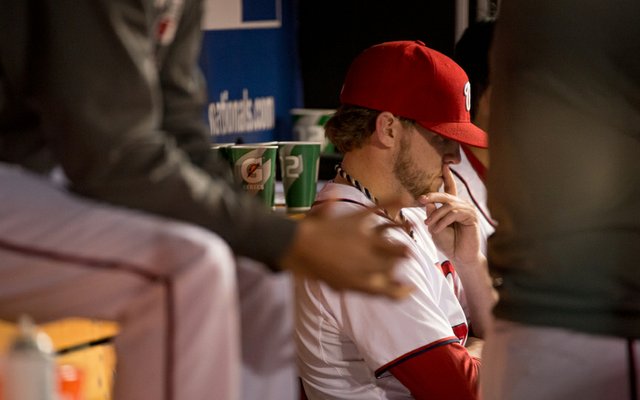
Strasburg sitting in the dugout during the NLDS, where he'll be for the rest of the playoffs. Photo Masn screen shot via nats enquirer blog

Rant on.  I couldn’t help myself today…

It was great to see that they couldn’t even wait until GAME THREE of the divisional series to post the first “Gee wish we had Stephen Strasburg” story.  Here’s the link, courtesy of Ken Rosenthal.  I’ll bet he had this article in the can weeks ago just waiting for a slow news day to post it.

Rosenthal quotes an anonymous player who doesn’t agree with the shutdown Situation, who said that “the team would be up 2-0″ if they had Strasburg.”   Such a gutless reporting technique; notice there was nothing other than a passing mention that there are clubhouse guys who agree with the shutdown.  Just cherry-picking opinions (of which there are dozens in a clubhouse) until he found one that enabled him to write the story he wanted to write.

He talks about how the Braves “handled” Kris Medlen so that he was still pitching in the post-season.  There’s no way Medlen-to-Strasburg comparisons are correct.  Medlen was absolutely not in the starting rotation discussion in Atlanta, and if he was he was 8th or 9th in line.  And there’s no way that Medlen was anything other than found gold to the Braves in terms of how good a starter he would turn out to be.  And there’s nobody who can tell me any differently.  Lastly, do you think perhaps the Braves would rather have used Medlen from the start of the season, had they known how dominant he’d be??  Do you think they would have finished in 2nd place in this division had they had Medlen all season?  Because last time I checked, the Braves lost their one-and-done WITH MEDLEN ANYWAY and are playing golf while the Nats are sitting pretty in the divisional series.

Nobody ever mentions this, but Strasburg was mediocre down the stretch.  He had a 4.14 ERA in his last 10 starts, a 4.50 ERA in his last handful of games, alternating between excellent and awful.   You could argue “arbitrary endpoints” but to me it sounds like a guy running out of gas, no?  Who is to say that the team wouldn’t have recognized that he was running on fumes anyway, and shut him down at the time they did regardless of an innings limit?  Why does nobody talk about this fact?  That’s because the National media narrative w/r/t Strasburg is LAZY.  Regurgitate the same stories, talk about the same platitudes of there being “no proof that shutting him down isn’t the best thing to do.”

Here’s my analogy; if  you had heart surgery and your cardiologist only told you to pitch 160 innings the next year, you’d do it and not complain about it right?  Well Strasburg’s ARM SURGEON advised the team on this limit after having ARM SURGERY, and the team followed it.  I don’t think we’d be hearing all these back seat pundits talking about how the Nats are idiots for resting a guy if it was his heart that was cut and not his elbow.  To say nothing of the fact that he’s young (24), under team control for at least four more years , and the team isn’t exactly looking like a one-year wonder right now, fielding the 3rd youngest pitching squad and the youngest hitting squad in the major leagues.   Every core player and pitcher is locked up or under team control for at least three-four years.  There’s NO reason to think that this team won’t be contending for years to come, irrespective of what any other team in the division does.

The Nats got a split in St. Louis.  That’s the best they could hope for against a dangerous opponent.  Wainwright isn’t going to strike out 2 batters an inning every time he goes out.  The Nats BLASTED Lohse this season.  Carpenter has what, three starts this year?  And the last time Jackson pitched against St. Louis at home, he went 8 shutout innings.  There’s more to this series than just Strasburg and St. Louis; the National media should try covering the Nationals for a change.

*sigh*.  So sick of hearing about Strasburg.  Can’t we talk about the Nats?!  They did have the best record in baseball after all.

/Rant off.  Stepping down from sandbox.

Written by Todd Boss

October 10th, 2012 at 10:49 am

NLDS Game 2 Recap: Zimmermann does not Execute

8 comments

Jordan Zimmermann did not have his best command Monday afternoon. PHoto JB Forbes/McClatchy-Tribune News Service via sfgate.com

There really isn’t much analysis needed of last night’s game 2 12-4 pounding; for me it was clear from the beginning that Jordan Zimmermann was missing his spots.  After a clean 1st inning (which included a relatively lucky strike-3 call on leadoff hitter Jon Jay) the potent St. Louis lineup teed off on mistake after mistake from Zimmermann.  A scorched line drive to third, then a well struck single up the middle, then a double off the wall, all seemingly within a blink of the eye.  Only Jay’s bloop hit to drive in the 2nd inning’s fourth run was not “well struck.”

Zimmermann was missing his spots, plain and simple.  Instead of getting a ball on the corner, it was drifting over the plate.  Instead of keeping the ball at the knees, it was floating upwards into the hitting zone.  St. Louis can hit the ball.  They’re in the top 3 in the NL in most standard offensive measures  (BA, wRC+, OPS, wOBA).  And, as we saw last night, they can power the ball pretty easily against mistakes.

When Craig Stammen relieved Zimmermann and couldn’t stop the bleeding, I stopped watching.  Yes our team has shown it can make up leads, but for me a 7-1 lead in the 4th against a playoff team is pretty much the definition of insurmountable.  I was rooting to just leave Stammen in the game to save the pen frankly.  We did get a chance though to get everyone in the bullpen an inning; kinda like the way you manage little league.  So there’s that.

So much for home/away, day/night and days rest split analysis.  When your starter can’t execute, you don’t have much chance on the night.  Its one of the reasons we play 162 games (these off-nights for good pitchers even themselves out over time), but also one of the reasons the playoffs are such a crap shoot (Aces get blown out and 5th starters pitch lights out in the playoffs all the time).

Lets just hope that scoring 12 runs made the Cardinals really tired (you know, from all the running around the bases they had to do) so they’re at a disadvantage in game 3.

Written by Todd Boss

October 9th, 2012 at 9:56 am

NLDS Game 1 Recap: Gonzalez the Escape Artist

10 comments

The team escaped Game 1 with a victory despite Gonzalez’s struggles. Photo Joy Absalon/US Presswire via usatoday.com

Nats take Game 1 of the NLDS 3-2.

You know your pitcher is having a rough day when the score line reads “2-0-0.”  As in, 2 runs, 0 hits and 0 errors.  That was the score at the end of the second, an inning in which Nats starter Gio Gonzalez had walked no less than four batters, thrown a wild pitch and given up a sac fly for the second run despite giving up zero hits.

TBS broadcast a stat showing Gonzalez’s ERA on various days of rest; the key stat was that he had a 5.80 ERA when he had more than 5 days rest.  His days rest entering Game one of the playoffs?  Nine days.  He last threw in Philadelphia on September 27th.

Being able to rest your starters and “set up” your post season pitching rotation can be a blessing and a curse.  Today it was a curse; clearly Gonzalez was overthrowing, missing his spots, and his pitching line showed it.  He didn’t trust his curve early, was relying solely on his fast ball and couldn’t locate it to his desire.  To his credit he settled down for a couple innings, got a couple of very timely plays in the field, and exited having given up a sole meaningless hit to go with seven walks in 5 innings.  To me it looked like he was over-throwing, that he was “too strong.”  Starters are creatures of habit; throw one day, rest the 2nd, toss the 3rd, bullpen work the 4th, rest the 5th and then repeat.  When too many extra days are thrown in, younger guys can get off schedule.

In the first inning I thought perhaps Gonzalez was trying to “save” his curve for later in the game; a great strategy for professional pitchers who can do it.  Instead of showing guys your whole arsenal the first time through the order, pound them with fastballs and make them hit your pitch.  Then, in their 2nd and 3rd at bats mix in curves and off-speed stuff as out pitches as needed.  If you play your cards right, you can work through each hitter’s 3 at-bats keeping them off-balance and suddenly you’re deep into the 6th or 7th inning as a starter.   As it turned out, he wasn’t trusting his curve at all, and suddenly he was pressing to hit his spots.

Craig Stammen escaped an incredible jam in the bottom of the 7th, having loaded the bases with none out.  Usually that situation has a run expectancy of somewhere greater than 2 runs but the Nats defense came through; an Ian Desmond force out at the plate for the first out then a clutch 5-4-3 double play to end the inning.  Despite Tyler Moore‘s late inning heroics, this was the key of the win.

Adam Wainwright showed exactly why he’s a Cy Young candidate when he’s healthy; his curve-ball was absolutely fantastic on the night.  The already-strike-out prone Nats fanned 10 times, many times on a fantastic curve that Wainwright was controlling and commanding to the outside corner.  I was surprised when he got the hook despite being on 100 pitches; as it turned out he probably wasn’t going to finish 7 complete regardless.  You can’t really fault the bullpen management by Cards manager Mike Matheny; he had his 8th inning guy on the mound (Mitchell Boggs) and the Nats beat him.

Other thoughts from watching the game:

  • I scoffed aloud when the TBS announcing crew spoke of Ryan Zimmerman‘s defensive prowness and said that “he rarely makes throwing errors.”  Really?  I know they don’t watch Nats games normally but the narrative behind Zimmerman’s throwing issues on non-pressure plays is well documented in DC.  He had 12 throwing errors on the year, and his 19 total errors tied him for 3rd in baseball.  Sure enough, a throwing error in the bottom of the 8th put the lead-off guy on board and caused the inning to be far more stressful than it needed to be for Tyler Clippard.  Guy on first with nobody out?  Roughly an 85% chance he scores.  For years I’ve defended Zimmerman and talked of the ridiculousness of “wasting” his defense by moving him to first, but the fact remains that every time he fields a routine ground ball I’m waiting for him to air-mail the throw.  When Anthony Rendon is ready to hit at the major league level, I think the talk is going to be about Zimmerman moving to first and not Rendon moving to another position.
  • For as clutch as Moore, Ian Desmond and Kurt Suzuki were on the day, Jayson Werth and Danny Espinosa were the opposite.  TWICE Werth squandered bases-loaded situations with two outs, leaving a total of 7 guys on base.  He may be our current lead-off hitter, but he’s normally a middle-of-the-order bat and he needs to capitalize on situations like that.  In Werth’s defense (no pun intended), the over-the-shoulder grab was a game-saver in its own right, so on a day when he disappointed at the plate he made up for it in the field.  Meanwhile it was not really shocking that Espinosa whiffed over and over; he led the NL in strikeouts on the season and was batting from his clearly weaker side.
  • How about Tyler Moore?  A fantastic job of hitting, hitting a pitcher’s pitch and not trying to do too much with it.  The old “game winning RBI” stat went the way of the Edsel, but tonight the clubhouse knows exactly who won that game.
  • Here’s to the return of “Clip-Store-and-Save.”  Clippard escaped Zimmerman’s throwing error in the 8th and Drew Storen dispatched two of the best St. Louis hitters in a 1-2-3 ninth.  The team has to feel great about its bullpen on the night.  No worries about using your 3 best guys; they’ll all be able to go tomorrow then get a travel day of rest.
  • The ridiculousness of the Hold stat: Boggs was credited with both a “Hold” and the Loss.  How is that possible?  Because he put on the go-ahead run that Mark Rzepcynski eventually allowed to score.  I think the Hold stat would carry more weight if it was withheld from relievers who don’t actually “hold” the game at bay and who contribute to the blown save and (if applicable) eventual loss.
  • The sideline reporter couldn’t help but compare the handling of Wainwright to Stephen Strasburg; both had Tommy John surgery last year.  He said the Cardinals “trusted” Wainwright more and let him pitch 200 innings.  But they didn’t really talk about the real difference: Wainwright is into the club option portion of his FA contract and is no sure thing to stay with the team beyond 2013.  He’s also 30.  Compare that to Strasburg; he’s 23 and is under team control for at least four more seasons, and is likely to be offered a multi-year contract that buys out those arbitration seasons and a couple of FA seasons beyond that (similar to the deal Gonzalez signed).  The point is; the Nats know they’ve got this guy for years to come and clearly played it conservative with his re-hab.  Why this point is glossed over by pundits and bloggers is beyond me.  Every time I hear some know-it-all say things like, “there’s no proof that letting him pitch more than 160 innings will harm him” my blood boils.  Well, there’s no proof to the other side either!  The fact is you can either be reckless with your major investment and overuse him, or you can play it safe and hope for the best.  There’s no guarantees in life and thus there’s no guarantee that Strasburg won’t blow out his elbow again in 2013.  But on this point I can guarantee; had the team continued to ride Strasburg down the stretch, push his innings to 190-200, and then he re-injures himself in the last week of September?  You can guarantee all those know-it-alls would immediately be clucking their tongues about how the Nats “mis-used” Strasburg and should have played it safer.  I don’t envy Mike Rizzo this post-season, because unless the Nats win the world series there’s going to be the inevitable stories about how the Nats would have won had they kept their Ace in the rotation.  To borrow a quote from Major League, “Well, I guess then there’s just one thing left to do … win the whole !?@& thing.”  (link NSFW)

Great comeback by the Nats, snatching a win in a game they probably should have lost.  They now have the split in St. Louis and are in a commanding position to win this short series.

Washington vs St. Louis – A tale of two Series

2 comments

We need Edwin Jackson to perform against his former team. Photo Nats team official via espn.com

Ok, I’ll admit to being (as one commenter said recently) the “Eeyore” of Nationals fans.  I was scared of Atlanta and thought we would struggle to beat them in a short series starting on their turf.  I posted my baseball predictions and the two teams I thought would make the series both lost under sometimes interesting circumstances.  The unbeatable ace Kris Medlen got beat, losing a start for the Braves for the first time in 24 times (not that he really pitched badly; I’ll take a 6+ inning, 3 hit, 0 walk performance every day of the week.  Think about how difficult it is to give up 5 runs on 3 hits…).  So perhaps I’ll understand if you don’t really want to trust my opinion on predicting the divisional series.

Anyway.  So the Nats are traveling to St. Louis to start the NLDS.  If you’re looking for a guess as to who has the advantage by looking at the two meetings between the teams this year, you may find definitive proof wanting.

  • The Nats took 3 of 4 at the end of August from St. Louis, bombing them for 31 runs in four games and really roughing up three of St. Louis’ best starters (in order Jaime Garcia, Adam Wainwright and Kyle Lohse, tagging each for 5-6 runs).  Only Jake Westbrook kept the Nats offense at bay, and as far as I can tell he’s not going to be on the playoff roster.  The one loss in this series was in one of the more amazing games the Nats played this year; they blew a 4 run first inning lead, fell behind 8-6 on Jordan Zimmermann‘s worst outing of the year, rallied to take the lead only to have the bullpen blow the game.
  • The Nats then traveled to St. Louis the last week of the season and were pretty much bombed themselves, with St. Louis scoring 26 runs in three games while taking 2 of 3 with our guys Edwin Jackson and Ross Detwiler having nights they’d rather forget.

So, which series is more educational to help predict what may happen now?  As commenters have pointed out, momentum means nothing and a shutout yesterday indicates nothing for today.  Fair enough.  We have learned that both offense are capable of really putting runs on the board, fast.  But that wasn’t exactly news either; the teams were 2nd (Cardinals) and 5th (Nationals) in runs scored in the NL this year.

What is fair to say is that the Nats probably have a more dangerous opponent in St. Louis; they’re a better offense, though they clearly hit right-handed hitters better than lefties (a 113 wRC+ versus right handed hurlers versus 104 versus lefties).  And they’re getting back a grizzled post-season veteran in Chris Carpenter just in time for the playoffs.  Carpenter is probably on most people’s short list for “guys i’d trust to start Game 7” in this league, and now the Nats seem set to face him in Game 3.

Lets look at the pitching matchups (some of this is a guess; official starters havn’t been named all the way through the 5-game series but the below should be what we see);

Series GM# Date/time (EST) Home-Visitor Home Starter Visiting Starter Advantage
NLDS 1-4 1 10/7/12 3pm Stl-WAS Wainwright Gonzalez Wsh
NLDS 1-4 2 10/8/12 4:30pm Stl-WAS Garcia Zimmermann Wsh
NLDS 1-4 3 10/10/12 ?time WAS-Stl Jackson Carpenter Stl
NLDS 1-4 4 10/11/12 ?time WAS-Stl Detwiler Lohse Tossup
NLDS 1-4 5 10/12/12 ?time WAS-Stl Gonzalez Wainwright Wsh

The good news: Washington has shown it can blast St. Louis starters.  As mentioned above, the team put up very big numbers on 3 of the 4 starters they anticipate seeing in this series.  Meanwhile, St. Louis gets to see our Ace Gio Gonzalez twice; the last time they saw him Gio pitched a 5-hit shutout.  They also see Detwiler in game 4, meaning three of their five potential series games are against Lefties (whom they are weaker against).  Zimmermann’s home-away splits favor him on the road, and I think Jackson will be looking for revenge for his poor outing against them the last time out.

I’ll admit; I was scared of Atlanta.  And I’m wary of St. Louis, especially after the late season spanking.  But, they didn’t see Gonzalez in that series and now are set to see him twice.  The Nats offense isn’t going to be afraid of any St. Louis starter (perhaps outside of Carpenter, who a lot of them havn’t seen in a while), and should put runs on the board.

Prediction?  I think the Nats have the pitching matchup advantage in 3 of the 5 games and may only be a pitching “underdog” in the Jackson-Carpenter start.  The goal is to get a split in St Louis and Gonzalez-Zimmermann gives them a great shot in both games.  I like our chances.

Jimmy Rollins; time for Philadelphia to sleep in the bed they’ve made.

4 comments

Courtesy of Nat Enquirer; this video of Jimmy Rollins classlessly giving the Nats zero credit for having the best record in the majors in 2012.

Specifically, “With us healthy, they’re a second-place team. But we weren’t.”

But that’s the problem that Rollins needs to understand; when you build your team on the backs of aging players … you’re NEVER going to be as healthy as you expect to be.  There’s a reason the Nats didn’t lose ONE start to injury all year; our pitchers are younger and healthier.  Philadelphia has built a rotation of aging stars and free agents.  Cliff Lee missed 3 starts this year, Cole Hamels missed a couple, and Roy Halladay missed 7 or 8.  Those guys are 33, 28 and 35 this year.  They’re not getting any younger and likely will miss starts again in 2013.

How about Philadelphia’s positional players?  Ryan Howard only played 71 games.  Chase Utley only 83.  Placido Polanco just 90.   Carlos Ruiz missed all of August.  Maybe you can argue that the two big names from this list should start 2013 healthy and that may make a difference.  Fair enough, except that Howard is 32, Utley is 33, and both now have a slew of injuries on their resume.  Nobody should assuming those guys are playing 150+ next year.

Meanwhile, Washington had a TON of time lost to injuries in its offense.   Desmond missed a month.  Morse missed two.  Werth missed half the season.  Zimmerman lost a few weeks.  And we went through no less than SIX catchers on the season.  And the team persevered, struggled offensively most of the early part of the year, and maintained its lead.

Philadelphia made its choices, signing major dollar contracts to extend its own guys and to buy its rotation and its key bullpen members.  And now you have to live with those decisions, which leave you with an aging roster overpaying for the decline years of your players.  Meanwhile Washington rode the wave of 100-loss seasons, committed to building its farm system, didn’t overpay for Free Agents, and now sits with one of the youngest teams in baseball (3rd youngest pitching staff and youngest on-field staff), with a below-average payroll and the best record in the majors.

Sour Grapes Jimmy Rollins.  You should get used to 3rd place because its probably where the Phillies reside for the next several years, until you can jettison your ill-signed contracts and start over.

Nats Clinch on Lannan’s last Audition for 2013

8 comments

The Nats clinching was the story of the night. Photo MASN screen grab via Nats Enquirer blog

The story of the day is obviously the Nats clinching the NL East title, cementing a fantastic turnaround season for the traditionally moribund franchise.  This is a great achievement for a team that very few pundits gave a shot at competing for a playoff spot, with even the most ardent fans thinking that 2012 would be a great stepping stone for 2013 and beyond.  The team surprised us all with fantastic pitching all year (the pitching staff is in the top 5 in most statistical categories league-wide) and breakout offense performances from Ian Desmond and Bryce Harper.  The team boasts a lineup where batters 1-7 all have 20+ homer seasons on their resumes and have to be seen as a tough out by any eventual playoff opponent.

We were lucky enough to be in the stadium last night to see the clinch.  I can honestly say I’ve never seen the crowd as pumped up and vocal at any other time that I’ve been present at the stadium; not at the 2009 home stadium opener, not at the first game in RFK, not during the Yankees series over the years.  The crowd regularly came to its feet to cheer the team in critical situations, was loud and vocal from the first pitch, and (thanks to the proliferance of smart phones) knew the moment that the Atlanta loss was final.  The moment came just after the Nats got the last out of the top of the 9th, making for a very odd scene where the team was about to lose a game but was giving high-fives in the dugout ahead of their last at bat.

John Lannan took the loss, going 5 relatively mediocre innings and surviving 9 baserunners (3 by walk) to give up 2 earned runs on 6 hits.  Lannan was all over the plate; 80 pitches but only 42 for strikes and was lucky not to have given up more runs.  He got three double plays in his 5 innings, including a nifty first-to-home play from Adam LaRoche to get out of a bases loaded jam in the 4th.  It was an inauspicious final appearance from Lannan, who finishes the season with a 4-1 record, a 4.13 ERA and a slightly-worse-than average 97 ERA+ in 6 starts (2 spot starts during the season and 4 starts in September replacing Stephen Strasburg in the rotation).  The loss is slightly unfair to Lannan; the real story on the night was the offense’s inability to touch Kyle Kendrick, whom they had battered just 4 days ago in Philadelphia, allowing him to go 7 shutout innings and only allow 4 hits.  The team was 0-8 with runners in scoring position, and had several crucial called-3rd strike K’s in situations that called for clutch hitting.

The team didn’t end up needing Craig Stammen‘s amazing stint; 2 innings, 6 strikeouts.  Stammen has really surprised me; I never thought he’d go from 4-A starter to shutdown middle reliever in just a season.  But he is an excellent weapon for this team and I hope he continues his dominance into the post-season.

Where does Lannan go from here?  Clearly he’s not in the Nationals plans; he’s arbitration eligible and due to get a raise from his 2012 salary of $5M, meaning he’s a non-tender candidate since the team would rather get a Mike Rizzo preferred arm (i.e., a power pitcher, a high K/9 guy instead of a finesse lefty like Lannan).  I could see him getting cut loose and finding a one or two year deal for an AAV of $4M/year (maybe even more; remember the Nats signed Jason Marquis to a 2yr $15M deal after a series of comparable seasons earlier in his career).  Lannan is an effective 4th or 5th starter on most teams and likely would excel in an NL pitcher’s park like Los Angeles, San Diego or San Francisco. There will absolutely be teams looking for guys like Lannan on the FA market and he’d likely be a great fit for a team looking for Starter help (off the top of my head; Kansas City, Chicago Cubs, Cleveland and Minnesota).

Washington isn’t going to get to 100 wins like I predicted in August (they’ve sputtered in September, going just 16-12 after two great months preceeding it), but 97 or 98 should be good enough for Best in Baseball and (hopefully) a #1 seed in the playoffs.  Go Nats!

Nats Playoff Rotation & Bullpen Decisions

4 comments

20-game Winner Gonzalez is our likely #1 starter in the playoffs. Photo Joy Absalon/US Presswire via usatoday.com

The Nats rotation has been incredibly stable this year; only a mid-season experiment with Chien-Ming Wang interrupted a near season-long quintet of starters unmarred by injury or poor performance.  The shutdown and playoff unavailability of Stephen Strasburg is well, well documented, so we won’t talk about him here.  But two important decisions await Davey Johnson in terms of his playoff roster construction: playoff rotation and bullpen construction.  Lets take these questions one-by-one:

1. What is your playoff rotation?  Here’s the evolution of our rotation this year:

  • The year started off with your starters in this order: Strasburg, Gonzalez, Zimmermann, Jackson and then Detwiler. The starters went R-L-R-R-L.
  • After the All Star Break, Johnson shuffled the starters and re-ordered them to go Zimmermann, Gonzalez, Strasburg, Jackson, Detwiler (still R-L-R-R-L), ostensibly to give Strasburg a bit more rest and extend his season a few days.
  • On August 3rd (around a double-header) Zimmermann and Gonzalez switched places.  Now you’ve got Gonzalez, Zimmermann, Strasburg, Jackson and Detwiler (L-R-R-R-L).  All three RHSPs are in order, as are the two LHSPs.
  • On August 15th around an off day, Detwiler and Jackson switched places, probably to keep Detwiler on regular rest and probably to fix the aforementioned issue of 3 RHSPs in a row (starters now Gonzalez, Zimmermann, Strasburg, Detwiler, Jackson for L-R-R-L-R).
  • On September 12th, John Lannan replaces the shut-down Strasburg in the rotation.  Now we’re Gonzalez, Zimmermann, Lannan, Detwiler and Jackson for L-R-L-L-R.

If we play out the rotation the rest of the season, barring any more rain-outs or injuries, the starters will be (Starting 9/21):

9/21: Jackson
9/22: Gonzalez
9/23: spot starter Wang, to give the rotation its regular rest.
9/24: Zimmermann
9/25: Lannan
9/26: Detwiler
9/27: Jackson
9/28: Gonzalez
9/29: Zimmermann
9/30: Lannan
10/1: Detwiler
10/2: Jackson
10/3: Gonzalez

At this point I’m going to assume that the Nats will win the division and go straight to the divisional series, which (per MLB’s playoff schedule) starts either Saturday 10/6 or Sunday 10/7.  Which day the Nats start will be critical; if the Nats are the #1 seed they’ll start Sunday; if they’re the #2 seed they’ll start Saturday.

But in either case I think we’re going to see some manipulation of the above schedule, because I think the team wants Gonzalez to start the opener.   And he cannot start an opener on 10/6 or 10/3 if he throws 10/3.   We may see him skipped on 9/28 and then throwing a start 10/1 (which I’d be happy for; that’s the last game I have tix for this year), which would put him on regular rest for either a 10/6 or 10/7 start.

After that though, there’s some decisions to be made.  The NLDS ridiculously gives the lower-seed the first two home games, so I think Johnson may want to have some options available to him for his 2nd, 3rd, and 4th starter (I think its a pretty basic assumption that Lannan is being left completely off the playoff roster; more on this later down when talking about the bullpen options).  Here’s the home/away splits of our 4 likely playoff starters (numbers as of 9/21/12).

Interesting; Zimmermann is far more effective away, Detwiler is far more effective at home, and Jackson is just about the same either way.  This seems to imply that Zimmermann is your best bet to take the 2nd start, away from home, then line up Detwiler-Jackson-Gonzalez (or some combination thereof) at home.

Here’s another take; Johnson likes to play match-ups with certain teams.  Will the Nats opponent factor into the equation?  Assuming the Nats are the #1 seed, your likely wild-card winners right now are Atlanta and St. Louis (its hard to see a scenario where St. Louis loses its current 3 game WC lead in the next 12 days, but it could happen, but for the purposes of this article we’ll assume these two teams hold on).  How do these teams fare against lefty versus righty starters?

  • Atlanta is hitting .247 as a team versus Lefties with an 86 wRC+.  That’s bad.
  • Atlanta is hitting .251 as a team versus Righties with a 97 wRC+.  That’s certainly better than they do versus lefties.
  • St. Louis is hitting .275 as a team versus Lefties with an 113 wRC+.  That’s basically 2nd in the majors behind the uber-hitting Rangers.
  • St. Louis is hitting .270 as a team versus Righties with a 104 wRC+.  That’s roughly a 10% difference in Run Creation.

So, it seems like if we play Atlanta, we want to load up on Lefties while if we play St. Louis we want to load up on Righties.  This would seem to indicate that, if Atlanta is our opponent we’ll want to go Gonzalez-Zimmermann-Detwiler-Jackson-Gonzalez again, meaning Atlanta has to face 2 lefties in the first 3 games plus 3 out of 5.  If we play St. Louis, you’d think that we’ll want to switch up Detwiler and Jackson so that St. Louis gets L-R-R-L-L.  The idea being that once we get home, even though we’re lefty-heavy we’ll have the advantage.

However, with the #1, #2 and #3 seeds far from settled with a week and a half to go, lets also look at the same logic for both Cincinnati and San Francisco, since its conceivable at this point we could be playing either of these teams (use the same links in the Atlanta links above to see these statistics):

  • Cincinnati is hitting .268 as a team versus Lefties with an 107 wRC+.   Both Tied for 6th in the majors.
  • Cincinnati is hitting .248 as a team versus Righties with a 89 wRC+.
  • San Francisco is hitting .268 as a team versus Lefties with an 96 wRC+.
  • San Francisco is hitting .270 as a team versus Righties with a 98 wRC+.

Conclusions?  Cincinnati matches up very well against lefties and struggles against righties, while San Francisco is a pretty well balanced team with no real weakness against either side.

One last factor is post-season experience, of which this group has very little.  Jackson is the sole guy with any post season experience, it being last year with potential opponent St. Louis.  I cannot see Johnson bumping any of the guys who are pitching better than him though, at least in a short series, based on this veteran experience (we’ll revisit this though in a 7-game series, where the identity of the 4th starter is incredibly important, as he only goes once in that series).

In any scenario, I think your first two starters away are going to be Gonzalez and Zimmermann.  After that will depend on the opponent.

2. What is your playoff bullpen?  By virtue of the fact that we don’t need a 5th starter, the team can carry an extra player.  Here’s the bullpen as it sits now, divided into “regulars” and 9/1 call-ups:

  • Regulars: Burnett, Clippard, MGonzalez, Gorzelanny, Mattheus, Stammen, Storen
  • Sept 1 callups: Duke, Garcia, Wang (and technically Lannan).

I think this decision is pretty simple; you keep the 7 “regulars” and add in power arm Christian Garcia, who has been lights out since arriving, as an extra middle-relief guy.  There’s no reason to have minor league starters Duke, Wang or Lannan on the post-season roster; the only function they’d have is as long-men, but the regulars include two such arms already in Stammen and Gorzelanny.

The possibility exists that Johnson will opt for an extra bench guy instead of an 8th bullpen arm, but I doubt he’d choose that route.  Your “extra” bench guys right now are Leon (3rd catcher), Brown and Perez (ofs), and one of either DeRosa or Tracy (technically it was DeRosa who got added off the DL after roster expansion; he likely would have been delayed in the minors had this happened earlier in the season).  I can’t see any reason to keep any of these guys on a post-season roster at the expense of an 8th reliever.  Tracy gets a few ABs a week and can only play 1B, while DeRosa can provide cover at multiple positions and seems to have more value.  I could be wrong though; Tracy continues to deliver timely pinch hits in the clutch (as he did this past weekend).

Man, it feels good to talk about playoff baseball!

Who still thinks the Nats will pursue a CF in the off-season?

24 comments

Harper has turned into a very good defensive CF. Photo Gary Vasquez/US Presswire via Natsinsider.com

Jim Bowden was the latest pundit to repeat the often-mentioned mantra “The Nats need a Center Fielder,” but this isn’t entirely a “pick on Jim Bowden” post.  Most pundits think the Nats are still in love with BJ Upton or newly in love with Michael Bourn and will aggressively pursue one or the other this coming off-season.  Now, that tired statement may have been true in the 2011 off-season, but anyone who still prints this now hasn’t been watching what has been going on in the Nats outfield this season.

To put it simply; Bryce Harper has turned into a very good defensive center fielder.  And there’s no reason to move him off the position for a number of years.

It only took about a week for rumors of Harper’s arm to circulate around the league; within a week or so 3rd base coaches were already playing it conservatively and refused to challenge his arm.  It only took a couple of Sportscenter highlight throws from the outfield to earn that praise.  Harper has 3 outfield assists on the year and probably won’t get too many more given the reputation he’s already earned.

But his arm is just one part of the equation.  Click here for the advanced fielding measure “UZR/150” for all 2012 center-fielders with at least 500 innings played.  Harper currently possesses a 28.6 UZR/150, good for 2nd in the league and far above vaunted defensive outfield wizard (and fellow Rookie phenom) Mike Trout.  In fact, he’s just ahead of Bourn and only behind reserve outfielder Craig Gentry.  To put this into english; right now Harper is just about the best defensive center field in the league.  He’s very fast, shows great range on the ball, and his errors have generally been on over-aggressive throws instead of dropped balls.

By way of UZR/150 comparison, Bourne is clearly a top defender, but the other rumored target Upton actually boasts a -1.3 UZR/150 right now, indicating that he’s actually costing his team runs.

The common narrative is that the Nats want a lead-off/center fielder type so they can move Harper to one corner and Jayson Werth the other and have a plus outfield all the way around.  But lets face it; that’d be a monumental waste of Harper’s defensive talents right now.  An .850 OPS hitting center fielder with 30 homer capabilities is one of the rarest commodities in baseball, and usually good ones only come around once in a generation.  We already knew Harper was such a generational talent, but even I was surprised to see just how well statistically he has played CF thus far.  Do the Nats need a prototypical lead-off hitter?  Yes …. but not as long as Werth is willing to be in that role.  Here’s a fact; Werth has an OBP of .426 hitting lead-off this year, which would be the 2nd best OBP in the league (behind the amazing Joey Votto) if he qualified.  When you have almost an entire lineup of guys who have 20-hr power, someone has to bat lead-off.

The other problem with the “Nats get a free agent CF” scenario is that it leaves no room in the outfield for Michael Morse.  Buying another outfielder pushes Morse to 1B, which pushes Adam LaRoche out the door.  Now, this scenario may happen regardless (LaRoche absolutely should parlay his 2012 season into a multi-year FA deal, or at least explore the possibility), but I’d rather have the positional flexibility to give someone like Tyler Moore more starts, or to give the resurgent Roger Bernadina starts against right-handed starters, or even keep LF the rotating door between Moore, Bernadina and Lombardozzi so that all three valuable players can get playing time.  And if you don’t think the team really wants to give Moore playing time, then you havn’t been paying attention to his season.

Lastly there’s this: spending money on an unneeded CF means less money to spend on pieces that we WILL need; money towards either Edwin Jackson or his rotational replacement, money towards some bullpen reinforcements, or perhaps money to extend a trade target that we leverage to free up some positional log-jams (middle infield for example, between our current starters and the upper-end reinforcements on the way in the high minors).

There’s been comparisions of Harper to the vaunted Mickey Mantle in the past; if Harper sticks in CF for the next decade, those comparisons will just be all the more viable.

Repost: Are the Nats suddenly a 100-win team? With this offense, yes.

7 comments

The return of Michael Morse has energized the offense. Photo Jacqueline Martin via federalbaseball blog

(Editor note; I attempted to publish this last Friday, then the server immediately went down all weekend.  Wanted to re-post it to get commentary from typical readers.  All numbers below were as of last friday, before the wild 4-game series against Atlanta).

There’s been lots of press this week, and to an extent all season, about Stephen Strasburg‘s innings limit.  Mike Rizzo came out this week and said (paraphrasing) that there’s not a hard-and-fast 160ip limit, but that he will be shut down, and it will be Rizzo’s decision when Strasburg doesn’t pass the “eye test.”

Nats pundits are already discussing this impact on a playoff race, who the replacement may be (with John Lannan getting an early audition during this weekend’s double header), and whether we should flip someone out of our “thinned” farm system for a rental SP like Zack Greinke or Ryan Dempster (I put “thinned” in quotes out of deference to those that don’t share my glass-is-half empty opinion on the state of our farm system right now as posted here earlier this week).

Inarguably, this team will be a worse team without Strasburg.  We’d be weaker in September once he got shut-down and we’d be hampered in a short series without our staff Ace.  I’m not worried about September though; remember last year?  Some teams were fielding 40-man roster specials, with lineups that mostly started the year in AAA.  And I’m not entirely worried about how we’d look in a playoff series, since playoff rotations go 4 deep (meaning whatever question mark we’re throwing out there as a 5th starter in September is in the bullpen in October), and a rotation of Gonzalez, Zimmermann (who, amazingly, is tied for the NL lead in pitcher bWAR right now), Jackson and Detwiler getting the game 4 start is still pretty durn good.

But, here’s some interesting stats that should give you (and anyone in baseball frankly) some pause; this team is positioned to get significantly better from here on out, despite the looming loss of Strasburg and despite the fact that they’re already in first place.  Why?

Because the offense is really starting to heat up.

Here’s some stats to give context: based on the Team Scoring page at baseball-reference.com, here’s the Nats scoring-based records:

  • When the Nats score 0,1,2 or 3 runs, they are 14-28, for a .333 W/L percentage. This is pretty common; even last year’s 102-win Philadelphia team rarely won when scoring 3 or fewer runs.
  • When the Nats score 4 or more runs?  They are 39-9 this season, a .795 W/L percentage.
  • Taking this a step further, when the nats score 5 or more runs, they’re 29-6, a .828 W/L percentage.

(For context, a record of 100-62 equates to a .617 W/L percentage).

Perhaps the above states the obvious; most teams have pretty good records when they score a bunch of runs.   For comparison sake’s, here’s the same analysis for the team with the best record in baseball, the Yankees:

  • Scoring: 0,1,2,3 runs: 5-23 for a .178 W/L
  • 4+ runs: 52-12, .813 w/l
  • 5+ runs: 44-10, .815 w/l

The Yankees and their superior offense leads to a ton of wins once they get above 4-5 runs.  The difference between the Yankees and the Nats is our current ability to win a pretty sizeable number of games when scoring 3 or fewer runs.  This difficulty in winning close games and depending on bashing your way to victory has been a theme for the Yankees for a few years now, and is one of the reasons they have only won one World Series since 2000 despite being in the playoffs nearly every year (only one missed playoff appearance during that span).  They are susceptable to getting shut down by a good rotation in a short series.  But I digress…

Getting back to the theme of this post: Here’s a look at the monthly W/L records for the Nats, along with average Runs scored and Runs Allowed (through July 19th’s game):

Month W/L W/L pct RS RA
April 14-8 0.636 3.36 2.68
May 15-13 0.535 4.21 3.85
June 15-11 0.576 4.46 3.73
July 9-5 0.642 4.78 3.57
season 53-37 0.588 4.166 3.488

Look specifically at the average number of Runs Scored by this team.  It is distinctly trending up; from 3.36 RS/game in April to a massive 4.78 RS/game so far in the month of July.   That’s almost 1 and a half more runs they’re scoring a game right now as compared to April (when their 14-8 record was mostly on the backs of one of the best opening months of starting pitching seen in the Majors since the dead-ball era).

Some reasons for this outburst of runs?

  1. Ryan Zimmerman‘s cortisone shot on June 24th: he had a .589 OPS in June (which should have been even worse, but he finished the last week of June on a tear, going 11-32 with 5 extra base hits after getting his shot), but has a blistering 1.280 OPS so far in July.
  2. The top of the order stepping it up: Danny Espinosa is hitting .327 in July and Lombardozzi is hitting nearly as well.
  3. The resurgence of Roger Bernadina, hitting at a .375 clip so far in July and leading to the DFA of Rick Ankiel (my wife’s favorite player; I havn’t broken the news to her yet).

Meanwhile, the rest of the sluggers in the lineup (Harper, LaRoche, and Tyler Moore doing his best effort to prove scouting pundits wrong who thought he couldn’t hack it against MLB pitching) are for the most part churning along and providing pop in front of and behind the 3-4-5 hitters in the order.

And, this offense could only get better when Jayson Werth returns.  Remember; he was quietly having a solid year at the plate, with an .810 OPS and a 121 OPS+.  You insert Werth and suddenly this team is rock solid and full of power from position 2-7.  You’d have to sacrifice Bernadina and Moore to the bench primarily, but they’re great insurance in case Werth’s wrist betrays him.

They’re averaging 4.78 runs a game, and on the season they’re 39-9 when they score 4 or more runs.  That spells a pretty serious run I expect this team to make in the next month and a half, especially against a slate of opponents that are mostly .500 or below.  Right now, sitting at 53-37 they’re on pace for a 95 win season … but, amazing as it is to say it, this team easily has the capability of reaching 100 wins if their offense continues its upward trend.

Are you concerned about the state of the Nats farm system?

26 comments

Will Giolito become the Nats #1 prospect? Photo Eric Dearborn via Win For Teddy blog

I know it seems silly to criticize the team with the best record in the NL, but I thought the question was worth asking, given a couple things I read this week prospects related.  Given the drain of prospects in the last 6 months (through the Gio Gonzalez trade and through graduation to the majors for several of the team’s better prospects), its safe to say that our cupboard is relatively thin right now.  This point was highlighted to me by two recent online articles;

1. ESPN’s Keith Law posted a mid-season review of farm systems on the Rise or Fall (sorry, insider only), and stated the obvious about our system.  His summary: Yes we got Lucas Giolito but it was essentially at the expense of any other high-end talent in the 2012 draft.  And, a lot of our high-end guys are taking significant tumbles on boards due to lack of performance or injury (see later on for a look at our top 10 prospect performances).

2. Baseball America’s Jim Callis posted an updated Midseason top 50 prospects post 2012 draft and included where he’d put the top-end talents drafted (including international signees) in his weekly Ask BA feature on July 16th.   Of note to me was the fact that Washington, even with the signing of the high-end Giolito, does not have a SINGLE player in his mid-season 50.   Luckily for us, our NL East competition didn’t fare too much better, with a grand total of 5 players between our divisional rivals.  This compared to teams like Seattle (5), Kansas City (4), and the rich-keep-getting-richer Rangers with 3 guys likely to become impact players within a year or two.

Why is this a concern if the team is in first place?  Two primary reasons:

1. If you’re not going to matriculate your prospects and depend on them for production, then you need to utilize them in trade to acquire needed talent.  There’s plenty of trade rumors right now mentioning the Nats desires for a starter to cover for Stephen Strasburg‘s innings limit.  But who are we going to trade to acquire said pitcher?   I’d go as far as saying that there’s not one guy on our 2012 top 10 prospect list (not including Harper and Lombardozzi of course) who, at this point in 2012, could be the centerpiece of a marquee acquisition.  Who is trading for our #1 prospect Anthony Rendon right now? 

2. This team has a LOT of money committed to players over the coming years, and won’t be able to depend on hefty production from salary controlled guys forever.  They will need a stream of up-and-coming players to offer cheap alternatives to free agents and players who have become too expensive.  For example; in the year 2016 the team has $47M committed to just THREE players right now, before considering at least that much in arbitration for just Strasburg, Bryce Harper and Jordan Zimmermann.  $47M is nearly the team’s payroll just a few years ago!  Yes we will naturally grow payroll and revenues with success and the renegotiation of the MASN contract, but constructing a 25 man roster is about making choices.  The last thing we want is to see this team become the 2012 Philadelphia Phillies; a bloated, old team with a ton of injuries and the 2nd highest payroll in the league at $175M, but mired in last place.

For context of this discussion, here’s a list of Baseball America’s top 10 prospects for this team for 2011 and 2012 (compiled after the Gonzalez trade), and a status of where they are as of now:

Year Nats Rank Name, pos Status
2011 1 Bryce Harper, of In majors
2011 2 Derek Norris, c Traded
2011 3 Danny Espinosa, ss/2b In majors
2011 4 A.J. Cole, rhp Traded
2011 5 Wilson Ramos, c Out for Season (two knee surgeries)
2011 6 Sammy Solis, lhp Out for Season (Tommy John)
2011 7 Cole Kimball, rhp 60-day DL (shoulder surgery)
2011 8 Eury Perez, of .299/.325/.342 in AA Harrisburg in his 6th pro season
2011 9 Chris Marrero, 1b 60-day DL (torn hamstring)
2011 10 Brad Peacock, rhp Traded

That’s 2 guys who are starters in the Majors, 3 traded for Gonzalez, 4 guys on long term DL stints and Eury Perez with his meager .667 OPS in AA, in his 6th pro season.  How about 2012’s list?

Year Nats Rank Name, pos Status
2012 1 Bryce Harper, OF In majors
2012 2 Anthony Rendon, 3B Out for Season (broken ankle, his 3rd major leg injury in 4 years)
2012 3 Brian Goodwin, OF .324/.438/.542 in low-A.  Stellar season so far
2012 4 Alex Meyer, RHP 7-4, 3.10 Era, 1.13 whip and 107/34 k/bb in 90IP in low-A Hagerstown.  Just promoted
2012 5 Matt Purke, LHP Long term DL (Shoulder concerns); hasn’t thrown in 5 weeks.
2012 6 Sammy Solis, LHP Out for Season (Tommy John)
2012 7 Steve Lombardozzi, INF In Majors
2012 8 Destin Hood, OF .223/.296/.313 in AA Harrisburg, in his 5th pro season
2012 9 Chris Marrero, 1B 60-day DL (torn hamstring)
2012 10 Michael Taylor, OF .225/.314/.333 in High-A Potomac in his 3rd pro season

2012’s list includes 4 major injury concerns, two guys under-performing (Hood and Taylor), and two guys matriculated to the majors.  The two players putting up good statistical seasons may come with astericks though; Alex Meyer was compiling his stats in low-A, going against guys 2-3 years younger than himself.  His promotion to High-A was overdue and should be telling, to determine if his future lays as a dominant 12-6 starter or a high-leverage reliever.  Brian Goodwin’s excellent season is a great sign of things to come … but again, in Low-A.  I know he was a Juco signee, but he’s 21 now, turning 22 in November and is the same age as college juniors getting drafted now.  If he continues to produce upon promotion to better competition, I’ll feel better.

Now, I know there’s guys in our system who are coming back from injuries (i.e. Nathan Karns), or who are putting up good numbers despite being lower draft picks (i.e. Matt Skole, Cameron Selik, Danny Rosenbaum), and we have some guys who we acquired through trades and who are having surprisingly good seasons in the minors (i.e., Zach Walters, Ryan Perry and Corey Brown) but are these kinds of players going to step up and either be a) next year’s top prospects or b) eventual productive major leaguers?  I know we all love Rosenbaum for example, but most scouts think he’s a marginal prospect at best (and his lack of inclusion on our top 10 lists reinforces that notion).

This sudden lack of depth was one of the reasons I wasn’t the biggest fan of drafting Giolito.  With the new draft rules and specific limits on bonuses, combined with the significant injury issues we’ve had with high end draftees Rendon and Purke in 2011’s draft, I thought the team should have gone the safer route.  Yes I’m sure Mike Rizzo did a ton of due diligence and was confident in Giolito’s long term health.  But missing on three first rounders (or in Purke’s case, a first round talent given a significant bonus and a 40-man deal) could lead to a significant hole in player development for this team right at a time a couple of years from now when they desperately need a MLB-minimum impact guy.