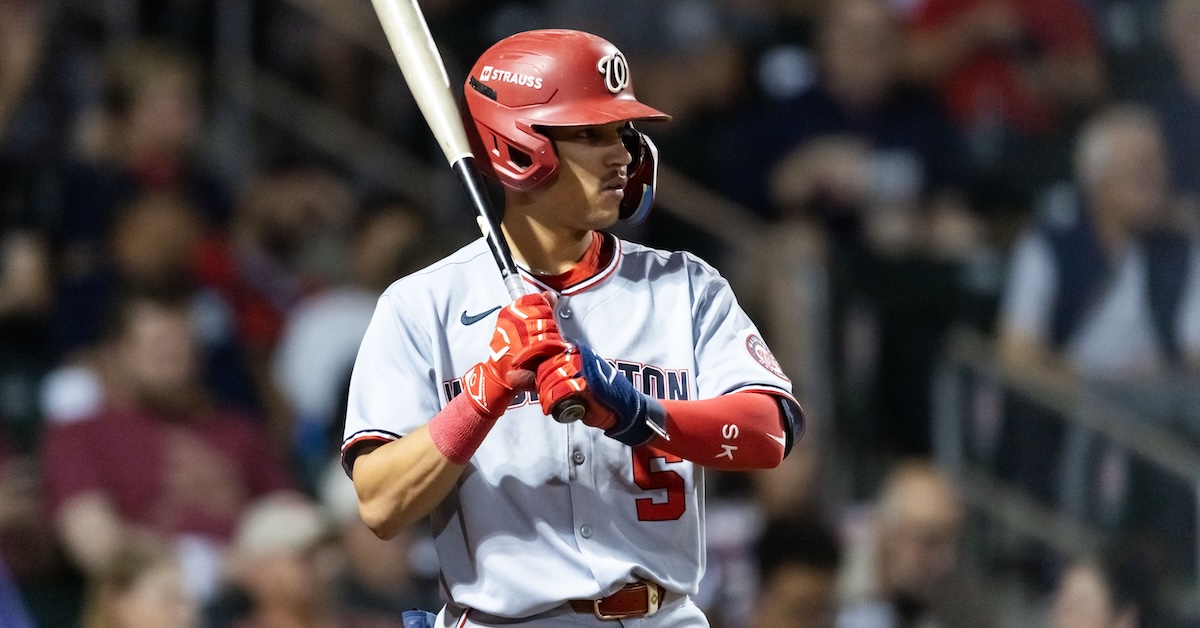
So, Keith Law released an updated Top 50 minor league prospects today, and something really struck me after reading his analysis. We’ve talked about this particular issue in the past in the comments after analyzing the rankings, but now its time to put all the scouting reports on the table openly.
Here’s how Law described Seaver King in his write up today from a defensive standpoint:
“He’s a 70 defender at short with plus bat speed, above-average power and an aggressive approach at the plate that should produce a lot of contact but maybe not many walks.“
70 defender at Short. The scale only goes up to 80. A 70 grade is a plus-plus grade indicating that the player is among the absolute best in the game at that particular skill. Keith Law does not throw out those grades lightly.
Meanwhile, here’s what we have on the books as grades and quotes from the other major pundits in the space.
Fangraphs/Eric Longenhagen. Here’s his top 41 prospects published earlier this year, where he gave King a 30 present/45 future grade on his defense, and a 60 arm, writing the following:
“He isn’t yet a polished shortstop defender (he’s seen his first pro action at second base in 2026) and can be error-prone both fielding and throwing … It’s going to be important for King’s shortstop defense to polish up because his future big league fit is likely in a utility role.”
This was published in April 2026 and is already aging poorly, but a 30 present grade for his defense is wildly different from what Law is reporting. Wildly.
Baseball America is a bit more middle of the road. In their January 2026 write-up, they gave him a 55 Arm and a 50 Field, then wrote the following:
“King played more third base and center field at Wake Forest, but he settled in as a reliable everyday shortstop with an above-average arm. He has the athletic ability to adapt at the position and learn its nuances..”
How about the boys at MLBPipeline? Their current scouting report is here. Current defensive grade: Arm 55, Field 50, exactly the same as BA, and had this to say about his defense in general:
“He played third base and center field at Wake but has been focused on shortstop in the pros. His athleticism could make him average there, but he has the arm strength to move back if needed.”
So, what is it? Is King’s defense a 30 or a 70? Is it really a 55 like BA/MLB say and both Law and Longenhagen are smoking something?
Better question, one that has been articulated before in the comments … how is it possible that two professional scouts watch the same guy and come to such wildly different conclusions? I mean, it’s one thing for Jonathan Mayo to watch a Seaver King game and go, “eh, 55” while Jim Callis sits right next to him and says, “nah i like him, i’m going 60.” It’s entirely another for two guys to come to such a completely different opinion.
I don’t get it either.
Also, FG had his defense as a 50 (present) / 60 (future) as recently as his AFL update. So whatever Eric saw that cratered his take, it only happened this spring.
SMS
28 May 26 at 1:41 pm
I doubt that Eric himself saw anything. To update that much on something like defense, he’d have to have spent a lot of time observing King, and it’s unrealistic to think Eric did so. I think it’s more likely that one or more of his trusted sources have soured on King’s defense recently. But, as SMS points out, the magnitude of the updating is significant. It’s strange. Perhaps it’s just as simple as some scouts no longer believe King’s athletic talent will translate into consistent SS play whereas others continue to focus on the athletic talent and think he can become more consistent over time?
Derek
28 May 26 at 2:01 pm
Todd, it seems we read each other’s minds. Im reposting my comment from NatsProspects here to add to the much more relevant thread
If anything, Law has doubled down on his defensive rating, calling it a “70” this time. I still don’t know who to trust here, when FanGraphs gave him a 30! And MLB Pipeline calling him at best average at SS. Its crazy that very talented scouts could be so certain and divergent in their assessment.
I find it almost impossible to gauge defense by watching televised games, so I’m totally lost. But I cannot imagine that one of the best 5 or so defenders in all of baseball – that’s what a 70 scoring means! – could maintain a fielding percentage of .945. At best, it suggests King is a work in progress. I also don’t believe a team would experiment moving possibly the best defensive SS in all of the minors to 2B, as the Nats did earlier this year.
I can imagine King has the potential to be above average, better than FG and MLB give him credit for, but it strains credulity than King is a 70 defender.
Will
28 May 26 at 2:15 pm
It seems likely to me that
– someone told Longenhagen he sucked, and he’s sticking to it
– Law saw King in person make some nifty plays, remembers him from college and was just too effusive
– in reality he’s probably a 55 across the board, meaning he could easily man SS or 2B with a promotion and eventually move to the marquee position if we move Abrahams.
Todd Boss
28 May 26 at 4:13 pm
While we’re on the topic of defensive minor league scouting, I wanted to bring back a point I’d made in a thread not too long ago about the inaccuracy of defensive scouting reports.
It seems increasingly apparent to me that whatever data/sources the prospect watchers are relying on are not good. I understand that pretty good batting stats are kept that, coupled with first hand scouting, allow for relatively good understanding of a player’s profile and then extrapolate that to a major league level based on age, growth potential, etc. But it seems that the kind of defensive data available at the major league level isn’t anywhere close to being available in the minors yet. Thus, it seems that prospects rely entirely on first-hand scouting reports. But here is where I’m a bit confused. Surely, watching King play baseball in person a handful of times should give scouts an approximate idea of whether he’s currently good/has the potential to be good in the future, or not. So how do we get such incredibly divergent perspectives?
It’s not just King.
Jacob Young has been one of the best defenders in baseball over the past 4 seasons in the majors. Every defensive metric rates him as elite; a true “70” or “plus-plus” defensive CF. And yet, the scouting reports on him pre-2023 were that he was not even a prospect. His defense was limited to corner outfield, where his bat profiled as too weak to play there (at least that was accurate). Even after MLB Pipeline got a 33 game glimpse of him in 2023, they still only gave him a defensive score of 55 in early 2024. Even though all us Nats fans saw that Young was exceptionally talented.
At the same time, MLB was giving James Wood the same defensive rating: a 55, describing him as competing with Dylan Crews to be the better defensive CF in the future. Wood has been a disaster defensively. Since 2024, he has the 8th worst defensive rating among 158 OFs according to FRV (Young is 2nd).
Speaking of awful defenders, CJ Abrams in 2022 was also rated a 55 defender by MLB Pipeline (FG, to their credit, rated Abrams as below average and an FV of potentially average). Abrams has been the worst non-catcher defender in all of baseball since 2023. (Side note: I’m only ragging on FG and MLB Pipeline because I have access to their old scouting reports, and they helpfully score tools individually unlike ESPN or KLaw)
If you include catchers, Abrams has still been the worst, but Keibert Ruiz (-37 FRV) is only narrowly behind Abrams (-38 FRV) to be the 2nd worst defender in all of baseball. Ruiz’s scouting reports at the time he was acquired spoke of him being an above average (or even better) defensive catcher. MLB Pipeline: 55, FG: 50. Though funnily enough FG’s scouting report spoke of Ruiz’s poor blocking ability, while being good defensively otherwise. Meanwhile in reality, blocking turned out to be Ruiz’s strengths, at least relative to everything else he has done defensively as a catcher (he was still below average at blocking though).
I’ll withhold judgement on Brady House, for the moment. He was slightly above average last season, and awful this season. So it’s hard to tell if he’ll live up to the 60 FG gave him and 55 MLB Pipeline gave him ahead of the 2025 season. Same story, but opposite for Daylen Lile. FG scouted Lile as quite bad defensively (30) whereas MLB had him as a 50, a difference of which seems close enough for neither to be entirely wrong, and in reality Lile has been BOTH the FG version and MLB version. Last season, he was horrifically bad defensively, but it seems that it was as simple as just moving him to LF instead of in RF, a position he never played much before. This season, he’s been way above average there. It remains to be seen which version he really is, or somewhere in between…
While it’s also a relatively small sample size, Dylan Crews’ defensive scouting reports have proven to be rather accurate. FG was again down on Crews’ defense (40) and MLB Pipeline high (60). Crews has proven to fall right in between, around a 50, so far mostly playing above average (but not elite) defense.
That’s basically all the hitters the Nats have graduated this decade.
All that to say, is this an aberration? Are the Nats just unique in their players basically performing the opposite of what their scouting reports predicted? Are other teams’ prospects also just as inaccurate? Or is this a product of (now hopefully apparent to all) an horrendous coaching staff under Martinez, where players were not playing to their fullest potential due to bad instruction, and seemingly in Wood and Abrams cases are now irreparably broken?
Or, is this a product of really bad scouting? Surely looking at a larger sample size of prospects from outside the org would indicate if this is a Nats-specific thing, but I’ve already spent too much time on this point. Still, it’s something that’s rankled me for some time now. I’m not sure what to make of it, but King is definitely a perfect illustration of just how wrong the prospectors are.
Will
28 May 26 at 4:28 pm
I’ll mostly give the pundits a pass on JY. He was barely a prospect. FG’s only mention of him was in the unranked bulk section in 2023 and, as you say, Pipeline only ranked him 18th after he almost put up a full WAR during his cup of coffee in the majors. That’s exactly the kind of player that falls through the cracks when you’re scouting all 30 orgs. You had to pay close attention to see that he was getting moved around because other more highly touted prospects needed reps in CF and I can easily understand how the majority of the public scouting was based the implication that he was shaky in center.
But your other names are all top prospects. Lile was a 2nd rounder on all team top 10s and the others were consensus top 100s. Hell, Wood, Crews and Abrams were all FV60s+ that were top 10 nationally. I have to think the pundits give those guys a lot of video time and at least a couple of in-person looks. And those players have enough salience that you could reliably get your sources on other teams can give you (relatively) disinterested industry takes.
Those misses really do feel perplexing. And I’m with Will wondering if this is a global issue with the scouting, or something Nats specific.
(I also want to give Rizzo and team credit for giving Young a chance. The guy was 7h round draft pick running a BABIP driven 120 wRC+ across A+ and AA, while being about average age for the level. Positional need or not, they had to have clocked his superlative defense to call him up. I’m agnostic about whether the coaches did anything to help develop his defense, but it would have been very easy for him to toil away in obscurity.)
SMS
28 May 26 at 6:46 pm
Test comment reply; i’m having some issues with this site lately. Cannot post, it’s been down twice. Seeing if this comment posts.
Todd Boss
29 May 26 at 10:54 am
Todd, I was also having trouble loading the site earlier today, but it seems to be working fine again now.
SMS, I don’t fault prospectors for not rating Young in 2021 or 2022. He had an awful start to his career and was easily overlooked. However, by 2024, he was impossible to ignore, particularly having put up legitimately good numbers in 2023 in both MLB and AA, and was still rookie eligible. At that point, his exclusion couldn’t be an oversight, but a deliberate decision. That’s where I take exception to the scouting reports. Also, it’s not like our farm system was deep at all in 2024. Guys like Daison Acosta and Everett Cooper were getting ranked, while Jacob Young was not.
But to the question of whether this is a more systemic problem or a blind spot to the Nats specifically, I’ll try to have a closer look. There’s always some guys that come out of nowhere to be elite defenders (like Young), Henry Davis (2021’s 1-1 pick) is a great example of this. Everyone crapped on him for his questionable defense at catcher, and he’s turned out to be elite, possible 70-caliber there (though perplexingly his bat, which was his carrying tool, has been abysmal). But these guys are known for being outliers, rather than the norm. But then again, most people don’t pay much attention to every org’s prospects, like we do with the Nats, so things like this might get lost in the data noise. FanGraphs’ Prospect Board should make this somewhat easy to look into.
Will
29 May 26 at 1:48 pm
Just cherrypicked a few data points, and the scouting reports – at least for the best of the best – seem to be pretty spot on. In 2021, FG rated 21 players 60 PV or higher on defense. Weirdly, almost every single one of them went on to play pretty significant time in the majors, and nearly all of them proved to be, at least, average defensively. There were a couple outliers. Joey Bart was one of 7 players rated 65 or above, and he turned out to be a pretty lousy catcher. Taylor Trammell was only ever, at best, average despite being rated 60 PV and 70 FV…
Still, it’s pretty accurate. Maybe it’s easier to rate the standouts as standouts than guys who look like they might be a bit better than average (like Wood, Abrams and Ruiz), but were just deceptively good on the few occasions scouts saw them?
Though it’s quite strange how bad the reports have been for Nationals guys. It’s why I’m not so quick to dismiss the coaching explanation. For example, as we discussed last season, Lile and Wood were putting up horrific defensive numbers, and I speculated that it might be because both guys had played very little at their position. Lile was predominately a LF in the minors, starting 155 games in LF and only 52 in RF (+62 in CF). He was then promoted to play RF, weirdly. Meanwhile, James Wood played mostly CF, then next RF in the minors, 171 starts vs 52, respectively. But almost no LF (only 26 starts). The logical solution was to swap them. Fortunately, the Nats did that this season. It hasn’t paid dividends for Wood. He’s still really, really bad. But Lile is a new man. He went from 5th percentile (!!) last season to 82nd percentile (!!!) this season, playing his favored LF. Davey had antiquated ideas about player shifts and positioning, which almost certainly did few favors to our infielders. I’m also not sure it’s a coincidence that Ruiz went from a 1st percentile defender in 2023, to 6th percentile in 2024, to 5th percentile in 2025, to 83rd percentile in 2026. Sure, the ABS system takes some stress of a catcher, but there’s more to it. The Athletic just yesterday wrote a good article that focuses on the coaching support Ruiz has received and how it’s potentially saved his career (https://www.nytimes.com/athletic/7313046/2026/05/28/washington-nationals-keibert-ruiz/), but it focuses almost exclusively on the offensive side. I’m certain there’s a similar story to be told about the defensive side of his game too, that he wasn’t getting in past seasons. Given the almost systematic underperformance among our fielders, I think there’s something to this being part of the explanation.
Will
29 May 26 at 2:18 pm
I really appreciate the passion and words of my fellow posters. to get things really riled up I’ll offer a recent Keith Law take.
Q: Is Yohandy Morales’ resurgence legit, and if so, is he within spitting distance of the top 100?
A: No
FredMD
30 May 26 at 8:29 am
I’m convinced that we won’t understand the true story on Morales until he’s in the majors. At that point, we’ll have better public data and, whether he succeeds or fails, at least we’ll have a some chance to understand why. Until then all we can say is that nothing about this makes any sense.
You have an age appropriate guy leading qualified AAA hitters in wRC+. Barely a prospect.
If he can’t hit fastballs and he’s crushing everything else (2 more HRs yesterday, one off a changeup and one off a slider), why isn’t he being thrown 90% fastballs?
Law also doesn’t trust Fitz-Gerald’s power surge in part because the one HR he saw was a wall scraper. (He acknowledges that’s just an anecdote, but still thinks it’s worth mentioning.) Surely a guy like Law can get non-public EV data that would weigh in on that question pretty heavily.
SMS
30 May 26 at 11:09 am
to expand on Fitz-Gerald, Law is anything but down on him. he is just waiting to see if he can avoid too many K’s as he moves up. something I would love to see happen soon.
FredMD
30 May 26 at 2:20 pm
@SMS: 100% on Morales. The dude has been in AAA for years now and he’s still not to Arb. Maybe scouts are just pooh pooing him b/c he’s 1B only.
Todd Boss
31 May 26 at 9:36 pm
Fred, I might be Morales’ biggest fan, but even I am not making a case that Morales should be a top 100 prospect. What I strenuously disagree with is that Longenhagen, Law, et al are saying Morales isn’t a prospect AT ALL. Longenhagen refused to label Morales even a 35+, which is by definition a replacement level player. Longenhagen rated over 40 players in the org ahead of Morales, including guys like Sam Brown and Kevin Bazzell, who are MUCH, MUCH worse players all around. Bazzell is presently 2 levels below Morales and only 1 year younger, while Brown is a level below, also a 1B-only bat and one month OLDER than Morales! Keith Law left Morales off his top 20 list, putting guys like Caleb Lomavita and Abimelec Ortiz ahead of him (if you don’t like Morales’ age/positional profile, then what is there to like about Ortiz?!). That’s crazy to me. There is no doubt that Morales is an imperfect player, for well documents reasons. But once you get past the top 5 or so players in an org, every player is imperfect. And the problems I see in Morales (launch angle, chases too much) are fixable, especially the former – just look at Keibert Ruiz!
I also disagree that Morales is definitively 1B only. As I’ve ranted about ad nauseam above, these guys stink at scouting defense. And despite such assured proclamations that Morales can’t play 3B, he… continues to do so. Two thirds of his playing time this season has come at the hot corner, which has only recently decreased to accommodate House.
And even so, being bad at defense hasn’t stopped Abrams, Wood and Garcia from playing their positions, and I don’t think it will suddenly stop Morales either (if he is even bad defensively at 3B).
Me, I’d put Morales in the teens in our org, around similarly imperfect guys like Sam Petersen and Luke Dickerson, and behind the guys with serious upside (like Cruz, Cabrera, Fitz-Gerald, Willits, etc. – who are/should be in consideration as top 100 prospects).
Will
1 Jun 26 at 4:32 am
From Spencer N. at the Athletic re King’s defense: “Defensive consistency remains a work in progress. He’s still making elite plays, but the team is working with him on his footwork, which should help his arm accuracy. Several evaluators who spoke to The Athletic believed that footwork was fixable, and said they aren’t ready to rule out a big-league future at short, though the org will have him play second and third in Triple A.”
I think the wide variation in defensive grades for King is a flavor of the more general ceiling/floor issue with prospects. The ability to make “elite” plays suggests a high ceiling, whereas the inconsistency suggests a low floor. Given that King moved around a lot on defense as an amateur, one might expect some inconsistency.
For the Nats as an org, clearly the best outcome is King as an everyday SS combined with extending Abrams and having him play 2B going forward. Here’s hoping…
On YoYo, I would think we have enough data on minor league hitting performance for the naysayers to make a tight statistical case that his 1.000+ OPS is smoke and mirrors and/or won’t translate to MLB for whatever reason. Instead we get terse responses from Law and Longenhagen that amount to “neh.” I’m not doubting the strength of their convictions, but I think the quality of YoYo’s performance (ESPECIALLY given the improved performance of Nats’ farmhands up and down the system) establishes a burden of proof the naysayers haven’t sufficiently carried. We’ll have to wait and see…
Derek
1 Jun 26 at 10:08 am
So the pitch mix isn’t there today, but yesterday, this URL https://prospectsavant.com/player/691002 showed he was facing something like 38% fastballs. That’s probably average. Clearly he’s doing okay against them — he’s hitting 342/417/589.
Unless he doesn’t know where the bag is, I think you have to at least give him 100 ABs to see how he’ll handle a big-league fastball. If he can’t hit in the bigs, just sell him to the Japanese leagues now, because he can go there and break every record they have.
It just mystifies me that this kind of production isn’t worth so much as a look.
kevin r
2 Jun 26 at 1:42 pm
@kevinR: I love it. so the scouts say he can’t hit fastballs, and he’s got 1.000 OPS against them in AAA.
I feel like we’re still missing something here.
Todd Boss
2 Jun 26 at 4:21 pm
Yeah, it doesn’t make sense with what’s publicly available. Maybe he’s got fungus on his shower shoes?
I get giving Garcia a long leash to see if he can hit better. But Garcia is Arb-2, and I doubt he’s part of the long-term plan. If Toboni hates Morales, you’d think he would just trade him.
kevin r
2 Jun 26 at 7:58 pm
The scouting reports have never corresponded to the publicly available data.
“His hit tool is below average” – He has a career .295 AVG and 130 wRC+.
“He strikes out too much.” He has a career 25.2 K% (and 25.0% in AAA at the moment; league average is 23.6%).
“He doesn’t hit for enough power.” He has the 3rd highest SLG in AAA.
“He can’t hit fastballs.” He has an expected slash of .225/.328/.374 against fastballs this season (courtesy of Prospect Savant), which is ABOVE LEAGUE AVERAGE. Morales is absolutely destroying nearly every other pitch, while against fastballs, he’s hitting them at an expected rate slightly above AAA average. Again, where the criticisms don’t actually correspond to the data available…
It defies explanation. Meanwhile, you have countless players who in spite of all statistical evidence remain elite prospects for years, even while sporting fatal flaws and underperforming the whole time (how many years did it take for Elijah Green to drop off these lists?). I’ll never understand why a guy like Morales went from a highly rated prospect at the time of his drafting to almost IMMEDIATELY and UNANIMOUSLY being written off by prospectors, while still being…. really good.
In terms of getting a chance in DC, there’s a whole range of options beyond just Garcia. For a team that is playing so well offensively, there’s a ton of dead weight on the roster. Jorbit Vivas is redundant when we have Nunez, Mead and Tena capable of playing his position of 2B/3B. Tena the same story. I don’t understand why we’re carrying BOTH of them. Then Andres Chaparro too is doing nothing to justify his roster spot. That’s 4 bats who could be dropped without any problem, which would pave the way for Morales to get playing time in the majors. Though Chaparro is the only one with options remaining. However, as Morales isn’t yet on the 40 man, a DFA would be necessary, though again there’s plenty more dead weight here. Beyond those 4, there’s also Carson Palmquist, Andre Granillo and Zak Kent stealing a living on the 40 man, each of whom has an ERA over 8.00 in the minors at the moment.
Will
3 Jun 26 at 4:41 am