Nationals Arm Race

"… the reason you win or lose is darn near always the same – pitching.” — Earl Weaver

Archive for the ‘Nats in General’ Category

Spring Training 2019 NRI Discussion

20 comments

Kieboom is probably the surest NRI thing in 2019. Photo via PerfectGame

Kieboom is probably the surest NRI thing in 2019. Photo via PerfectGame

The Nationals, on the eve of spring training, announced their list of Non-Roster Invitees (NRIs) for 2019.

Here’s the list:

  • RHP — Henderson Alvarez, Aaron Barrett, Scott Copeland, Wil Crowe, J.J. Hoover, Ronald Peña
  • LHP — Vidal Nuño
  • C —Tres Barrera, Taylor Gushue
  • INF —Luis Garcia , Carter Kieboom, Jose Marmolejos, Jake Noll, Matt Reynolds, Brandon Snyder, Jacob Wilson
  • OF — Hunter Jones, Chuck Taylor

Now, before you say “who cares” here’s some stats.  In the last four seasons (through 2018):

  • 5 NRIs made the 25-man roster straight out of Spring Training (and Guthrie technically made it 6 since he got called up a few days later and was always intended to be the 5th starter in 2017)
  • 18 NRIs eventually played for the MLB team at some point that same season.

So its likely that we’re going to see these NRIs at some point in the future.  Like, on average at least 4-5 of these NRIs are going to play for this team in 2019.

So lets squint and make some predictions.

  1. Do any of these guys stand a chance at making the Opening day roster?  Yeah maybe.  I think a couple of the relievers (especially Nuno) have a real shot at the bullpen if they perform in Florida.  Three of the seven guys I’m projecting to the MLB bullpen have options remaining (Barraclough, Suero and Glover), the team only really has one legit lefty in the pen (Grace) and may end up carrying 8 relievers through some roster chicanery early on.
  2. Do any of these guys project to feature at all in 2019?  Absolutely: I think Alvarez, Hoover, Nuno, Reynolds, and Snyder in particular seem likely to get call-ups to cover for injury, unless they exercise opt-outs.  Reynolds is one of the few SS capable guys in the high minors, Snyder could be Zimmerman or Adams injury coverage, and Alvarez could get the call to provide spot starts if in-house options like Fedde continue to struggle at the MLB level.
  3. Who among these guys project to eventually get on the 40-man?  The top-end prospects on this list for sure: Crowe, Garcia, Kieboom, Barrera and perhaps Gushue all seem likely to eventually make the 40-man.


NRI Details by year, in case you were wondering…

Summary of NRIs for 2019 (post season update): 18 total

  • One (1) made the 25-man roster out of spring: Jake Noll
  • Three (3) more eventually got added and called up:  Aaron Barrett, Tres Barrera, Carter Kieboom
  • Zero (0) others have since been added to 40-man (as of 2/6/20).

Summary of NRIs from ST 2018: 21 NRIs total:

  • One (1) made the 25-man roster out of spring: Miguel Montero
  • Four (4) eventually got added and called up:  Tim Collins, Moises Sierra, Jimmy Cordero, Spencer Kieboom.  Special Mention to Edwin Jackson, who opted out of Washington then excelled for Oakland later in 2018).
  • Zero (0) others have since been added to 40-man

Summary of NRIs from ST 2017: 24 NRIs total:

  • Zero (0) made the 25-man roster out of spring (though technically one kinda was; see next).
  • Five (5) eventually got added and called up (Jeremy Guthrie, Matt Albers, Grant Green, Jacob Turner and Andrew Stevenson): Guthrie was the 5th starter, stashed in XST for a few days before his ill-fated debut.
  • Five (5) have since been added to 40-man (Erick Fedde, Taylor Hill, Kyle McGowin, Wander Suero, Tim Collins)

Summary of NRIs from ST 2016: 20 NRIs total (plus perhaps a couple more that got signed late):

  • Two (2) made the 25-man roster: (Chris Heisey and as noted in the comments, thanks for the correction, Matt Belisle).
  • Two (2) eventually got added and called up (Lucas Giolito, Sean Burnett)
  • Two (2) have since been added to 40-man (Matt Skole, Austin Voth)

Summary of NRIs from ST 2015: 20 NRIs total:

  • Two (2) made the 25-man roster out of spring (Dan Uggla and Clint Robinson)
  • Two (2) others eventually got added and called up (Rafael Martin and Emmanuel Burriss)
  • Two (2) others were young catchers since added to the 40-man (Spencer Kieboom, Pedro Severino)

(I believe the above analysis is correct; feel free to comment if i’ve missed someone.  this is a bit tougher to keep track of b/c the team often signs MLFAs mid-spring then technically gives them NRIs … especially for Vets, and I may miss some from the original announcements).


Ask Collier 2/1/19

49 comments

Taylors days may be numbered. (AP Photo/Nick Wass via nbcsports.com)

Taylors days may be numbered. (AP Photo/Nick Wass via nbcsports.com)

Another week passing with barely any FA movement, and another set of questions taken by Jamal Collier.

Big Nats news of the week seems to be the team beating Michael A. Taylor in arbitration … over $250k.   That’s 1/10th of 1% of their team payroll, for context.  I *hate* it when teams go to arbitration battle with their players; by all accounts the team basically trashes the player in the presentation, making all the arguments about why they’re NOT worth the salary.  I think it completely poisons the relationship between player and management.  The Nats under prior management used to do this constantly; they were among the league leaders for  years in arbitration cases.  This is the 5th arb case that I believe Mike Rizzo has argued in the 10 years he’s been in charge.  Here’s the previous cases the team has argued:

  • 2006: Alfonso Soriano.  After acquiring him they immediately went to war with him … which was only a precursor to the Spring Training war, basically forcing him to play the OF.   Great way to treat your team’s best player.  Asked for $12M, got #10M when the club beat him, and he left via FA after the season.
  • 2007: Chad Cordero: Cordero beat the Nats in Arb over $500k difference.  The team and player were able to come to a pre-arb agreement in 2008 but Cordero’s days were numbered.
  • 2007 John Patterson: The team and Patterson were way, way off (1.8M vers 1M); the club won, then releaesd Patterson before the season had even started.
  • 2008: Felipe Lopez: the club beat Lopez over $300k … then released him mid-season.
  • 2009: Shawn Hill; went to battle again over $275k … then released him in the spring before they had to pay a dime.
  • 2010: Sean Burnett: went to battle over $150k.  That’s right: 150,000, one of the smallest argument values I can find in the last decade.  Club won.
  • 2010: Brian Bruney: just after acquiring the guy (similar to this year’s Kyle Barraclough situation) they immediately argued against him in arbitration and won.  Bruney never contributed in a meaningful way and the team cut him loose in May.  I thought at the time he was suffering from a “Bruised Ego” as the source of his crummy performance, but he didn’t pitch any better the next year for the White Sox and was soon out of the league.
  • 2012: John Lannan, who the club beat to only pay him $5M versus $5.7M … then immediately relegated him to AAA for most of the season.  He made 33 starts for Washington in 2011 … then 24 starts for Syracuse in 2012.  What an insult.  Unsurprisingly, he was non-tendered before the 2013 season.
  • 2015: Jerry Blevins, who beat the team for $200k … and was then dumped in trade a few weeks later in what I read at the time (and still believe) as an act of petulance from Rizzo.

We havn’t had an arb hearing since the 2015 debacle.  But now it seems like the team will battle not once but twice.

Of these 10 hearings (including the Taylor hearing): here’s some interesting stats:

  • Club has won 7 of the 10 hearings
  • Seven of the Nine players that went to arbitration were GONE from the team (one way or another) that same season.   Most of them cut either in spring training or quickly there-after.

So, it doesn’t bode well for Taylor or Barraclough’s future the fact that they’re arguing against the team.

Lets get to the questions.

Q: How are the Nationals matching up against the rest of the division this 2019 season?

A: What, you can’t read the papers?  Here’s the summary:

  • Nats have filled every hole they had and spent more than 14 other teams combined this off-season.  They’ve conservatively added 10-12 “wins” and are projecting on Fangraphs to win the division.
  • Braves have grown a very solid core and did a little FA work on the edges, but have no reason not to repeat what they did last year.  They’re only projecting to a $122M payroll, and that’s AFTER signing Josh Donaldson to a $23M one year deal.
  • Phillies have signed a couple guys, but already had a fully formed rotation and still have $50M of room.  But they could still land one of the two big FAs and improve quickly.
  • Mets have made some odd choices (acquiring Robinson Cano), have a ton of payroll just to Cano and Cespedes, and have completely re-made their bullpen.  Are they contenders?
  • Marlins continue to be a dumpster fire, projecting to spend just $84M in 2019.

So i’m predicting Nats win division, Braves to WC, Phillies just miss out but still win 88 games, Mets go about .500 and Marlins lose 105 games.  Its going to be the most competitive division in the game.

Collier predicts a competitive division with four teams actually trying.  That’s refreshing.

Q: What are the Nationals’ needs? Do they need left-handed bullpen help and maybe a utility player?

A: In an ideal situation sure they’d love more Lefty bullpen options.  But they’re kinda out of cash.  They could also use rotation insurance, but looking at the list of starters still available (nearly 20 who had MLB starts last year, several of whom could improve nearly any rotation in the game) I doubt we’ll be able to spin a MLB deal for any of them.

Collier agrees, thinks the bench is fine.

Q: I would rather have another pitcher like Dallas Keuchel or even Wade Miley, and let Harper go. What do you think?

A: well, this guy clearly missed the news, b/c Miley is already gone (to Houston, improving them to be at least a top 10 rotation now if not slightly better).  But this asker also clearly doesn’t know just how close to the luxury tax the team is.

If you’re going to go over … then frigging go over.  Sign Keuchel, sign another loogy, blow past the cap by $20M, Sign Harper, blow payes st it by $50M.  It seemed to do pretty well for Boston last year.

I don’t think there’s a team in the league that wouldn’t like having Keuchel in the fold (maybe the Cubs or Indians); certainly Keuchel would be an upgrade over Joe Ross for us.

All this being said … the tea leaves say one thing to me pretty clearly; Harper is gone, the team has already moved on.  Is this even a discusCollsion?

Collier notes they’re about $11M under the cap, have indicated pretty frequently they intend to stay below it, and 

Q: With the injury history regarding Stephen StrasburgPatrick Corbin and Ross, is it possible there will be a six-man rotation instead of five?

A: So, on the one hand its true that no team can go 162 games without having to rely on additional starters…. but it’d be stupid to go to a 6-man rotation with a bunch of veterans like what the Nats are projecting.  This isn’t high school; these guys are trained professionals, highly paid, and are conditioned to pitch ever 5 days.

What is true is this: our 6th, 7th and 8th depth chart starters WILL get starts.  So while it’d be awesome to have a ton of depth … you have to store it somewhere.  So project Erick Fedde and Austin Voth and some veteran 35-yr old MLFA  hanging on for one more shot to contribute in 2019.

Collier says the same thing about routines.

Q; Any word yet on non-roster invitees to Spring Training? 

A: Yes; there’s going to be a few of them.  Some of them will look great.  A couple will stick around.  In fact, we do an annual post here every year about NRIs who make it.  Here was 2018s http://www.nationalsarmrace.com/?p=15657 and 2017’s: http://www.nationalsarmrace.com/?p=13409 .

Last year, 1 NRI made the team out of spring, another 4 played for the team in the 2018 season, and Edwin Jackson was an NRI for us and excelled for Oakland.

So, NRIs are important.

Collier notes a couple of specific NRI arms who may very well be options to make the bullpen at the expense of someone like Sammy Solis.

Ask Collier 1/11/19

40 comments

Harper Harper Harper. Photo Evan Habeeb-USA TODAY Sports

Harper Harper Harper. Photo Evan Habeeb-USA TODAY Sports

On deadline day for doing arbitration contracts, MLB beat reporter Jamal Collier did a mailbag.  Its been a notable week with more Bryce Harper rumors and the Nats running their payroll right up to the limits of the Luxury tax cap with the Brian Dozier signing.

Here’s the questions he took:

Q: Harper is on my mind. Spring Training is days away. Aren’t the guys worried about will happen? No way they can be just “whatever,” right? Especially if he ends up in Philly?

A: If they can’t figure out from the slew of Mike Rizzo moves what the team’s intention is with Bryce Harper by now … well maybe a sledgehammer would be more subtle.  Its mid January and Rizzo has made 8 moves that should impact the opening day 25-man roster and another 2-3 that may be impactful down the road.  He’s now got the payroll north of $190M.

So what if he goes to Philly?  I think the whole “don’t trade within the division” is nonsense.  Yeah we’ll see him a lot.  But its a closed loop; he has to go to one of the 30 teams in the league, and we are bound to see him no matter who he plays for.  There’s 30 teams, and only half of them are even frigging trying to win right now, and then halve that again for those who even have payroll room to compete for Harper (or Machado).  And Philly is one of them.

As far as “the guys” … are you talking about his team-mates?  Well one of two things would be true about his teammates:

  1. They hate his guts and are like, “good riddance.”
  2. They are his fellow union members and want him to get every dollar possible because their union so royally screwed them selves in the last couple of CBA negotiations.

Collier notes that his fellow players know this is “part of the business” that Harper may eventually leave, and that he’s been a national figure since he was 16.  

Q: If Harper re-signed with the Nationals, how would they work the outfield? Would Victor Robles start the season in Minors? Or would they trade Eaton?

A: You’d have to trade Adam Eaton.  And you’d be trading low.  You can’t move Juan Soto … he’s making MLB Min and could be an MVP candidate.  You really shouldn’t move Victor Robles; he’s supposed to be a *better* prospect than Soto, so you’re hoping for 4-5 win performance for (again) MLB min salary.  These are the kinds of players you keep when you’re trying to win.  Putting Robles in the minors would be an absolute waste, and if that was their plan then i’d advocate attempting to flip him as a centerpiece for a top 20 player in the league (like a Corey Kluber or something).

Collier agrees.

Q: If Harper returns, how does it change how the team will handle Anthony Rendon negotiations?

A: Hmm.  That’s a good question, because despite the fact that Anthony Rendon dropped in the draft over injury questions he’s actually been pretty solid as a pro.  I liken Rendon’s reputation and capabilities to Adrian Beltre; fantastic defender, sneaky good at the plate, and suddenly you look up and he’s put up a hall of fame career.

Will that translate into a $200m salary?  Probably not.  But Rendon is no dummy, and neither is his agent Scott Boras.

That being said … can the Nats do this whole “stars and scrubs” thing for ever?  If you have 5-6 guys on high 8-figure salaries (Scherzer, Strasburg, Corbin, Harper, Rendon) can you put a good enough team behind them?

I personally think Rendon is an incredibly important player for this team, even if he isn’t that high a profile.  And because he’s not high profile, I think you can get him for $20M/year or something like that on a longer term deal, which would be a steal value-wise.  I hope committing money to Harper doesn’t close the door on a Rendon negotiation.

Collier says …. he has no idea, nor does Rizzo.

Q: How should we look at 2019 Dozier replacing ’18 Daniel Murphy? Both are above-average offensive second baseman with liability at fielding. Is this an upgrade, downgrade or equal move?

A: Absolutely an upgrade; Daniel Murphy had negative bWAR last year while even playing through injury Brian Dozier contributed.  If Dozier is healthy and performs at his 2015-2016 level again … watch out this is one of the steal signings of the off-season.

Collier basically agrees and gives good contextual numbers.

Q: Do you think Washington will add a starter? If it does, I think Wade Miley is fine.

A: I think they will … but not a guy to replace Joe Ross in the rotation.  I think they’ll be looking for MLFAs with 5/1 or 6/1 buy-outs, like Edwin Jackson or Tommy Milone signings last year.  I can’t see them breaking the luxury tax for a 5th starter.

Collier agrees, remembering that the team has already signed Henderson Alvarez for just such reasons.


Quick Dozier signing reaction

22 comments

Dozier slides nicely into the 2B hole on the Nats roster. Photo via mlbtraderumors.com

Dozier slides nicely into the 2B hole on the Nats roster. Photo via mlbtraderumors.com

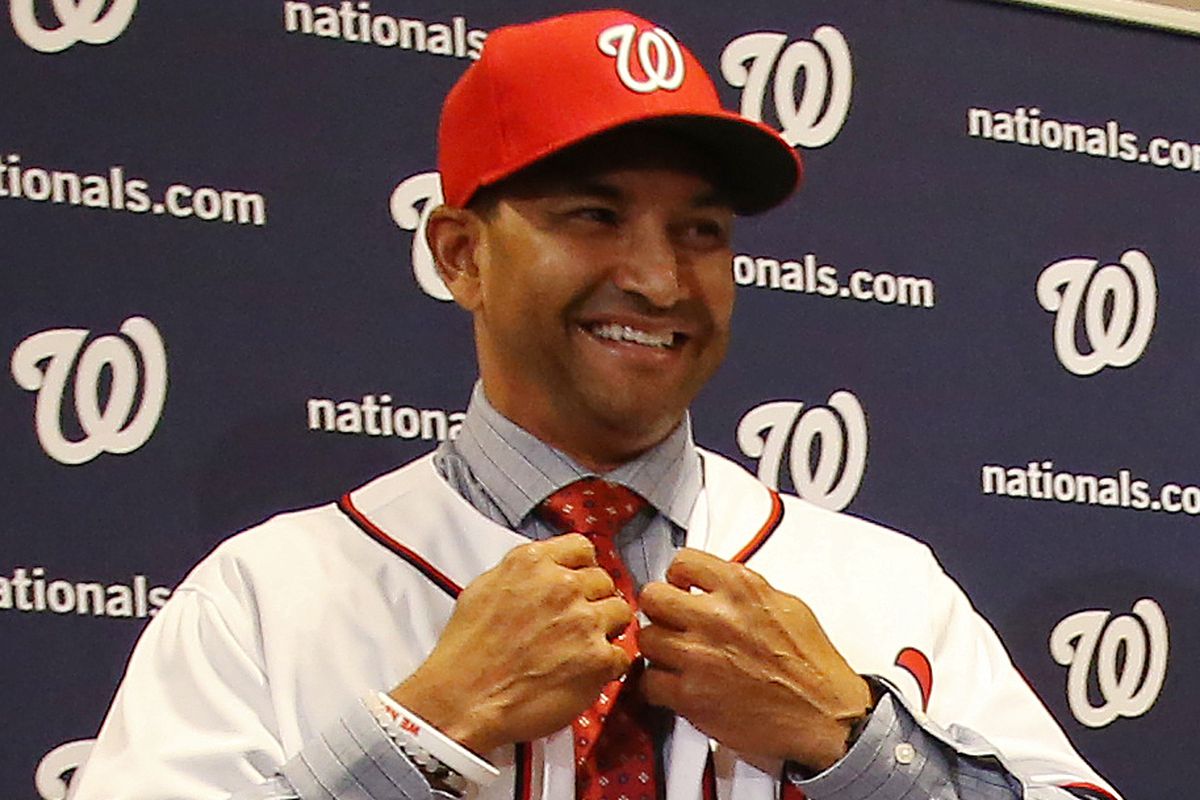
Well, for those who were not convinced that the Nats would roll into 2019 with a Wilmer Difo/Howie Kendrick platoon at 2B … the Nats solved your problems just now, signing former all -star 2B Brian Dozier to a one year deal worth $9M.

Immediate reactions seem to think its an overpay.  He did see his BA  and his overall production plummet in 2018, going from All Star/down-ballot MVP levels in 2015-16 to abhorrent in 2017.  Even so, he still provided a full 1.0 bWAR in 2018 … which would significantly improve upon the combined -0.8 bWAR the Nats 2B provided the team last year.

Another gamble from Mike Rizzo, betting he can get a rebound year out of a former star.

I like the gamble.

  1. Dozier’s signing is a one year deal; the old adage “there are no bad one year deals” comes to mind.  If he’s a total bust, its just money.  Yes perhaps money that could have been spent elsewhere (bullpen) but there’s more P depth in our minors than 2B dept right now.
  2. He doesn’t block Carter Kieboom at all.
  3. Even if he hits .220 again, he hits for power, and would be an improvement over the black hole we had running last year at 2B.
  4. This mitigates any concerns you had about starting Kendrick, or Difo for an entire season
  5. You can do worse than a Gold Glove-calibre former All Star defender in the #7 or #8 hole.

Add a couple more incremental wins to the ledger for this team.

Roster implications:

  • This puts them at 41 players; someone needs to drop.  My guess is Matt Reynolds, who is out of options and who was never going to make the 2019 team.
  • This also likely pushes Difo back to AAA; he’s gone one option left and there’s no room on the active roster.

I saw a couple of comments on the previous thread expressing some dissatisfaction over the move.   But feel free to discuss more.   The question I have for you is this: does this signing make the team better in 2019?

Written by Todd Boss

January 10th, 2019 at 3:59 pm

Ask Collier 12/26/18 Edition

18 comments

Did the team make the right decision on Roark?  Photo Alex Brandon/AP via wp.com

Did the team make the right decision on Roark? Photo Alex Brandon/AP via wp.com

MLB.com Nats beat reporter Jamal Collier gives us a holiday gift with a post-Xmas mailbag dated 12/26/18.

Here’s how I would have answered the questions he took.

Q: It Harper comes back to the Nats looking for 330/10, do the Nats go over the tax or let him walk?

A: Isn’t it obvious by now?  You let him walk.  I think this was pretty clear from two observations:

  1. Mike Rizzo has already spent his $30M AAV, and spent it quickly
  2. Mark Lerner pretty much said as much in ill-advised remarks to a reporter.

The Luxury Tax strikes yet again; the Lerner family, multi-billionaires, will not spend an additional 10-15M above some imaginary payroll number to keep one of the league’s most marketable players.   Player salaries actually FELL for the first time in two decades, as clubs in total spent less than they have since 2004.   Maybe one of these big-spending clubs will break the bank and hand Bryce Harper and Scott Boras their goal; the largest contract in the history of the game.  But it sounds like its a reach, and it definitely doesn’t seem to be happening in Washington.

Collier refuses to get into hypotheticals, then notes that the Luxury tax for last year was “only” a couple million dollars.  Yeah, and only a couple of high-end draft picks, and only the reason why the club fired one of Rizzo’s most trusted advisors for absolutely screwing it up.  

—-

Q: Roark trade more about getting a LHP or the analytics told them he was on MAJOR decline year? $10M for innings eater is the going rate

A: I think the team was taking a calculated gamble that Tanner Roark‘s best years are behind him.   Despite appearances or opinions, Roark was basically a league average pitcher last year.  That’s a significant step ABOVE a replacement level/5th starter type.  But, he’s been trending down, he’s heading into his age 32 year, and the team thought it could spend his $10M better.  I don’t think lefty versus righty had anything to do with it.  Of course, they basically replaced him with an even older Anibal Sanchez, so sorry for sounding hypocritical on his age.  But while Roark struggled to even get to his 98 ERA+ figure last year … Sanchez had a late-career ephiphany that led him to being one of the top pitchers in all of baseball for the 2nd half of last year.  A better trend line in the end.

Collier agrees, that this was a gamble betting that Roark is set to regress in 2019.

Q: If the Nats go out and sign one or two back end of the rotation starters, what does that do to the development of Joe Ross and Erick Fedde? Moved to the bullpen? Sent to Triple A?

A: I’d have a hard time seeing the Nats signing a MLB-contract for another starter at this point, because Joe Ross has nothing to prove in AAA.  But Erick Fedde does.   Joe Ross has proven he can be an effective MLB starter, with his 125 ERA+ in 19 starts in 2016 as evidence.   Now he’ll be 26, with a new elbow, and looking to answer the question whether he’s back from TJ surgery.  For me, for a relatively affordable salary (1st year arb estimate of $2.5M), that’s a great gamble to go with on your 5th starter.  If he suddenly comes out in 2016 mode, 20-25% above league average

Technically both players have one minor league option left, so the team could opt to send them both to Fresno to get lit up in PCL parks and prove nothing.  I expect that for Fedde and we’ll have to take his stats with a grain of salt.

That being said, I do expect the team to sign at least one more MLFA veteran starter in the Jeremy Hellickson ilk, to go to Fresno and be some rotation insurance/catch lightning in a bottle again.

collier kind of gives a non-answer, but he does think Ross could work out of the bullpen (I don’t).

Q:  In my opinion, 2B is their biggest [remaining] priority. Any movement on that front? There are so many available as an upgrade!

A: Well, either 2B or maybe more middle relief help.  Right now the team is looking at this for each spot:

  • 2B: Howie Kendrick starter, Wilmer Difo backup, with Adrian Sanchez and Matt Reynolds as options (Sanchez has an option, Reynolds does not).
  • Middle Relief: right now you’re looking at Justin Miller/Wander Suero/Koda Glover as RHP middle relief options, and Sammy Solis/Matt Grace as lefty options.

Which one of those scares you more?  For me, probably middle relief.  Reliever performance is so variable that its hard to look at the guys who did well last year (Miller, Suero, Grace) and count on them in 2019, just like its hard to look at the guys who struggled (Glover, Solis) and just assume they’re washed up.  But, if you buy more arms, its one in, one out on the roster, so who makes way?

Collier says the team is focusing on one-year deals for one of the many 2B out there, to coincide with the expected arrival of Carter Kieboom.  Makes sense.

Q: Other than what Zimmerman and Rizzo have said publically, is there any rumblings about reworking Zim’s contract? Sentimentality aside, would it be wise for the Nats to lengthen the deal in any way?

A: Hmmm.  man tough question.  Zimmerman is owed $18M for 2019, then has a $2M buyout or another $18M year in 2020.   He’ll be 34 in 2019, 35 in 2020.

When he’s healthy,  he’s good for 25-30 homers, a .300 BA, a .500 slugging, and an OPS+ figure in the 120-130 range.  When he’s not … he misses vast chunks of the season, hits in the .250 range, and has about as many homers as a typical middle infielder.

Its notable that he *already* has a 5yr/$10M personal services contract with the team in place upon his retirement, so even if he hangs them up after playing for an other team he’s coming back here for the long haul.  So he’s going to be associated with the team for a while.

First things first: if he puts up another 120 OPS+ season in 2019 and is healthy, I think its an easy option to pick up for 2020.  From there, again if he continues to provide value I can see perhaps the team extending him on a year by year contract kinda similar to what they’ve given Matt Adams the last couple of years.  I’m sure Zimmerman would take that, given his history, his Virginia roots, the fact that he’s settled here, etc.  At some point it’ll become pretty clear its time for him to hang it up … at which point he transitions to the front office nicely with a hope of staying in management for a while.

That’s what i’m hoping for.

Collier notes that both sides want to continue the relationship, so something should get worked out.


Happy Holidays from NAR

13 comments

Soto in his younger years.  Like the beginning of 2018.,   Photo via minorleagueball.com

Soto in his younger years. Like the beginning of 2018.
Photo via minorleagueball.com

Quick post to say thanks to everyone who contributes here and makes for a nice place to have a conversation about our favorite team that often drives us nuts.

As a Nats fan, i’m grateful this season for the furious work our GM has done to shore up the team for 2019.  Just thinking about his moves from a bWAR perspective:

  • Replacing 90+ innings from Ryan Madsen and Sammy Solis and A.J. Cole (combined 2018 bWAR: -1.7) with comparable innings from Trevor Rosenthal and Kyle Barraclough (combined bWAR for 2018: 0.4) is addition by subtraction, but we’ll call it 1 full win.
  • Replacing the black hole of production on both sides of the ball from our Catcher spot (combined 2018 bWAR: -0.1) with the production of our two new C signings Yan Gomes and Kurt Suzuki (combined 2018 bWAR: 4.7).  Call it 4 additional wins, since both catchers can’t play at the same time.
  • Replacing Tanner Roark and Gio Gonzalez in the rotation (combined 2018 bWAR: 4.5) with Patrick Corbin and Anibal Sanchez (combined 2018 bWAR: 7.6).   Call it 3 more wins.
  • Replacing Bryce Harper‘s abhorrent defense in the outfield this season (dWAR component of an astoundingly low -3.2 in 2018) with someone who actually plays the outfield competently in Victor Robles (a plus plus defender in center, allowing Adam Eaton to slide to RF, where he has posted dWARs in the 1.5 to 1.8 range.  I’ll call this at least 4 more wins.

That’s 1+4+3+4 more wins just based on the moves we’ve already made.  That’s 12 wins on last year’s 82-80 season.

And then there’s this: first year rookie manager Dave Martinez‘s learning on the job season contributed to an astounding -8 on the Nats pythagorean record, which just isn’t sustainable.  Between a better bullpen and better luck, the team should improve by this factor going forward.  Lets call it 4 additional wins.

Voila.  that’s 16 wins over last year’s 82-80 season, which equates to a 98 win season.  And that’s before we find out if Robles can put up a Juan Soto season, or if Soto improves on his 2018, or if we find a competent 2nd baseman to add more value, or if Ryan Zimmerman doesn’t blow off an entire season and puts up 2017-esque numbers, or if we find out that Joe Ross can return to his 2016 form (2 bWAR season in half a season starting).

So that’s some optimism heading into the new year.

Written by Todd Boss

December 25th, 2018 at 6:48 pm

Anibal Sanchez as #4 starter; I like the risk

10 comments

Sanchez joins the Nats on a 2 year deal. photo Atl official via ESPN

Sanchez joins the Nats on a 2 year deal. photo Atl official via ESPN


Well, now we can have the argument; was the Tanner Roark salary dump worth it?  Because just a few days later the team signed his replacement; Anibal Sanchez last night to a  deal to be his replacement.  Contract details are a bit complicated by the reports i’ve seen: 2 guaranteed years, $19M of guaranteed money, with $6M deferred and a 2021 option worth $12M, and some unspecified details that could add $4M to the package.

From what I can tell, the luxury tax implications are just the guarantees; $19M over two years means $9.5M of a luxury tax hit this season … which is almost identical to the $9.8M we’d been using to project Roark.

So, is the team better off?  Probably.  Roark has had flashes of brilliance (2014 and 2016) … but his last two years he was losing velocity and had plateaued as a slightly below league average pitcher.   Despite being much younger, we all kind of saw where he seems to be going, and the team clearly didn’t think his potential performance was worth the money.

Sanchez was a solid, familiar opponent in our division for years, always a solid competitor, an under the radar solid rotation piece.  He was god-awful in the AL, then suddenly found a new pitch and a new approach upon returning to the NL and pitched like a #2 starter most of last season.

So the Nats are betting on his 35-year old resurgence continuing, and paying him for it.

Implications for the team:

40-man: this is the 40th guy on the 40 man; the next move requires us to cut loose someone.

Salary Cap: We’re basically treading water from where we were a week ago; i’ve got the team at $188.8M in luxury tax dollars for fy2019, versus a cap of $206M, still leaving $17.6M of room.  I’ve seen other reports saying the Nats are now above $200M for the year and I don’t really see how people are arriving at that conclusion:

  • $134M for 12 signed players for 2019
  • $32.75M estimate for 6 arb eligible players
  • $4.6M for the other 7 pre-arb players that will make up the rest of the 25-man roster
  • $2.25M for the other 15 guys on the 40-man in the minors
  • $14.5M for benefits

That totals $188.8M, leaving the $17.6M of room.  I know some people want to use “real” dollars instead of lux tax dollars, but the difference really isn’t that much.

Rotation: obviously this bumps Erick Fedde to AAA, where he probably should be.   This makes for a pretty solid rotation improvement over where we were yesterday.   I’m not sure where this places the Nats rotation in the pantheon of the league right now; i have a worksheet that I’ll turn into a blog post that ranks them 1-30 once the remaining impact starters sign (Dallas KeuchelYusei KikuchiWade Miley, Gio Gonzalez, Drew Pomeranz, Mike Fiers, etc).  But I think there’s a clear top 5 of rotations in the league in some order: Chicago Cubs, Boston, Washington, Cleveland and the Dodgers.  Right now i’ve got them roughly ranked in that order.  This move bumped up the Nats a couple of slots by replacing a sub-#5 starter in Fedde with at least a #3 quality guy.

Verdict; I think they did pretty darn good considering what’s out there and what they have to work with.   I’ll take Sanchez and his 2018 performance as my 4th starter any day.  The question is … is it sustainable?  Is it a one-off?  Scouting reports seem to indicate he found a new pitch and worked it heavily, but that his numbers had some luck involved w/r/t BABIP and soft contact.  He’s also 35, so we’re counting on an older guy to continue a sustained late-career surge.  Kinda like what the Dodgers have done with Rich Hillso it isn’t out of the realm of possible.

Patrick Corbin; that’s one way to go to address the 2019 Rotation

50 comments

Nats make as big of a splash in FA as they can. Photo via getty images

Nats make as big of a splash in FA as they can. Photo via getty images

Was walking into dinner last night and happened to glance at RSS sports feed … and saw this shockerPatrick Corbin signs with the Nats.  6yrs/$140M.

And my first reaction was this: wow, the Nats just beat out the frigging New York Yankees for a player.  In the FA market, straight up.  Wow.  Reports from earlier in the day had indicated Corbin was down to just the Yanks and the Nats and I figured, “well, he’s on record saying he has dreamed about playing in New York, oh well.”  Then a few hours later he’s wearing a Washington hat.

I have a few immediate thoughts on this.  Negative and positive.

  • Its not my money, but $23M/year AAV does seem like a lot for a guy who posted a 5.15 ERA just two years ago.
  • Its also a ton of money to commit to a player who really has only performed like a real Ace worthy of this level of financial commitment for one year.
  • That being said, he’s in-arguably the best pitcher on the FA market and the Nats got him.  Before the winter meetings even.
  • He’s a lefty too, nicely replacing the near replacement-level we got out of Gio Gonzalez this past year.
  • I daresay he might now be the best 3rd starter in the majors.   Houston’s rotation is half out the door in FA, Cleveland’s rotation is in the process of getting dismantled this off-season.
  • Its worth mentioning that Corbin has been pitching in one of the better hitter’s park in the majors … and probably will benefit and get a bump in numbers by moving to the NL East and moving to a more neutral park in Nationals park.
  • We get his age 29-34 seasons.  That’s not too bad honestly, given what we know about player decline.  He’s got less than 1,000 MLB innings on his arm, which is not a ton by age 28.  By way of comparison, Max Scherzer had 1,017 MLB innings through his own age 28 season.
  • Corbin is also the kind of guy who seems like he’d age gracefully, in a similar fashion to a guy like Tom Glavine.  He doesn’t depend on a ton of velocity (vFA in 2018 of 91.3).  Something obviously clicked with him in 2018 because his K rate skyrocketed, his walk rate fell, the value of his slider exploded, and he seemed to add a curve to his repertoire.  He’s already had his Tommy John, so that’s nice that he’s gotten that out of the way.
  • Is this yet another Rizzo-to-Arizona connection?   Maybe not: he was drafted in 2009 by the Angels, traded to Arizona in 2010 by which time Rizzo was in Washington.  Hopefully we’re now completely out of that cynical view of player acquisition from Rizzo’s background.

Speaking of, Mike Rizzo is being incredibly aggressive this off-season.  For all the concerns we may have had about Bryce Harper‘s signing possibly gumming up the works … this team is moving.   We had three-to-four major issues this off-season:

  • Catcher; he’s signed two guys, including the 2018 AL All-star
  • Starters: he’s signed the best available hurler.
  • 2B: nothing yet … but this was always going to be the easiest position to fill in FA thanks to a glut of available players
  • Relievers: he’s traded for a solid middle-relief RHP and has signed a high-upside former dominant closer to a reasonable contract.

Other information about this transaction that may have other implications:

  • Nats roster now at 38/40.  Still room on the broom.
  • Payroll implications: before this move I had the team with $43.8M available under the luxury cap.   This moves cuts them to about $20.5M under the cap.  I’ve read stuff in the press saying the team wants to stay a bit under the cap to allow for mid-season upgrades … so maybe we’ll see another $10-$15M in spending.  That should be enough to buy what they still need:
    • 5th starter reclamation projects
    • starting 2B (Marwin Gonzalez, Lowrie, LeMahieu, Dozier, Kinsler, Phillips, WalkerDaniel Murphy?).  Lots of options, not all of which will cost a lot
    • lefty bench bat (Justin Bour?  just got non-tendered, is from the area, would fit in perfectly)
  • This move will shred the 2019 draft for this team, costing them their second- and fifth-highest picks (as well as $1 million in international bonus pool money).  Poor cap management comes back to bite them.  Definitely an “all-in move” throwing draft caution to the wind.  They better really hit on that 4th round comp pick 🙂 (update: well technically if Harper leaves, then that 4th round comp pick would be the 5th highest pick … so it’d instantly disappear like it never got awarded.  Just to clarify).
  • Rotation now projected to be Scherzer, Strasburg, Corbin, Ross and Roark.  All 5 with guaranteed deals, four of them with 8-figure deals likely for 2019.  No room for Erick Fedde here, despite his Winterfest statements.  That’s got to be a tough nut to swallow for him, even given the fact that he hasn’t really earned it.  But, as we all know teams end up giving starts to 8-9 guys generally, and he’s first in line right now, so he still has hope.  But our SP depth is ugly: Fedde, Voth, McGowin, fresh-from-the-Mexican-league Henderson Alvarez, and then whatever MLFA reclamation project we can find in the Jeremy Hellickson ilk.  I do think this signing makes it a lot tougher for the Nats to find this role since they really can’t promise that player a non-injury shot at a 5th starter 25-man role.  So we’ll be looking at players who will be willing from the go to accept an AAA assignment … and one in Fresno to boot.

Any other thoughts?  Is this the move that pushes the team back to the top of the NL East and really makes them a contender in 2019?

My official take: the Nats bought the best arm they could.  This is better than the alternatives they faced this off-season.  It only cost them money, not more prospects, and in that respect its a complete win.  They’re using the payroll that they earned by virtue of 2018 expiring contracts well.

Does this move preclude them now from signing Harper?  Well, unless the team plans on trading away Scherzer … it should.   Or if the Lerners decide to go Boston-style and really blow out payroll and say “F it completely,” then they still can (and always could).  But if i’m Scott Boras i’m kinda shaking in my boots today, knowing that the likelihood of Harper’s baseline pillow 10yr/$300M deal from this team is likely gone.

Yan Gomes deal: I like it

19 comments

Gomes joins the Nats. Photo via nytimes.com

Gomes joins the Nats. Photo via nytimes.com

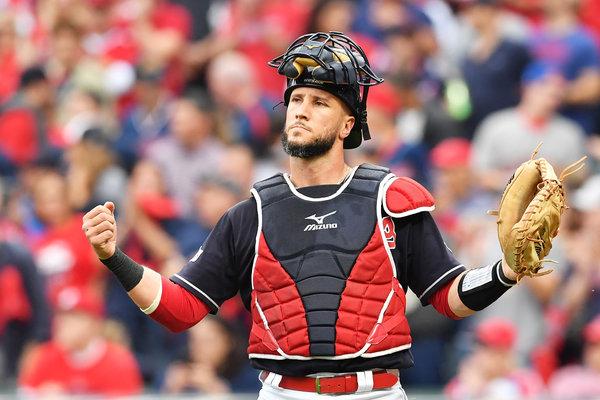
The Nats seemingly solved their catching issues for the next few years with the shrewd acquisition of Cleveland 2018 all-star catcher Yan Gomes.  And they didn’t have to break the bank to do it.

They part ways with Jefry Rodriguez, who was probably sat #6 on the current Nats roster of starting pitchers, soon to be pushed further downwards with whatever acquisitions may yet to come, and who had proven over the course of the last two seasons he couldn’t be trusted with the ball for a playoff team.  They also part ways with 2017 minor league POTY Daniel Johnson, cashing in on a guy who is still low minors but could flourish for a team like Cleveland.  There’s also a PTBNL thrown in, usually indicative of a lower level prospect that Cleveland gets to pick from later on after scouting the Nats low-A team or something.

Johnson becomes the 4th player flipped from the 2016 draft, which is more and more looking like the best Nats draft in a decade.  He joins Jesus LuzardoDane Dunning, and Sheldon Neuse heading out the door from that draft, and all three of these previously traded players have more or less flourished with their new organizations.   Luzardo is now considered one of the best left-handed prospects in the game, Dunning regularly is called an “under the radar” type pitching prospect who the White Sox seem to be depending on as a solid mid-rotation piece in the future, and Neuse played all of 2018 in AAA as a 23-yr old after a 3-level rise in 2017.

(Yes, I’d like to have all of them back, especially Luzardo, who the team spent so much to acquire, nursed back to health and really could help with the current rotation crunch).

Nonetheless, for me this acquisition kicks off a series of new consequences for the 2019 team:

  • No more pursuit of additional catchers, which should be a sigh of relief for Victor Robles fans, who had repeatedly been dangled to the Marlins for J.T. Realmuto.  No longer.
  • I like this Gomes acquistion, and I like the semi-platoon they now have setup with Kurt Suzuki.  If one goes down with injury, the other can cover while they bring back up Kieboom for protection.  This is such a better situation than we had the past two seasons, where had a crummy hitting, poor defending catcher in Matt Wieters with the likes of Kieboom or Severino as the guy getting regular day-after-night game starts.
  • Pedro Severino‘s days are numbered; no options, no roster spot for 2019.  He’ll hang around all spring to guard against injury, but faces a looming DFA next April 1st.  Will he get picked up by another team?  Perhaps.  He was just so bad at the plate in 2018 that its hard to project any team giving him even a backup role, no matter how good his defense is.
  • If Severino stays in the system though, he’ll likely push downwards in a cascading manner our current catching “depth,” since he’ll join Spencer Kieboom in AAA,   That pushes Taylor Gushue back to AA, likely with Raudy Read who seems lost in the shuffle here.  That then leaves Jakson Reetz and Tres Barrera basically repeating High-A for the time being.  I don’t think any of these guys are really pushing for promotion necessarily based on offensive performance: Gushue hit .212 in AA in 2018, Read hit much better in AA but showed almost no power in a half-season in AAA, Reetz has never hit even .240 in any stop since the rookie league, and Barrera hit good but not amazing in Potomac.  Probably the best case would be to just part ways with Severino, and have this be your C depth in 2019:
    • AAA: Read and Kieboom splitting time evenly
    • AA: Gushue and Barrera, who probably needs a promotion
    • High-A: Reetz and perhaps one of the low-A 2018 catches like Alejandro Flores or Alex Dunlop

Suffice it to say … we have very little reliable catching depth in our minors right now.  Thankfully Gomes has options through 2021 for reasonable money.

  • We already knew we had no SP depth, and now we just traded our primary backup hurler.  Not that i’m enamored of Jefry Rodriguez and think he’s our savior … but I do slightly question the choice of player to ship out.  I understand “trading from strength” and I also understand that you have to give up something to get something … but this team has traded away SO MUCH starting pitching over the past few years that I wonder if they need to, you know, save some of it?  As has been noted elsewhere, the last time the Nats developed and kept a for-real MLB starter was Stephen Strasburg, which, lets be honest, even the most incompetent organization could have done.  Here’s a list of the starters we’ve traded away in the last 2 years: Jefry Rodriguez, McKenzie Mills, Tyler Watson, Jesus Luzardo, Taylor Hearn, Pedro Avila, Lucas Giolito, Reynaldo Lopez, Dane Dunning.  That’s a ton of starters.  And now we’re looking at acquiring even more via trade or FA.  At some point we have to stop spending money on FA starters and grow them from within.
  • This was actually a fantastic Salary Cap move: Gomes counts just $3.8M towards the 2019 luxury tax cap.  With all the tenders and salary estimates, I still have the team $43M under the cap, so that’s plenty of room to buy the upgrades they need.

In the end…. one major position of need down (C), two more to go (SP and 2B).


2018 Non-Tender Decisions

33 comments

Roark is the big decision the team faces. Photo Alex Brandon/AP via wp.com

Roark is the big decision the team faces. Photo Alex Brandon/AP via wp.com

Its that time of the year as noted.  Lets get right to it.

Nats have 7 arbitration-eligible players.   Four of them are no-brainers to tender and negotiate with in Arbitration.  2019 salary guesses are MLBtraderumor estimates that are now pretty well accepted as the best analysis estimates out there.  I feel like the Nats are a bit generous and usually end up paying slightly more than their estimates, but these will work for now.

Arbitration Eligible Player2018 salary/contract2019 estimate
Rendon, Anthony1 yr/$12.3M (18)$17.6M
Turner, Trea1 yr/$0.5772M (18)$5.3M
Ross, Joe1 yr/$0.5679M (18)1.5M
Barraclough, Kyle1yr/$1.9M (18)$1.9M

Joe Ross at $1.5M could be an absolute steal and could be a factor in consideration for Tanner Roark‘s decision later on.  If Ross returns to his 2016 form for this salary we’ll be in great shape for next year’s playoff race.  Rendon and Turner are obvious players to continue with, and/or to consider some longer term contract negotiations with.  Lastly, the team just traded for Barraclough, he’s relatively affordable, and will be a key arm in the 2019 bullpen, so he’s not going anywhere.

Lets talk about the more iffy candidates:

Arbitration Eligible Player2018 salary/contract2019 estimate
Roark, Tanner1 yr/$6.475M (18)$9.8M
Taylor, Michael1 yr/$2.525M (18)$3.2M
Solis, Sammy1 yr/$0.5603M (18)$900k

First, i’ll just say this: I feel like the team is going to tender Michael A Taylor  He’s got too much value  as a defender, his projected salary in the $3.2M range is going to be better than projections for similar outfielders on the market … but he’s 27 not 33, plays Gold Glove-calibre defense and has shown some flashes of capability at the plate.  I think he makes perfect sense as a 4th outfielder.

I also don’t think i’m going out on a limb saying that its likey that Sammy Solis has thrown his last pitch for the team.  He was patently awful in 2018, couldn’t get lefties out at all, and even though his projected salary is a pittance ($900k), his big limiting factor is his lack of options.  He burned his last minor league option in 2018, so if he can’t make the team he’s gonna get DFA’d anyway.  Might as well get it out of the way now and clear the roster spot.

So, lets get to the main discussion item.  What to do with Tanner Roark?  He’s projecting to a $9.8M salary in his last year of Arbitration.  That’s a hefty sum.  He was fantastic as a starter for this team in 2014 and 2016.  He struggled when the team jerked around his role in 2015.  And the last two seasons he’s essentially been a just-slightly-worse-than-average MLB starter.  Sounds like a classic 4th starter type.  So is a 4th starter worth $9.8M?

He’s not getting any younger; he’ll be playing in his age 32 season next year.  He’s trending the wrong way; you can easily make the argument that the odds of him being more 2018 next year than 2016 are high.

So the real question is this: can you replace him in the trade market or in Free Agency and find someone comparable?   There havn’t been many signings thus far to use as a barometer for this off-season, but one stuck out in my mind; CC Sabathia.  Sabathia is older, fatter, and better.  And he signed for $8M.  All the projections for 4th/5th starter types seem to be falling in the $6M AAV range.

Unfortunately for the team; they’ve basically shredded the top of their starting pitcher prospect ranks in trades lately so they have no real options for internal replacement here.  If you non-tender Roark, then w/o additional acquisitions your 2019 Rotation is:

  • Scherzer, Strasburg, Joe Ross, Erick Fedde, and Jefry Rodriguez with Austin Voth and Kyle McGowin in AAA.

That’s two aces and 5 question marks.  TJ surgery recovery rates are now in the 80% I believe … but Ross won’t be throwing more than 160 innings or so in 2019.  Does anyone here Fedde is ready to be anything other than a spot-starter?  Same with the others.  The Nats are already looking at buying at least 2 starters on the open market (to replace Gio Gonzalez and to compete for 5th starter in a Jeremy Hellickson– type signing).  If you cut Roark loose … you have to buy another starter.  (or trade for one of course … but at this point does anyone have the stomach to part with any more top prospects?)

So if you non-tender Roark, you lose a guy who has never gotten hurt, answers the bell, eats innings and can be pretty dominant.  Isn’t that what you want in a solid 4th starter?   What are you going to get on the FA market for that price that’s better?

If it were me, i’d tender him.

Prediction: only Solis is non-tendered.

Actual tender results for 2018:  all arb-eligible players tendered.  Solis (the one we thought was in most jeopardy) negotiated a contract ahead of time.  1 yr, $850k so just slightly below MLBtraderumor’s estimate.  If he flails in spring training the Nats can cut him in mid March for just 1/6th of $850k or just $141k guaranteed.  Not a bad deal.


Here’s a great history of the Nats non-tender deadline decisions over the years, research I first did for last year’s post and which I’ll keep carrying forward.

  • 2018: no-one non-tendered (Roark, Taylor, Solis all candidates in one form or another).  Solis negotiated a contract pre-deadline leading to his tender.
  • 2017: No non-tender candidates; all arb-eligible players tendered contracts at the deadline.
  • 2016: we non-tendered Ben Revere, waived Aaron Barrett before having to make the NT decision, and declined Yusmeiro Petit‘s option as a way of “non-tendering” him.
  • 2015: we non-tendered Craig Stammen, but kept NT candidates Jose Lobaton and Tyler Moore (eventually trading Moore after waiving him at the end of spring training).
  • 2014: we did not non-tender anyone, though a couple weeks later traded NT candidate Ross Detwiler to Texas for two guys who never really panned out for us (Chris Bostick and Abel de los Santos).
  • 2013: we did not non-tender anyone, only Ross Ohlendorf was a candidate, and in retrospect he probably should have been NT’d since he didn’t throw a pitch for the Nationals in 2014.
  • 2012: we non-tendered three guys (Jesus FloresTom Gorzelanny, John Lannan) in the face of a huge amount of arbitration players (10).
  • 2011: we non-tendered Doug Slaten deservedly, but tendered candidate Gorzellany.
  • 2010: we non-tendered Chien-Ming WangWil Nieves, Joel Peralta.  We also outrighted 5 guys prior to the NT deadline, DFA’d two more in December, and DFA/dreleased four more guys prior to Spring training in a very busy off-season.
  • 2009: we non-tendered Scott Olsen, Mike MacDougal
  • 2008: we non-tendered Tim Redding, now the Pitching coach for our Auburn Short-A team, so I guess there was no hard feelings there 🙂
  • 2007: we non-tendered Nook LoganMike O’Conner.
  • 2006: we non-tendered or declined options for Ryan Drese, Brian Lawrence, Zach Day (it might have only been Day who was officially non-tendered)
  • 2005: we non-tendered Carlos BaergaPreston WilsonJunior Spivey.