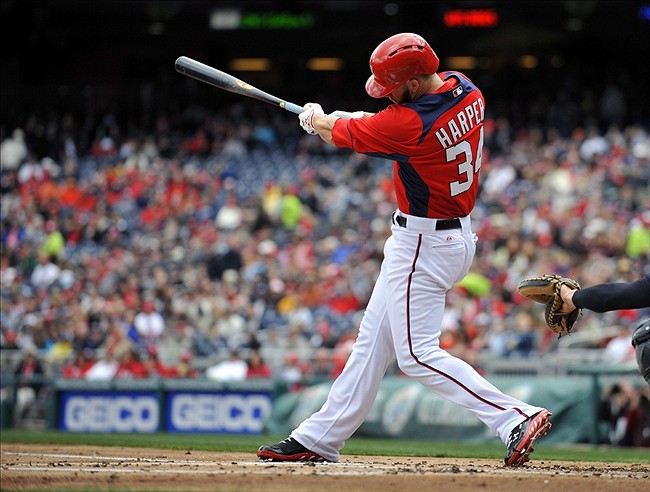
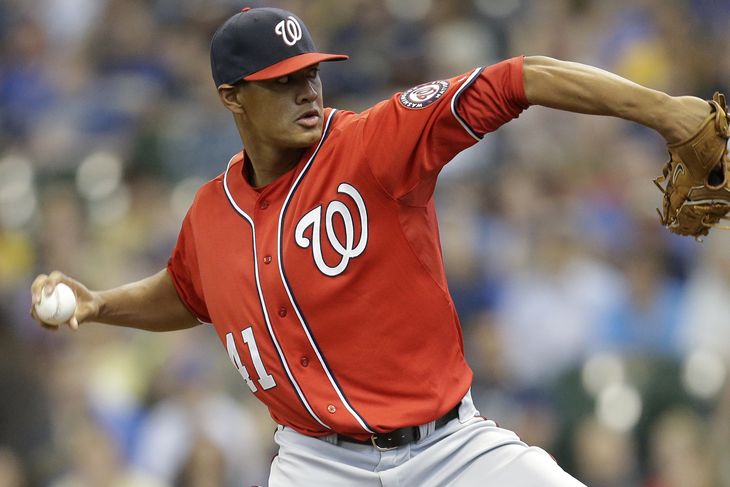
Nationals Arm Race

"… the reason you win or lose is darn near always the same – pitching.” — Earl Weaver

Archive for the ‘Nats in General’ Category

Remember this Weekend

10 comments

Scherzer can't pitch a no-hitter every time; at some point this team needs to start hitting.  Photo via thesportsquotient.com

Scherzer can’t pitch a no-hitter every time; at some point this team needs to start hitting. Photo via thesportsquotient.com

If the playoffs started today, here’s what the match-ups would look like (and frankly the odds of this setup changing seem slim; maybe SF catches Chicago for the 2nd WC but otherwise this seems like it will be the line-up):

  • Chicago Cubs at Pittsburgh for the wild card
  • St. Louis hosting the WC winner
  • Washington traveling to Los Angeles.

And in said short series, with the Nats traveling to Los Angeles, they’d likely face Clayton Kershaw and Zack Greinke again in games 1 and 2.

Here’s what the LA 1-2 punch just did to our hapless lineup, on the road no less where Kershaw has a significantly worse stats:

There’s not a pundit in the game who doesn’t think the Nats aren’t going to win the NL East.  That they’re in first place while their #1, #2, #4 and #5 hitters sit on the D/L is pretty amazing (or, perhaps more to the point, a pretty bad indictment of our division in 2015).  But the toll is being seen; between outings against Kershaw, Greinke and (just before the all-star break) Johnny Cueto, we now see the effect of such a weak offense.  MLB-wide Aces will absolutely dominate the Nats.  To the point where we could have Cy  Young himself throwing and not have a chance.  If there’s just one or two legitimate hitters in your lineup, you can pitch around them and attack guys who otherwise would be in AAA or on the bench.  As we just saw.

The question is this: can the Nats offense turn this around?  We have now seen this team make the playoffs twice, each time with the best record in the league, and then each time flail out of the playoffs while barely hitting.  In 2012 they hit .232/.290/.393 and in 2014 they hit .164/.222/.258.

Yes we plan on getting everybody back.  Most of our D/L guys are on rehab assignments as we speak actually.  Can they get their expected form back and make this team respectable on offense?  Can Jayson Werth regain his stroke despite recovering from a broken wrist?  Can Denard Span regain his batting stroke despite a chronic back issue?  I’m less worried about Zimmerman and Rendon; they just need time and luck to stay on the field despite leg/foot issues, and both those guys profile as the kind of middle-of-the-order hitter that would give the Nats lineup some potency back (not to mention some protection for Bryce Harper).

Will it be enough?  Are you worried about looming playoff match-ups?


State of the Nats at the halfway point 2015

41 comments

Per KW’s comment suggestion, here’s a “State of the Nats” at the halfway point of 2015.

Salient key phrase: “Holding On.”  Lets look at some component parts.

Offense

Here’s the full-strength outfield lineup the Nats would optimally like to deploy: Span, Rendon, Harper, Zimmerman, Werth, Desmond, Ramos, Escobar.

Here’s what they lined-up against Red’s ace Johnny Cueto a few days ago: Taylor, Espinosa, Harper, Ramos, Robinson, Uggla, Desmond, den Dekker.  Yeah, its no wonder they wimpered into the night as Cueto threw a 2-hit shutout.  If you’re Cueto, you pitch around Harper (who got a hit and a walk), you attack the rest of the lineup (strike-out prone lead-off hitter Taylor took a hat-trick), and you laugh as you blow through the rest of the lineup (11Ks on the night).

That’s five regulars out, but not just any regulars; the D/L includes your expected #1, #2 #4, and #5 hitters.  Instead they are replaced by a rookie (Taylor), a career minor-leaguer (Robinson), a cast-off veteran failure (Uggla), a career .230 hitter who the team has spent the last 3 years trying to replace (Espinosa) and a 4th/5th outfielder with just a couple hundred MLB at-bats prior to this year (den Dekker).

Frankly, its a miracle the team is in first place.  Only by the grace of Harper’s incredible season does this team manage to stay in games.  For the record, at the halfway point Harper leads the league in bWAR (6.1), OBP, Slugging, OPS and OPS+.  After having a 3-1 K/BB ratio last year, this year he basically has as many walks as strike-outs, one of the primary reasons his average is 60 points higher and his OBP is 130 points higher than it was last year.  Hold your breath that Harper doesn’t crash out and miss a month with some injury like he’s done in the previous seasons.  If he ends the season with this level of an adjusted OPS+, it’ll be one of the 10-12 best offensive seasons in the history of baseball.

Ironically, even given all these injuries the Nats aren’t even close to what some other teams are dealing with; per mangameslost.com, we’re not even close to what the Mets, Rangers, Rays or Oakland has had to deal with.  Though I’d venture to say that perhaps the games lost by Nats players are slightly more “important” than the cumulative games lost by some of these other teams.  I don’t care who you are; if you remove four of the top five batters from any team’s lineup, they’d be lucky to be out of the cellar.

The team has gotten absolutely nothing from presumed bench players McLouth and Johnson (Do you think Rizzo will *ever* buy a 4th outfielder for 8-figures again in his life?).  Guys who should be in AAA are getting starts and (at least in the case of Robinson) holding their own.  We talked before the season about where Taylor should be (on the MLB bench or in AAA getting starts) … well he’s getting playing time, for better or worse.  Instead of worrying about whether Moore was going to get DFA’d to make room, we’re *adding* guys to the 40-man like Burriss to help out.

Rotation

We know about Scherzer.  He’s been amazing, should start the NL All-Star game (of course, he’s scheduled to throw the series ender in Baltimore so we’ll see) and he leads all NL pitchers in bWAR.

What about the rest of the rotation?  Both Fister and Strasburg have missed a  handful of starts, and the Nats have tried a whole AAA-rotation worth of replacements to varying results.  With apologies to “short sample size judgements” I’ll say that Ross was good, Hill has been ok, Cole has been bad, and Jordan has been worse.  Of course, both Cole and Jordan’s delta between ERA and FIP is massive, so their poor ERAs are unlucky to a certain extent.  In the meantime, Ross has a 23/2 K/BB ratio and a FIP of 1.11 in his three starts.  Its safe to say that this person is excited to see what he can do next, and for me he’s at the head of the line for 2016 rotation candidates.

Clearly we know Strasburg has had an off season.  But so has Fister.  And Gonzalez‘ ERA is in the 4’s.   Just how bad is this rotation?  Not as bad as you think; they’re ranked 8th in the league in starter ERA but are 1st in FIP and fWAR.   Last  year they were 1st in all of these categories.  So perhaps we can expect some “progression” in the 2nd half as (hopefully) guys like Strasburg clean up their act and pitch closer to their FIPs than their ERAs.

Bullpen

We knew Rizzo had weakened the bullpen from 2015, which could have been fine had the injury bug not hit.  But the turnover of this bullpen has caught up to the team in some ways.

  • End of 2014: Soriano, Storen, Clippard, Stammen, Thornton, Blevins, and Detwiler.
  • As we stand now: Storen, Janssen, Treinen, Carpenter, Thornton, Rivero, and Roark.

That’s a lot of turnover.  Yes Storen has been typically excellent (as long as its not the post-season, he seems to be one of the most reliable closers in the game).  As we speak, the bullpen is 11th in ERA; last year they were 4th as a bullpen.  Janssen’s injury did not help, as it pushed guys into the 8th inning role they weren’t ready for.  And we saw Treinen and Barrett struggle (3.69 and 5.06 ERA’s respectively).  Granted their FIP shows that those ERAs are unlucky … but those are still runs on the board, blown leads, blown saves.  Roark (predictably) has regressed as he’s pitched in practically every role a pitching staff has (long-man, mop-up, spot-starter, rotation guy, middle reliever, setup guy and even a closer).  Luckily the gambler Rizzo has gotten pretty good performance out of scrap heap guys like Thornton and Carpenter, both of whom have given the team good innings.

Will this last?  It better: there’s practically nothing left in the farm system for reinforcements.  Barrett is set to return soon (probably pushing Carpenter to AAA), but the other options in the minors do not inspire confidence.  Martin got shelled (unfortunately; we were all cheering him on after his call-up and his fantastic start).  Grace and Solis were both mediocre in their auditions, and I can’t quite figure out why Erik Davis is even still on the roster.  Maybe the team will try some more waiver claims or trades (Neftali Felix just got DFA’d…) to shore up middle relief.

Streaks

Lets talk about streaks.  As of the time of this posting, the Nats season can neatly be fit into these four periods, and then talk about what spurred the beginning/ending of each streak.

  • The Slow Start: 7-13 from opening day through 4/27/15.  The team came out of the game 7-13, thanks to a sputtering offense and a make-shift lineup still trying to gel.
  • The Comeback: 21-6 from 4/28/15 to 5/27/15: Uggla hits his sole homer on the season to spur a pretty incredible 13-12 comeback win in Atlanta, and the team goes on a 21-6 tear following it.
  • Rotational Worries: 6-13 from 5/28/15 to 6/19/15.  Strasburg lasts just 5 batters on his 5/28/15 start, putting 40% of the rotation on the D/L and throwing the rhythm of the pitching staff off.
  • The Kid dazzles: 12-5 from 6/20/15 to 7/9/15; A long road trip/tough schedule stretch ends with a dominant Ross performance at home 6/20/15, kicking off an easy stretch in the schedule and a mostly full-strength pitching rotation.

Definitely a streaky team so far.  At 7-13, they were 8 games back.  At the end of their 21-6 streak, they were 1.5 games up in the division.  Despite their 6-13 stretch the only lost 3 games in the standings as the Mets faltered equally, and as of 7/9/15 they’re still 3 games up despite getting dominated at home by the Reds.

The team is beating who they should be beating (9-3 against Atlanta, 8-5 against Philly).  And they’ve had some success against other teams that are “good” this year (3-1 against the Yankees, 3-0 against Pittsburgh, and a sweep of San Francisco).  But they’re inexplicably bad against Cincinnati (0-5?), Miami (2-4), and were expectedly weak against the rest of the AL East (a combined 3-7 against Boston, Tampa Bay and Toronto).  I’m guessing they’ll struggle against Baltimore this coming weekend since they sputtered against Cincinnati.

Lets just say that the All-Star break is coming at a pretty good time for this team.

Where do we go from here?

The Nats should be healthier coming out of the all-star break.  And they’ll need it; their July schedule is tough.  They host the Dodgers and the Mets to start, then travel to Pittsburgh, Miami and New York.  That’s a slew of games against good teams and their primary divisional rivals.

In August they host some bad teams (Arizona, Milwaukee, Colorado) but they also do their big West Coast trip (at Los Angeles, San Francisco and Colorado).  They also get a 3-game set at St. Louis that could be an eye-opener for where they really stand ahead of the playoffs.  September features practically all divisional games against teams that should all be completely out of it by then, so I forsee a team in cruising mode.

Playoff Outlook

The Nats remain in 1st place despite all their issues, and their closest rival is putting out a lineup that most AAA teams could beat.  Philly is already 30 games under .500.  Miami is 15 games under .500 and just lost their best player.  Atlanta sits around .500 but isn’t really trying for 2015 and won’t spend to compete.  So I think its safe to say the Nats are winning the division.  I’ll guess the Mets hang around since their pitching is so good, but in the end the Nats win the division by at least 10 games.

If the season ended today, Pittsburgh hosts the Cubs in the WC, St. Louis hosts the WC winner and Washington would be traveling to Los Angeles to open the playoffs.  And frankly its hard to see this changing much between now and October 1st.  I don’t think its a stretch to say that the Nats would be underdogs to both the Dodgers and the Cardinals in a playoff series, not unless Strasburg remembers how to pitch again or the offense gets healthy in time.  Are we looking at another first round playoff exit?


Nats All-Star review: 2015 and years past

10 comments

Harper becomes just the 3rd starter in Nats history.  Photo via fansided.com

Harper becomes just the 3rd starter in Nats history. Photo via fansided.com

Here’s my annual Nationals All Star selection post.

(* == All-Star game starter.  The Nats now have three ASG starters in their history, dating to 2005).

2015

  • Nationals All-Star representatives: Bryce Harper*, Max Scherzer
  • Possible Snubs: Yunel Escobar, Drew Storen
  • Narrative: Harper not only made it in as a starter for the 2nd time, he led the NL in votes, setting a MLB record for total votes received.  This is no surprise; Harper’s easily in the MVP lead for the NL thanks to his amazing first half (his split at the half-way point of the season: .347/.474/.722 with 25 homers and an astounding 225 OPS+).  I guess he won’t be earning the “Most overrated player” award next year.  That Harper is electing to skip the Home run derby in a disappointment; his father is nursing an arm injury can cannot throw to him in the event.  In a weird year for the Nats, the only other regular worth mentioning is newly acquired Escobar, who is hitting above .300 and filling in ably at multiple positions that, prior to this year, he had never played.  Storen is having another excellent regular season … but at a time when mandatory members from each team often leads to other closers being selected (there are 5 NL closers and 7 AL relievers), the odds of him making the All-Star team were always going to be slim.  Scherzer deservedly makes the team and probably would have been the NL starter; he’s got sub 2.00 ERA and FIP and leads all NL pitchers in WAR at the mid-way point of the season.  But his turn came up in the final game of the first half, making him ineligible for the game and forcing his replacement on the roster.

As a side note, the 2015 All-Star game will go down as the “Ballot-Gate” game thanks to MLB’s short-sighted plan to allow 30+ online ballots per email address.  This led to severe “ballot stuffing” by the Kansas City Royals fans, led to MLB  having to eliminate 60 million+ fraudulent ballots, but still led to several Royals being elected starters over more deserving candidates.


Here’s past year’s information, mostly recycled information from past posts on the topic but fun to read nonetheless, especially the early years.

2014

  • Nationals All-Star representative: Jordan Zimmermann (Update post-publishing: Zimmermann strained a bicep, and had to withdraw from the ASG.  For a bit it looked like the Nats wouldn’t even have a representative, until Tyler Clippard was named on 7/13/14).
  • Possible Snubs: Adam LaRoche, Anthony Rendon, Rafael Soriano, Drew Storen
  • Narrative: Zimmermann’s been the best SP on the best pitching staff in the majors this year, and thus earns his spot.  I find it somewhat odd that a first place team (or near to it) gets just one representative on the team (as discussed above).  Rendon tried to make the team via the “last man in” voting, but historically Nationals have not fared well in this competition (especially when better known players from large markets are in the competition, aka Anthony Rizzo from the Chicago Cubs), and indeed Rendon finished 4th in the last-man voting.  LaRoche is having a very good season, almost single handedly carrying the Nats offense while major parts were out injured, but he’s never going to beat out the slew of great NL first basemen (Joey Votto couldn’t even get into this game).  Soriano has quietly put together one of the best seasons of any closer in the game; at the time of this writing he has a 1.03 ERA and a .829 whip; those are Dennis Eckersley numbers.  But, the farce that is the all-star game selection criteria (having to select one player from each team) means that teams need a representative, and deserving guys like Soriano get squeezed.  Then, Soriano indignantly said he wouldn’t even go if named as a replacement … likely leading to Clippard’s replacement selection.  The same goes for non-closer Storen, who sports a sub 2.00 ERA on the year.  Advanced stats columnists (Keith Law) also think that Stephen Strasburg is a snub but I’m not entirely sure: he may lead the NL in K’s right now and have far better advanced numbers than “traditional,” but its hard to make an argument that a guy with a 7-6 record and a 3.50+ ERA is all-star worthy.

2013

  • Nationals All-Star representatives: Bryce Harper*, Jordan Zimmermann
  • Snubs: Stephen Strasburg, Ian Desmond
  • Narrative: Harper comes in 3rd in the NL outfielder voting, ahead of some big-time names, to become only the second Nationals position player elected as an All-Star starter.  He was 4th in the final pre-selection vote, so a big last minute push got him the starter spot.   Harper also becomes the first National to participate in the Home Run Derby.   Zimmermann was 12-3 heading into the game and was on mid-season Cy Young short lists in July in a breakout season.  Strasburg’s advanced stats are all better than Zimmermann’s, but his W/L record (4-6 as the ASG) means he’s not an all-star.  It also probably doesn’t help that he missed a few weeks.  Desmond loses out to Troy Tulowitzki, Everth Cabrera and Jean Segura.  Tulowitzki was having a very solid year and was a deserving elected starter, while Cabrera and Segura are both having breakout seasons.  Desmond was on the “Final vote” roster, but my vote (and most others’ I’m guessing) would be for Yasiel Puig there ([Editor Update: Desmond and Puig lost out to Freddie Freeman: I still wished that Puig finds a way onto the roster but ultimately he did not and I believe the ASG was diminished because of it).   Gio GonzalezRyan Zimmerman, and Rafael Soriano are all having solid but unspectacular years and miss out behind those having great seasons.

2012

  • Nationals All-Star representatives: Stephen StrasburgGio GonzalezIan Desmond, Bryce Harper
  • Possible Snubs: Adam LaRocheCraig Stammen
  • Narrative: The two SPs Strasburg and Gonzalez were the obvious candidates, and my personal prediction was that they’d be the only two candidates selected.  Gonzalez’ first half was a prelude to his 21-win, 3rd place Cy Young season.  The inclusion of Desmond is a surprise, but also a testament to how far he’s come as a player in 2012.  Harper was a last-minute injury replacement, but had earned his spot by virtue of his fast start as one of the youngest players in the league.  Of the “snubs,” LaRoche has had a fantastic come back season in 2012 but fared little shot against better, more well-known NL first basemen.  Stammen was our best bullpen arm, but like LaRoche fared little chance of getting selected during a year when the Nats had two deserving pitchers selected.

2011

  • Nationals All-Star representatives: Tyler Clippard
  • Possible Snubs: Danny EspinosaMichael MorseDrew StorenJordan Zimmermann
  • Narrative: While Clippard was (arguably) the Nats best and most important reliever, I think Zimmermann was a more rightful choice.  He was 10th in the league in ERA at the time of the selections and has put in a series of dominant performances.  Meanwhile Espinosa was on pace for a 28-homer season and almost a certain Rookie-of-the-Year award (though a precipitous fall-off in the 2nd half cost him any realistic shot at the ROY), and perhaps both players are just too young to be known around the league.  Lastly Morse is certainly known and he merited a spot in the “last man in” vote sponsored by MLB (though he fared little chance against popular players in this last-man-in voting).

2010

  • Nationals All-Star representatives: Matt Capps
  • Possible Snubs: Adam DunnJosh WillinghamRyan Zimmerman, Steven Strasburg
  • Narrative: Capps was clearly deserving, having a breakout season as a closer after his off-season non-tender from the Pirates.  The 3-4-5 hitters Zimmerman-Dunn-Willingham all had dominant offensive seasons as the team improved markedly from its 103-loss season.  But perhaps the surprise non-inclusion was Strasburg, who despite only having a few starts as of the all-star break was already the talk of baseball.  I think MLB missed a great PR opportunity to name him to the team to give him the exposure that the rest of the national media expected.  But in the end, Capps was a deserving candidate and I can’t argue that our hitters did anything special enough to merit inclusion.

2009

  • Nationals All-Star representatives: Ryan Zimmerman
  • Possible Snubs: Adam Dunn
  • Narrative: The addition of Dunn and Willingham to the lineup gave Zimmerman the protection he never had, and he produced with his career-best season.  His first and deserved all-star appearance en-route to a 33 homer season.  Dunn continued his monster homer totals with little all-star recognition.

2008

  • Nationals All-Star representatives: Cristian Guzman
  • Possible Snubs: Jon Rauch
  • Narrative: The first of two “hitting rock-bottom” seasons for the team; no one really merited selection.  Zimmerman was coming off of hamate-bone surgery in November 2007 and the team was more or less awful across the board.  Rauch performed ably after Cordero went down with season-ending (and basically career-ending) shoulder surgery.   Guzman’s selection a great example of why one-per-team rules don’t make any sense.  Guzman ended up playing far longer than he deserved in the game itself by virtue of the 15-inning affair.

2007

  • Nationals All-Star representatives: Dmitri Young
  • Possible Snubs: Ryan Zimmerman, Shawn Hill (though I wouldn’t argue for either)
  • Narrative: Young gets a deserved all-star appearance en route to comeback player of the year.  Zimmerman played a full season but didn’t dominate.  Our 2007 staff gave starts to 13 different players, most of whom were out of the league within the next year or two.  Not a good team.

2006

  • Nationals All-Star representatives: Alfonso Soriano*
  • Possible Snubs: Nick JohnsonRyan Zimmerman, Chad Cordero
  • Narrative: Soriano made the team as an elected starter, the first time the Nats have had such an honor.  Our pitching staff took massive steps backwards and no starter came even close to meriting a spot.  Cordero was good but not lights out as he had been in 2005.  Soriano’s 40-40 season is a poster child for “contract year” production and he has failed to come close to such production since.  The team was poor and getting worse.  Johnson had a career year but got overshadowed by bigger, better first basemen in the league (a recurring theme for our first basemen over the years).

2005

  • Nationals All-Star representatives: Livan HernandezChad Cordero
  • Possible Snubs: Nick JohnsonJohn Patterson.
  • Narrative: The Nats went into the All Star break surprisingly in first place, having run to a 50-31 record by the halfway point.  Should a first place team have gotten more than just two representatives?  Perhaps.  But the team was filled with non-stars and played far over its head to go 50-31 (as evidenced by the reverse 31-50 record the rest of the way).

Is Ross making the Nats re-think their future rotation strategy?

13 comments


Joe Ross has been a revalation at the MLB level.  Photo Getty Images via federalbaseball.com

Joe Ross has been a revelation at the MLB level. Photo Getty Images via federalbaseball.com

Joe Ross, who it is fair to say was in some respects the “other guy” in the Tampa/San Diego 3-way trade that netted the Nats presumed future shortstop Trea Turner but cost them Steven Souza and prospect Travis Ott, got a somewhat surprising call-up after the starters covering for Doug Fister didn’t quite give the Nats the performance they were looking for.

Three starts later, two of which were easily defined as “dominant,” is it too soon to think that perhaps Ross is a bigger part of the Nats future than the trio of starter prospects we have stashed in Syracuse?

He looked *really good* last night against a team on an 8-game winning streak.  He was making professional hitters look very, very ordinary with his slider.  His slider was so good, he threw it nearly 50% of the time last night and got an astounding 38% whiff rate.  Average fastball of 93.1, max of 96.8 on the night.  Wow.

Small Sample Sizes, of course.  And maybe you could ignore the 11-K performance against the god-awful Brewers.  But Pittsburgh is was hottest team in the league and was mowed down like little leaguers.

At the beginning of this season, if you asked me what the Nats’ rotation was going to look like in the next three transitionary years, I might have said something like this:

  • 2015: Scherzer, Strasburg, Zimmermann, Gonzalez, Fister with Roark as #1 replacement option
  • 2016: Scherzer, Strasburg, Gonzalez, Roark and a battle between Treinen, Cole, Jordan and Hill (in that order) for 5th and 6th spots.
  • 2017: Scherzer, Giolito, Gonzalez, Roark, and a question mark.  Maybe Treinen/Cole, maybe a veteran acquired via FA or trade.  Maybe Lopez if he moves up at the same pace as Giolito.  Who knows.

Now?  I think you have to think Ross has jumped to the top of the list in that 2016 rotational battle, maybe even solidifying his spot.   Does a rotation of Scherzer, Strasburg, Ross, Gonzalez and Roark sound good?  Keep Treinen in the bullpen.  Flip spare depth (Cole, Jordan, Hill) for whatever you can get for them, and make room for the next wave of guys (Giolito, Voth, Lopez, Pivetta).

Wishful thinking?  Perhaps.  We love dreaming on pitching prospects here, but give me  your thoughts.


First Look: Nats top 10 draftees from 2015 Rule-4 Draft

34 comments

LSU's Andrew Stevenson becomes the Nats highest 2015 draft pick.  Photo via nola.com

LSU’s Andrew Stevenson becomes the Nats highest 2015 draft pick. Photo via nola.com

As we did for the 2013 draft, and again in 2014, here’s a quick introduction to the Nats top 10 picks for 2015.

Here’s a slew of Draft Prospect rankings that I’ll refer to later on.

As he did last year, NatsGM.com‘s Ryan Sullivan live-blogged the draft and does a great job of pulling up stats and observations on each pick.

Draft Links of importance

  • MLB.com Official 2015 Draft Central home page.
  • MLB’s Awesome Draft Tracker; you can slice and dice the draft 10 different ways, search by schools and home states, etc.
  • Official MLB 2015 Draft Order (Nats first pick is #58 well into the 2nd round, next #69, then #103, then #134 in the 4th round, and then 134+30 picks there-after.
  • Official Draft Bonus Pool totals.  Astros have $17M (most).  Nats have 3rd least at $4.1M.
  • MLB Draft Database
  • Fangraphs Sortable Draft Board; a great new tool Fangraphs has that lets you slice and dice their top draft board.
  • Baseball-Reference Draft Tools: links to their draft database plus some custom reports.
  • Baseball America’s Draft Database for 2015; this will get updated with bonus amounts when the players sign.


Lets get to it!

1st round/#26 overall: in what would have been the Nationals first round pick had they not signed Max Scherzer and forfeited their pick, the Los Angeles Angels went way off-board and picked Taylor Ward, a Catcher from Fresno State.  He’s not even in Keith Law’s top 100 and is mostly in the 75-100 range of other ranking services, and players like Mike Nikorak, John Harris, Kyle Funkhouser, Daz Cameron and Mike Matuella (a Nationals special; a big righty with power and a Tommy John surgery) still on the board.  Unlike two years ago when I complained bitterly about the loss of the 1st rounder, here Scherzer is more than proving his worth and I’m not as worried about the loss of this pick in a weak draft.  But I wouldn’t have minded seeing how Harris or Funkhouser worked out.

2nd round/#57 overall: Andrew Stevenson, Jr. OF (CF) from LSU (hometown Youngsville, LA).  Rankings: Law outside #100, MLB #79, BA #168, Sickels #101, Draft Rpt #115.  A slightly built slap hitter who plays excellent CF for LSU but, from my limited observations, looks like he’s destined to be a spare outfielder at best.   More than one of the above draft guides mentioned Ben Revere as a comparison.  (This was the comp pick for last year’s non-signing of Andrew Suarez … who went 4 picks later).  FWIW, Law said he “fell out of his chair” when he saw the Nats taking him here.  I can only surmise what the team sees here; perhaps they got a deal on him and will apply some of the savings down the road.

2nd round/#69 overall: Blake Perkins, Prep OF (CF) from Verrado AZ HS (hometown: Phoenix, AZ).  Rankings: Law #96, MLB #162, BA #137, Sickels #148, Draft Rpt #283.  Perkins profiles similarly to Stevenson: slight build, very fast, great fielder, decent arm and a questionable hit tool.  He’s committed to Arizona State and hails from the Phoenix suburbs.  For what its worth, in Keith Law’s post-round 2 write-up, he specifically called out this pick as being a very good one.  But, he’s still *way* overdrafted according to most of the rankings.

3rd Round/#103 overall: Rhett Wiseman, Jr. OF (corner) from Vanderbilt (Hometown Mansfield, MA).  Rankings: Law outside #100, MLB #120, BA #88, Sickels #92, Draft Rpt #146.  Developed big-time power his junior year at Vanderbilt.  Probably projects as a LF but is no bigger than the CF draftees the Nats already have picked.

4th round/#134 overall: Mariano Rivera, JR, Jr. RHP (starter) from Iona (Hometown Harrison NY by way of the D.R.)  Rankings: Law #93, MLB #170, BA #142, Sickels #215, Draft Rp #198.  Well, you can’t argue with the pedigree.  He’s stepped it up this year as a junior with a huge velocity spike and *will* sign, but he barely weighs more than my labrador and one wonders if he can withstand the rigors if pitching in the pros.  Very little mileage on the arm (he didn’t pitch until he got to college reportedly).  Interesting pick.

5th round/#164 overall: Taylor Hearn, Jr. LHP  starter from Oklahoma Baptist (Hometown Royse City, TX).  Rankings: … well, nobody ranked this kid.  Not even on the top 500 prospect list.  He was 9-0 for the NAIA team with good K/9 rates.  Not much else to be said.  The Nats have drafted twice before players from this school (Richie Mirowski and Matthew Page) with decent success and clearly have a scout working that area with success.  Is this a signability/money saving pick?  But for whom?  Perkins?

6th round/#194 overall: Matt Crownover, Jr. LHP starter from Clemson (Hometown: Ringgold, Ga.).  Rankings: BA #344, Draft Rpt #161.  Great numbers at Clemson: 10-3 with a 1.82 ERA.  Tommy John survivor, undersized.  Perhaps projects as a future reliever.

7th round/ #224 overall: Grant Borne, Jr. LHP starter from Nichols State (Hometown: Baton Rouge, LA).  BA #348, otherwise unranked.  Another mystery player.  6-5 with a 1.48 ERA as a starter for Nichols State.

8th round/#254 overall: Koda Glover, Sr. RHP Oklahoma State (Hometown: Heavener, OK).  Sickels #297, otherwise unranked.  Glover was a back-end reliever for Oklahoma State, having transferred in after two years at Juco.  MLB says he’s a senior, OK State says he’s a junior.  Either way, he’s a reliever who could be quicker to the majors, which isn’t too bad a pick for the 8th round.

9th round/#284 overall: David Kerian, Sr. switch hitting 1B from Illinois (Hometown: Dakota Dunes, SD).  He hit .366 with 14 homers on the year for one of the best teams in the country.  Not a bad pick.

10th round/#314 overall: Taylor Guilbeau, Sr lefty starter from Alabama (Hometown Slaughter, LA): nice sign here, getting a Friday starter in the SEC.  3-6 with a 3.69 ERA on his senior season, which ended in the SEC playoffs for Alabama this year.


Breakdown by position:

  • Three outfielders, two definite CFs and one corner OF.
  • One 1B who could feature as a corner OF
  • Five college starters: four LHP and one RHP
  • One college reliever (RHP)

His first three picks were outfielders … then 6 of the next 7 were arms.  Mostly left-handed college starters.  How many of these starters will profile as pro relievers?  Probabaly a few of them; Rivera for sure, likely Crownover, probably Guilbeau as well.

Breakdown by Player Demographic

  • One Prep/HS player
  • Six College Juniors, all four-year college picks
  • Three College Seniors, all from four-year colleges

Well, Rizzo likes college grads, and this shows it.  ONE prep player out of his first 10 picks.

Breakdown by Region

  • Southeastern US: 1 from LSU, 1 from Vanderbilt, 1 from Clemson, 1 from Nichols State, 1 from Alabama
  • Midwest: 1 from Oklahoma Baptist, 1 from Oklahoma State, 1 from Illinois
  • Southwest: 1 from Arizona
  • Northeast: 1 from Iona College

Its amazing to me, year after year we seem to see this.  The Nats draft so heavily from the southeast and midwest.  Meanwhile, everyone knows that the two best states for prospects are California and Florida.  If you look at the home towns of these top 10 picks, still nobody from the two major baseball states and just one guy who hails from Texas.  I guess Rizzo really trusts his area scouts down there.

Summary

Well, like in 2013 when you don’t have a 1st round pick … you’re not likely to end up with a name that you’ve heard in the pre-draft coverage.  And I hadn’t heard of practically any of these guys prior to seeing their names read.  Picks 8-10 seem like typical low-value senior signs, but you have to wonder where the draft bonus dollars are going here.  Is everyone signing for slot?  Are there any risky picks here?

Ryan Zimmerman; Mr. Walkoff hits his 10th

14 comments


Zimmerman gets soaked on his 10th career walkoff.  Photo via mlb.com

Zimmerman gets soaked on his 10th career walkoff. Photo via mlb.com

When we last checked in on Ryan Zimmerman, aka Mr. Walkoff, it was July 2013 and he had just hit his 9th career such homer.

Well, last night he hit another.  His 10th career walk-off, an excuse-me shot down the RF line that bounced off the flag-pole and won a fun back-and-forth game against the visiting Yankees 8-6.  Here’s his career homer log via baseball-reference.

Last night’s shot wasn’t in his pantheon of great walk-offs: i’ll put these as his best:

  • The game-winner in the Nats Stadium opener in April 2008, salvaging a blown save in the top of the 9th.
  • A 2-run walk-off against Chien-Ming Wang on Fathers Day 2006 against the Yankees, a game in which the team set its long-running regular season attendance record.

But walk-offs are always awesome to watch, whether you’re at home or elsewhere.

Thanks to this SI.com article by Jay Jaffe, which did the baseball-reference.com play-index work for us, we know that Zimmerman is now tied for 10th all time in walkoffs.  The current active leaders in walk-offs are two noteworthy names; David Ortiz connected for his 11th and most recent walk-off homer on 6/6/13, as detailed by Billy-Ball.com.  Albert Pujols either has 10 or 11, depending on if you believe his homer log (which has him at 10) or B-R’s play finder, which says 11.  Since B-R itself says the Play Index data is more up-to-date, I’ll go with 11.

Jim Thome hit his 13th in June of 2012 to take over the career lead just before he retired and is the all-time leader.  Just behind Thome, tied for 2nd all-time, is this quintet of Hall-of-Famers: Jimmy Foxx, Mickey Mantle, Babe Ruth, Stan Musial and Frank Robinson.

That’s quite heady company; every name I’ve mentioned here is either a Hall-of-Famer or should be.

Being that Ortiz is nearly done, and Pujols is on the decline, and Zimmerman is just 30 and may have another decade in him, it seems like a safe bet that Zimmerman will eventually be the all-time walk-off leader.   Heck, he already had seven through is first 5 pro seasons.  We’ll keep track every time he hits one for sure.

Other links on the topic from the blogosphere:

Quick recap of all 10:

1. Home vs Yankees, off of Chien-Ming Wang (Fathers day 2006)
2. Home vs Marlins, off of Joe Borowski
3. Home vs Marlins, off of Jorge Julio (Mother’s day 2007)
4. Home vs Braves, off of Peter Moylan (opening day 2008)
5. Home vs Marlins, off of Leo Nunez
6. Home vs Padres, off of Luke Gregerson
7. Home vs Phillies, off of Brad Lidge (7/31/10)
8. Home vs Phillies, off of Ryan Madsen (8/19/11)
9. Home vs Mets, off of LaTroy Hawkins
10. Home vs Yankees, off of Andrew Miller (his first runs allowed of the year).

Written by Todd Boss

May 20th, 2015 at 9:45 am

Odd Difo promotion

25 comments

Welcome the majors Mr. Difo!  photo via offtherecordsports.com

Welcome the majors Mr. Difo! photo via offtherecordsports.com

So, Jayson Werth‘s wrist injury is going to keep him out longer than expected, so he hit the 15 day D/L and to cover his spot the Nats called up one of their two remaining outfielders on the 40-man roster, right?  You know, maybe Matt den Dekker, who was acquired in the late spring specifically to provide OF depth and who has MLB experience?

Nope.

They called up infielder prospect Wilmer Difo, he of exactly 33 games of experience above Low-A ball.  Difo, who last time I checked is NOT an outfielder.

Dave Cameron at Fangraphs also questioned this move, pointing out all the things i’d point out.  What exactly is Difo going to do on this team?  Are they planning on dumping Dan Uggla so that Difo becomes the backup utility infielder who can actually play shortstop?  I mean, I get that the team was already pretty over-loaded on outfielders (3 starters plus Moore, Robinson AND Taylor), so perhaps this move is to (finally?) rectify that imbalance.

Maybe the team just realized its 27th in the league in SBs and wanted some speed.

On another note, is it just me or is this team kind of running out of players?  Here’s how the 40-man roster breaks down right now:

  • 25 active
  • 6 on the 15 day D/L (Janssen, McLouth, Rendon, Rivero, Fister and Werth)
  • Another 2 on the 15-day D/L who should be on the 60-day, them having long-term injuries (Stammen and Johnson)

That leaves just seven 40-man players in the minors who could actually help the team.

  • Starters Hill and Jordan:
  • Relivers Martin and Davis, who was just optioned off the D/L for the first time in a year thanks to TJ recovery
  • Backup catcher Butler
  • Outfileders den Dekker and Brian Goodwin.

That’s it.  Has anyone heard one word about Nate McLouth?  That was $10M well spent.  At least Janssen is rehabbing and seems close.  Me, i’d be a bit worried about reliever depth.  Or not; it doesn’t seem to be exactly hurting them, as Bryce Harper powers the team into 1st place.


Still think he’s “overrated?”

8 comments

Yup; very overrated.  Sarcasm.  Photo: Sports Illustrated

Yup; very overrated. Sarcasm. Photo: Sports Illustrated

Prior to the season, MLB’s players were polled and our own Bryce Harper was voted “most overrated.”  Over Yasiel Puig, for the second year in a row, that both players were listed 1-2.

You know what I think?  I think that vote should actually be called, “Players you’re most jealous of because they’re incredibly good and accomplished at a young age.”  It isn’t Harper’s fault that he was asked to be on the cover of SI at the age of 16.  And it isn’t Puig’s fault that he’s burst onto the scene and has posted a career OPS+ of 150 (!! even I didn’t know it was that high) so far at the age of 24.

After yesterday’s 3-homer show and especially after his performance last post-season, under the hottest lights and against the best of the best, does anyone still think Harper’s over-rated?   How many guys are there in the league with that kind of power who also have his defensive capabilities?  Not too many.  I’m not sure what Harper has to do to “earn” the respect of his peers .. maybe its just as simple as putting together a full season w/o injury to see what kind of numbers you can put up in 150 games or so.


Written by Todd Boss

May 7th, 2015 at 9:30 am

Posted in Nats in General

Tagged with ,

All is not lost

12 comments

Nice performance from Fister on sunday.  Photo via wp.com

Nice performance from Fister on sunday. Photo via wp.com

So, after destroying the ball in Atlanta (30 runs in 3 games) and getting what feels like an early “turn around the ship” 13-12 epic come from behind win, the team goes to New York and takes 3 of 4 from the Mets (who were theretofore undefeated at home and had the best record in the game).  Even if you don’t think the Mets are really that good, it was still a statement series to go to a divisional rival ahead of you in the standings and take 3 of 4.

They couldn’t beat Matt Harvey (who can these days?), not even with Max Scherzer going, but beat Jacob DeGrom and got the kind of shut-down performances from their #4 and #5 starters (Gonzalez and Fister) that practically no other team in the league can depend on.  It isn’t a good sign having to depend on untested rookies and fortunate bounces to get one-off runs that lead to 1-0 victories, but then again, its a great sign that you have a team that *can* win these kinds of games.

Now Miami comes to town; they’ve been hot (8-2 in their last 10), but the pitching matchups favor the Nats.  I’ll take Zimmermann, Strasburg, Scherzer (the best 1-2-3 in the majors) over what Miami’s bringing to the table this week (Phelps, Latos and Koehler).  Anything less than a sweep of Miami will be a disappointment.  The Nats have clear, inarguable pitching matchup advantages, and Latos/Koehler sport ugly ERAs that should help the Nats offense get healthy again quick.

Are we backed away from the ledge yet?   There’s still areas of improvement of course.  Per Fangraphs today, the team ranks:

  • 23rd in team WRC+ at 86 (my favorite all-equaling offensive stat measure)
  • 23rd in team Batting Average at .235, which sounds awful but there’s seven teams worse right now.
  • 7th in Starter ERA … but 2nd in Starter FIP and 1st in Starter WAR (Scherzer leads the league in fWAR despite being just 1-3)
  • 12th in Bullpen ERA and 11th in bullpen FIP

So, the bullpen we’ve fretted about is holding on but could use improvement, the Starters are holding up their end of the bargain, and the offense needs to improve.  About where we expected the team to be?


Greatest (and worst) ever Nats games & Events; updated for 2014 events and April 2015 Atlanta game

26 comments

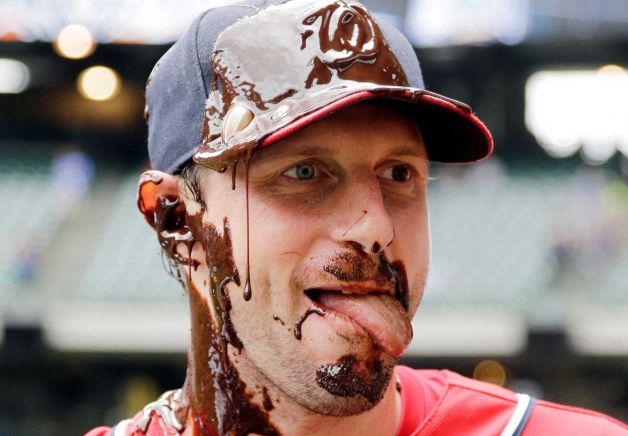
I think i would have preferred shaving cream. Photo TV screenshot via natsenquirer.com

I think i would have preferred shaving cream. Photo TV screenshot via natsenquirer.com

Editor note: thanks for all the suggestions; this post has evolved and edited as I’ve gotten them in comments.

So, given the unbelievable comeback win this week against Atlanta, I dug up an old topic for us to argue about.  The “Greatest” and “Worst” ever games in Nats history.  I had an old draft of this from the off-season, and this week’s Atlanta game coupled with the franchise’s first ever no-hitter being thrown in the last game of the 2014 regular season, as well as some new truly gut-wrenching playoff losses, I thought it was a nice time to re-post this list.

(side argument; was last night’s game a “great” game given the comeback or an “awful” game, given the arguments we all just made in the last post?)

This list started with a throw-away post I did a couple years ago titled “the greatest Nats games I’ve witnessed,” but the comments section turned into a great list of the larger “greatest ever” suggestions.  I’m counting on our crew to remind me of games that should make the best and worst lists.

Here’s my updated Greatest Nats Game List.  Subjectively ordered from best on downwards.  Feel free to argue.  🙂

  1. October 11th, 2012: NLDS Game 4: Jayson Werth walk-off homer in an epic battle against Lance Lynn, hitting the 13th pitch of the at-bat (!!) on a line-drive into the seats.  Ironic that what I think is the most special game in Nats franchise history occurred the day before what I consider to be the worst game in franchise history.  (note; thanks to my former coworker Eric Hay for correcting me on my pitch count memory here in the comments).
  2. April 14th, 2005: First home game as a franchise: April 14 2005 (even though half the crowd was stuck outside waiting to go through metal detectors for the first two innings thanks to George W. Bush‘s publicized appearance to throw out the first pitch).
  3. March 30th, 2008: Nats Park Opener 2008. I was in Las Vegas for a bachelor party that weekend and took a 4am flight out of Vegas to get back to Washington in time to catch the game.  It was cold, it looked like the bullpen had blown it … and then Ryan Zimmerman hit the latest in a long string of walk-off homers to win it in the bottom of the 9th.  Fantastic.
  4. September 29th, 2014: Jordan Zimmermann‘s season-closing no-hitter 2014, with the amazing game-ending catch by Steven Souza.
  5. June 18th, 2006: Fathers Day versus the Yankees 2006.  An attendance record that stood for this franchise until the 2012 playoffs, a walk-off win over the powerful visiting Yankees and a bright spot during an otherwise dismal season.
  6. June 8th, 2010: Stephen Strasburg‘s 14-k debut: still the franchise record for strikeouts in a game and just about the most electric debut this team has ever seen.  A college-aged kid made the Pittsburgh Pirates look like a little league team.  The Nats manipulated Strasburg’s service time to avoid the “super-2” status; it was worth the wait.
  7. October 7th, 2012: NLDS Game 1: 2-run rally in the 8th on Tyler Moore‘s flair to beat the Cardinals in St. Louis in the first ever playoff game for the team.  In theory it should have completely set up the Nats to cruise through the series.  Didn’t quite happen that way (see worst games ever)
  8. October 6th, 2014: Beating Madison Bumgarner in the 2014 NLDS; our only 2014 post-season win and the only time Bumgarner lost that post-season.
  9. September 4th, 2006: Ramon Ortiznear no-hitter in 2006, a game where he took a no-hitter into the 9th, hit his first (and only) career home run, but wasn’t able to even get a complete game after Albert Pujols crushed a ball 450 feet to dead-center at RFK the batter after he lost the no-no.  Still a fun night.
  10. April 28th, 2012: Bryce Harper‘s debut in LA , featuring his tomahawk double straight over Kemp’s head for his first hit and watching him run around the bases like the excited teen-ager he actually was.  Should Harper have been up with the team from the get-go?

Not sure how we beat my #1 game until we see some dramatic walk-off post-season series winner.

Honorable Mentions:

  • June 21st, 2015: Max Scherzer loses a perfect game with two outs and two strikes in the 9th, grazing the elbow of Jose Tabata.  He retires the next hitter for just the 2nd no-hitter in Nats history.  Scherzer’s previous start was a 1-hit shutout with 16 Ks, and these two games represented one of the best 2-game stretches for any starter in the history of the game.
  • July 8th, 2010: Adam Dunn 3-homer day in 2010.  There have been two three other Nats to hit three homers in a day: Alfonso Soriano did it in 2006 and Ryan Zimmerman did it against Baltimore in a losing effort in 2013, and Bryce Harper just accomplished it on 5/6/15, hitting homers in his first three at-bats against Miami (in his last at-bat, he had an RBI ground-out).
  • Only two Nats have ever hit for the cycle: Brad Wilkerson did it in the 2nd ever game the team played (4/6/2005) and Cristian Guzman did it on 8/2/08.
  • June 22nd, 2011: Wilson Ramos walk-off homer to complete a 5-1 comeback in the 9th against Seattle.
  • September 22nd, 2012: Gio Gonzalez gets his 20th win, a first for the franchise, and breaks the 200K barrier for the first time by a Washington pitcher since someone named Walter Johnson played here in in 1916.
  • September 23rd, 2007: the last game at RFK, with the largest crowd of that awful season in attendance.
  • Last game of 2012, beating the Phillies and clinching best record in baseball.
  • September 6th, 2010: Danny Espinosa‘s 2-homer MLB home debut.  Espinosa had debuted a few days earlier on the road, but in front of the home crowd and his family, he had a monster day, going 4-5 with 2 homers and 6 RBI.  Was this the apex of his career?
  • April 28th, 2015: 8-run comeback against Atlanta, winning 13-12 on Dan Uggla‘s 9th inning 3-run homer.  I’ll put this in the “good” category considering the unbelievable win-expectancy odds the team beat to win this game.
  • June 14th, 2005: The Frank RobinsonMike Scioscia toe-to-toe argument game, which was followed with an “eff-you” homer from Jose Guillen to propel the Nats to a home win.
  • September 17th, 2014: Nats clinch NL East in Atlanta; a great moment of course … but it wasn’t even here.  But clinching so early and in Atlanta, which had owned the Nats head-to-head even when the Nats were good, was satisfying.
  • October 1st, 2012: NL East clincher; even though the team lost … the crowd started buzzing in the 9th inning as those monitoring the Atlanta game on their phones learned that they were losing, thus clinching the division for the Nats and resulting in their first playoff appearance.  The stadium finally posted the result, annointing the Nats as division champs and they started high-fiving … even though it was the bottom of the 9th and they were losing.  The team had clinched a wild-card berth earlier in the week, but this was the event that the team openly celebrated.  Should a game we lost be on this list?
  • April 20th, 2009: Jordan Zimmermann’s debut vs Atlanta. A 3-2 win after a two-hour rain delay. Jordan goes 6 strong innings to provide the first glimpse of the Nats’ turnaround from what would be consecutive 100-loss seasons, though because of the rain and how bad the team was there were only about 5,000 of us in the stands that night.
  • June 12th, 2005: Nats defeat Seattle 3-2 for their 10th consecutive home win win on the strength of a Junior Spivey(!) two-run homer. I never felt RFK rock like it did that day. Incidentally, Mike Morse played shortstop for Seattle that day.
  • August 4th, 2005: John Patterson’s 14K game against the Dodgers. Nats win 7-0 in what was the highest ever game score (92) for a Nats’ starter until JZ’s no-no in 2014.
  • August 21st, 2014: Nats defeat Arizona 1-0 on an Anthony Rendon walk off single in the bottom of the 9th–their fifth walk off win in six games. Except for Strasburg’s debut, I never felt the NEW stadium rock for a non-playoff game like it did at that moment.
  • August 7, 2012. Roger Bernadina makes ridiculous catch behind a pillar in Minute Maid park to preserve a 3-2 Nats win in 12 innings. What everyone thought was a walk-off, game winning double for the Astros turned into a backbreaking loss.
  • July 28, 2009. Josh Willingham hits two grand slams in same game.  Arguably better than Dunn’s 3-homer performance because of the team aspect to it.  This remains the greatest RBI performance in Nats history (8 RBI on the day, two more than the 2nd best 6-RBI day by Espinosa, mentioned above).

How about more generally a quick list of the non-game related Greatest Nats Non-Game related Events?

  • September 29th, 2004: The day the team officially was announced to be moving to Washington.
  • December 5th, 2010: The Jayson Werth signing.  To me, that was a signal that a) the owners (previously accused of being penny-pinchers) were finally listening to the council of Stan Kasten and Mike Rizzo and were investing in the team.  It was also a statement contract to the rest of the league; the Nats were willing to spend, and were ready to compete.  Within two seasons the team was in the playoffs after having two 100+ loss seasons.
  • May 2006: MLB picks the ownership group led by Ted Lerner to buy the team.  The group includes vastly experienced baseball man Stan Kasten and his vision is clearly seen with the new stadium’s design.
  • August 2010: Signing Strasburg
  • August 2011: Signing Harper
  • October 3rd, 2012: Teddy wins for the first time.  We had privately wondered when Teddy would finally win the president’s race; would it be on his bobble-head night?  Nope; turns out the night after clinching our first playoff appearance, Teddy won.


… And now the Worst Games in Nats History.  I don’t have any way to really quantify the “worst” games for a team that lost 100+ games two years in a row just recently.  So please feel free to add on your suggestions.  I don’t think any of them will beat the top three losses listed here though:

  1. NLDS 2015 Game 5 (Drew Storen 9th inning meltdown)
  2. NLDS 2014 Game 2 (Zimmermann yank, another Storen post-season blown save, and then subsequent 18-inning loss)
  3. NLDS 2014 Game 4 (7th inning Aaron Barrett/bullpen debacle)

Honorable Mentions for me (with plenty of input from Zuckerman’s lists, links at the bottom, readers):

  • April 5th, 2010: The “Phillies Invasion” game; Opening day.  What started as a fantastic opening day (it was sunny and 80 degrees in early April) turned into a nightmare for Nats fans: the team got beat 11-1 on the field … and the park was perhaps 75% filled with Philadelphia fans.  Turns out the team “courted” event planners in Philadelphia and sold them thousands of tickets, which they turned into day-trips to/from Philadelphia on drinking buses for Phillies fans who (at the time, since they were great) couldn’t easily get home tickets.  As you might imagine, the crowd was incredibly pro-Philadelphia, booed the home team, was mostly drunk and aggressive having been drinking since 9am on their party buses, and there were times that we (sitting in the upper-deck, having given up our season tickets after getting screwed in the seat relocation process), literally felt afraid for our safety.  It was an embarrassment to everyone involved and led to some very specific changes (I believe from then on you had to be calling from a DC-local phone number to book tickets to opening day).
  • September 8th, 2015: After blowing game 1 in a critical head-to-head series against the division leading Mets, the bullpen implodes and blows a 7-1 lead, losing 8-7 in a must-win game that left the team 6 games behind with 24 to play (in other words, effectively eliminating them from the divisional race).  Over-manager Matt Williams yanked Jordan Zimmermann after just 100 pitches and then watched his bullpen issue six walks with two outs in the 7th, turning a 7-1 deficit into a 7-7 tie game.  The team at one point had a 99.2 win probability and turned the game into a loss.  To add insult to injury, Williams ordered Anthony Rendon to bunt in the 9th, which he failed to execute successfully, leading to a GIDP to end the game.
  • July 15th, 2005: Mike Stanton, making his Nats debut, committed a walk-off balk.   Quite a rarity; its only happened a few times that baseball researchers can find in the last 30 years or so.
  • April 18th, 2010: Jason Marquis failed to record an out on April 18th, 2010 against Milwaukee.  The team was down 10-0 before they even came to bat.  That’s a gut punch for the fans who paid to get into the game … to basically know that you’re going to lose before you even get a beer.
  • July 2012, the Nats blew a 9-0 lead against Atlanta.  With Strasburg on the mound. And they blew that lead in just four innings.
  • September 6th, 2006: Nick Johnson breaks his leg on the field, colliding with Austin Kearns going after a pop-up.  Johnson missed the entirety of the 2007 season recovering from this injury, in his prime as a player.
  • April 19th, 2009: judgement day for Jim Bowden‘s cattle-call bullpen construction for the 2009 season; after blowing their third straight 9th inning lead, new GM Mike Rizzo cleaned house; releasing two relievers (Shell & Ledezma) and demoting a third (Rivera).  Within two days their opening-day closer (Hanrahan) was demoted as well, and the tone was set for an ugly 103-loss season.
  • August 21st, 2010: Strasburg motions for his pitching coach to come to the mound … because he’s blown his UCL.  Ironically, the team announced his surgery and year off on the same day (two days later) that their previous high-profile TJ surgery survivor Jordan Zimmermann makes his season debut after his own rehab from the surgery.  The fall-out from this also included Rob Dibble, who on-air basically challenged Strasburg’s manhood for coming out of the game.  Dibble never called another game for the team.
  • May 25th, 2006: Frank Robinson is forced to remove emergency catcher Matt LeCroy mid-inning after he had committed two throwing errors and allowed *seven* steals.  Robinson was so embarrassed for what he was forced to do to LeCroy that he broke down at the post-season press conference.
  • September 17th, 2005: The Nats blow a 5-run lead in the ninth inning to officially eliminate themselves from post-season contention.  It is hard to believe now, but the 2005 Nats were 51-30 at the halfway point and in first place … and then went exactly 31-50 the rest of the way there as the MLB-stewarded team failed to make any meaningful acquisitions at the trade deadline to improve the team (and why would the owners-by-occupation?  Why help a competing, owner-less ward of the league team beat them to the playoffs?).  I don’t recall this as being that significant a game or event, having long since seen the writing on the wall as the team clearly was floundering to the finish line.
  • September 2nd, 2008: Jesus Flores injury game; Chase Utley barreled into Flores’ left leg in what I always thought was a dirty play.  Flores missed the rest of that season.  This is exactly the kind of play that now is barred thanks to too many catchers having season-ending injuries.  In the grand scheme of things, this might not be that “bad” of a game but it really sticks with me.


Perhaps a separate category for “Worst Nats ‘Events’” would include the following (partly pulled from Zuckerman’s crowd-sourced 2010 lists, but updated post 2015 season with the ridiculous Baker/Black manager incident.  Also using Dan Steinberg‘s worst 10 Nats events post on 11/3/15)

  • Aug 2008: Failing to sign Aaron Crow at the signing deadline.  While in hindsight this was a fortunate miss for the Nats (Crow has been a good but not great reliever and is currently out for TJ surgery, while his comp pick turned into Drew Storen), at the time this was an embarrassing misstep for the organization and another black mark on its GM Bowden.
  • Feb 2009: the team is forced to admit that “Smiley” Gonzalez is not who he says he is, that he’s *four* years older, and that his $1.4M bonus was probably a sham.  Combined into this event’s fallout of course was the forced resignation of Bowden (which to many DC fans was one of the “greatest” events in Nats history), the termination of Jose Rijo and a complete dismantling of our operations in the Dominican Republic.  Our pipeline of DR talent would basically disappear for years, a situation that affects the team to this day.
  • June 27th, 2009: Jim Riggleman abruptly resigns as manager the day he finally guides the team above .500 after  years of ineptitude.  While nearly everyone in the baseball world blamed Riggleman, my take at the time was a bit more supportive of his reasoning.  But this was still a huge amount of unwanted press for this team.
  • May 22, 2010: Nyjer Morgan misses on an attempted catch, throws his glove down like a petulant little leaguer and gives up an inside-the-park homer.  Just one more embarassing moment for Morgan, who was also suspended for throwing a ball at a fan.
  • 2012 Shutdown-gate; how do you feel about this event?  Do you find yourself *still* defending the team’s actions?  Or, if you didn’t agree with them, still irritated that the team went into its first post-season series without its Ace?  I call this a “worst event” because, frankly, I just wish the team was never in this position.
  • Dec 2014: word comes out that Jayson Werth will spend 5 days in Jail for a reckless driving incident.
  • Sept 27th, 2015: Jonathan Papelbon chokes Bryce Harper in the dugout after Harper flies out in a 4-4 game in the 8th the day after the Nats were eliminated.  And then Papelbon is *allowed to go out for the 9th* inning where he promptly gives up 5 runs.  He’s suspended for the rest of the season the following day and the Nats become a national punching bag.
  • November 3rd, 2015: Word leaks that the team vastly low-balled Bud Black and had to re-neg on the managerial job offer, a week after it was offered and the team thought it had its man.  Hours later Dusty Baker was named manager.
  • December 8th, 2015: brand new manager Dusty Baker manages to defend Aroldis Chapman‘s domestic violence investigation *and* stereotype all non-white baseball players in an ill-fated Winter Meetings interview.  He was forced to clarify his comments soon after.  Not exactly the kind of attention the team wants or needs after its embarrassing managerial search.

FWIW, here’s some 2010 links from Mark Zuckerman on his “top 5” list for both best and worst days/games.   Nearly every game mentioned from our early days is also in this post with context.