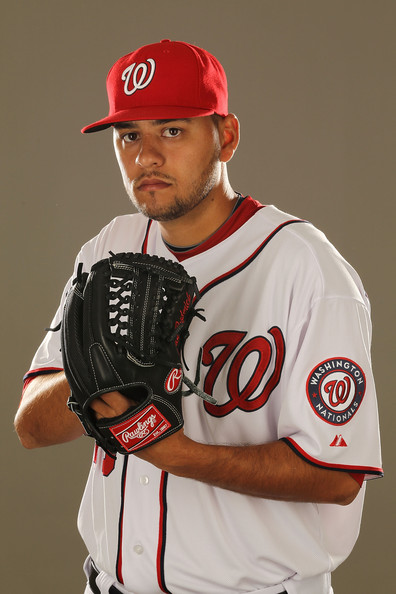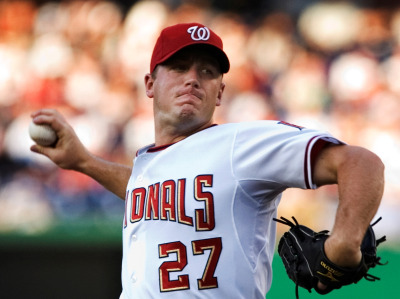
Jordan Zimmermann is starting to look like a very valuable starter.
Good
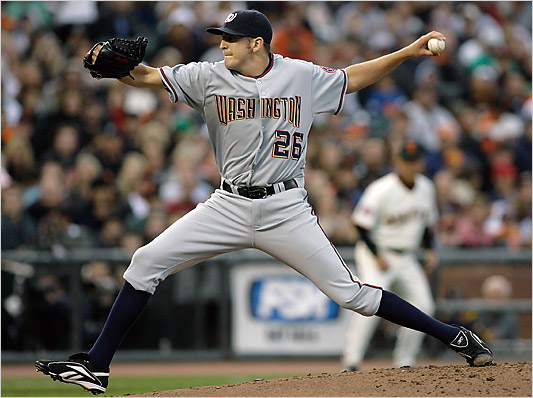
- Livan Hernandez kicks off the 3rd turn through the rotation with a great start against the NL favorite Phillies (running blog/gamer/box). Final line was 6 2/3, 7h, 1er, 6Ks and 0 BBs. His one run was on an opposite field smash by Ryan Howard on a pitch that wasn’t that bad (remember; Howard is a dead pull hitter so for him to put a ball out to left is an aberration, not a sign). Livan’s line would have looked even better had he not given up 3 straight singles in the 7th inning, leaving a bases loaded jam for Tyler Clippard to get out of. Livan was in control all night, following his typical pattern of hitting the corners and frustrating hitters with ridiculously slow curve balls. (Side note on this start; I had a real problem with the way Riggleman handled the bullpen this night; see this post for my thoughts).
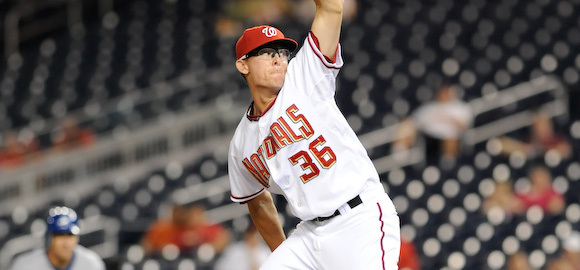
- Jordan Zimmerman was perfect through 5 innings on 4/14 (blog/gamer/box) before hanging a curveball for a homer in the 6th and loading the bases in the 8th. It wouldn’t matter; his counterpart Cliff Lee threw a 3-hit shutout. Final line: 7ip, 5hits, 0bbs, 4rs (only 1 earned) with 4ks. When he was removed in the 8th he had only thrown 85 pitches, showing the best efficiency of any starter yet this season. His one earned run line slightly flatters what happened to him in the 8th; the two guys who scored both got on base via hits. Either way, the most dominating pitching performance of 2010 from our starters.
- Doug Slaten pitched very effectively in his lefty-lefty matchups against Philadelphia, getting Ryan Howard and Raul Ibanez very effectively when presented with opportunities.
- Tom Gorzelanny‘s 4/15 start (blog/gamer/box) indicated to me that he’s still not quite in his mid-season groove. He cruised through 4 innings with just two weak hits (an infield bouncer and a liner to left that Michael Morse really should have caught). Then in the 5th he gave up a hard-hit double to weak hitting former Nat Wil Nieves and then Richie Weeks just pulverized a ball that Gorzelanny left over the plate for a 2-run double. Gorzelanny seems to really lose his typical rhythm when runners get on base; he slows down his normally fast tempo, pays too much attention to the runners, and suddenly loses his ability to command his pitches. Final line: 6ip, 5h, 2runs, 2bbs and 4ks. A quality start for sure, but I’d still put it as a slightly inconsistent outing.
- Jason Marquis went against Milwaukee’s ace Yovanni Gallardo on Sunday 4/17 (blog/gamer/box) and came away an 8-4 winner. Marquis pitched like a veteran for his team, knowing that they needed a long outing so as to save the bullpen for the 2nd game and the rest of the week. He scattered 9 hits and a walk through 7ip plus, got a couple of double plays from his defense and watched the offense get to one of the better pitchers in the league for a win. Final line: 7ip, 9hits, 2runs, 1bb and 4ks.
Bad
There really wasn’t anything “bad” to report out of any of our relievers on the week. Todd Coffey was placed on the DL with a calf strain, clearing the way for Collin Balester to join the team for 10 days or so.
Mediocre/Inconclusive
- John Lannan‘s 4/13 (blog/gamer/box) outing versus Philly ace Roy Halladay was always going to be a tough game to win. His line ended up looking better than his performance (6ip, 3r, 2er, 6hits and 3bbs). He struggled with his control all night, throwing 100 pitches but only 55 for strikes. He gave up a lead-off double but scattered 5 other singles throughout the evening. He worked around multiple mental mistakes and errors from shortstop Ian Desmond (including; an obstruction call, hesitation on a grounder in the first that turned a routine ground ball into a hit, dropping an easy grounder, and then failing to throw home on an infield-in situation, allowing one of the runs to score). Some would look at the end result and claim this is Lannan effectively working through a very strong lineup and working around defensive mistakes to keep his team in the game. And I wouldn’t be able to argue against it.
Thoughts on the offense
The Nats are being carried right now by the two rookies Danny Espinosa and Wilson Ramos. With Ryan Zimmerman on the DL we’re now missing our 3-4-5 hitters from last season, and it is showing. Zimmerman’s replacement Hairston is (as of 4/15) 1-22 at the plate. The Nats really pulverized a #5 pitcher (Joe Blanton0 but were completely shut down by better pitching. We seem to have no answer to replace struggling hitters like Morse, Desmond, and Ankiel. Ankiel in particular seems completely overmatched against lefties right now. 5 of our 9 starters are at or near the mendoza line.
Overall Summary
Well, Its a miracle we’re even near .500 as a team. Our starters have really been stepping up. MASN had a pretty startling stat comparing the team ERA of our staff through the first 13 games of this year (3.55 versus something north of 6.5). Unfortunately, we just have to wait for the lineup to come around, since we don’t have much of anything in the minors to help out.