Nationals Arm Race

"… the reason you win or lose is darn near always the same – pitching.” — Earl Weaver

Archive for the ‘Minor League Pitching’ Category

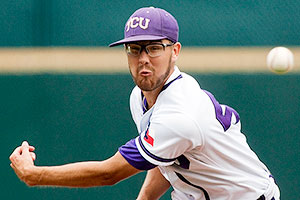
Matthew Purke is looking good..

12 comments

Purke is finally showing signs of life. Photo AP/Nati Harnik

Purke is finally showing signs of life. Photo AP/Nati Harnik

I’ll freely admit it: after two straight injury plagued seasons, I thought the Nats had made a mistake with the Matthew Purke pick.  I’ve even used the “B” word from time to time (“B” as in “Bust”).  Yes he was “only” a third round pick, and yes it isn’t my money that paid him.  But giving him a Major League Deal and a 40-man slot was a roster limiting move at the time and still remains so (Purke was the sole 40-man roster member in the South Atlantic League at the season’s start).

However, what Purke is doing so far in Hagerstown has been, well, impressive.  His latest start on 6/28 probably was his most dominant of the year, going 6 innings, giving up just 1 hit and zero walks while striking out 8.  On the year in Low-A he now has 6 starts, has thrown 29 innings and has 41 strikeouts to just 7 walks in that time.  Those numbers are good for a 2.48 ERA and a 1.10 whip.

Yes, he’s “old” for the level (at the season’s start he was about in the 75% percentile in terms of age for the level).  And yes he’s “experienced” for the level, being now a third year pro and having two college years under his belt when drafted.  But (as we all know) he’s been plagued with injuries and has now missed parts of four straight seasons with various ailments (his 2nd college season, his draft year, most of 2012).   In fact, June 28th was just his 9th professional start.

Nonetheless, its great to see him finally healthy and finally putting together the kind of dominant starts that one would expect from a guy who signed a $4M deal.  I look forward to him getting promoted up to High-A (perhaps after the all-star break) and continuing his trek back to the majors.  If the Nats could count on him to continue being a high-end prospect and a potential future starter for this team, that would go a long way towards roster stability in the coming years.

Written by Todd Boss

July 1st, 2013 at 8:08 am

Posted in Minor League Pitching

Tagged with

How do the Angels Prospect trades look now?

10 comments

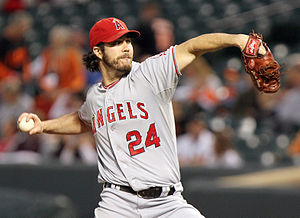
The Angels traded the farm to get Dan Haren a few years ago; would they make that same trade again?  Photo unknown via wikipedia

The Angels traded the farm to get Dan Haren a few years ago; would they make that same trade again? Photo unknown via wikipedia

When Jean Segura took off this season (especially well-known to fantasy baseball players, who were able to suddenly get a top-10 guy off the waiver wire), people asked, “Where’d he come from?”  Well, like many other rising stud prospects this season he was once the property of the Los Angeles Angels.  But the Angels have not valued their prospects much lately, and have traded away a slew of talented guys chasing after the playoffs in the last few years.
Here’s a quick look at the Angels’ prospect-involved trades as of late:
  • July 2010: Traded Patrick Corbin, Tyler Skaggs, Rafael Rodriguez and Joe Saunders -> Arizona for Dan Haren.
  • Nov 2011: Traded Tyler Chatwood -> Colorado for Chris Ianetta
  • July 2012: Traded Jean Segura and 2 minor leaguers -> Milwaukee for Zack Greinke rental
  • Nov 2012: Traded Jordan Walden -> Atlanta for Tommy Hanson
So, what do they have to show for these prospects-for-veteran trades?  After making the playoffs in 2009 but losing in the ALCS:
  • In 2010 with Haren, they finished in 3rd place, two games under .500 and 10 games back of the divisional winner Texas.
  • in 2011 with Haren in the rotation for a full season, they finished in 2nd place, again 10 games back of Texas.
  • in 2012 with both Haren, Ianetta and the Greinke rental they finished in 3rd again, 4 games out of the wild card.

And now in 2013 they’re scuffling despite hundreds of millions of dollars spent in the FA market on Albert Pujols and Josh Hamilton. The only things they have left to show for all the above trades are Ianetta’s .213 batting average and an injured Hanson.  But now they’re missing three potential front-line starter prospects, a closer-quality reliever and one of the more dynamic young infielders in the game.  Oh, and to fill in for those missing starters they’ve

When the San Francisco giants traded uber starter prospect Zach Wheeler for a 2 month rental of Carlos Beltran in 2011 in a failed attempt to get back to the playoffs, scouting pundits and Giants fans howled in derision.   Its harder to criticize the Giants moves in general (two World Series in the last three years) , but now with Tim Lincecum looking like the highest paid middle reliever in baseball history and with regular AAA pitcher tryouts to fill Ryan Vogelsong‘s 5th starter spot, you can only wonder what that team would look like with the newly promoted Wheeler slotting in behind their big guns Matt Cain and Madison Bumgarner.

Some GMs over-value prospects and hoard them, while some under-value them and have no problem flipping them for proven major league talent.  What I’m afraid of as a Nats fan, right now, is our GM panicking and trading away (ala the Angels over the past few years) even more of our long-term prospect depth chasing the short-term goal.  Especially if we trade away guys and then still don’t make the post-season.  I realize this is a hedge towards the rumors we’re hearing about how Mike Rizzo is “heavily working the phones,” but I don’t think we should break the bank and trade one of our best prospects for 3 months worth of a guy like Matt Garza.

Haren’s 6 week Demotion, er I mean D/L Trip

5 comments

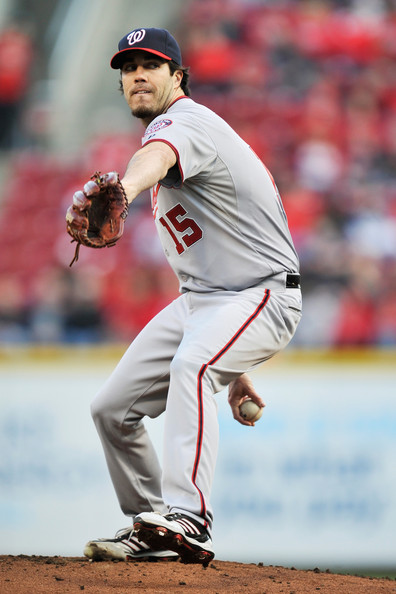
Haren's struggles earn a well-deserved D/L trip.  Photo via Zimbio.com

Haren’s struggles earn a well-deserved D/L trip. Photo via Zimbio.com

Little surprise that the Major’s worst starting pitcher Dan Haren was sent to the D/L.  As of 6/24/13, out of 99 qualified Starting Pitchers he currently ranks 99th in ERA, 95th in FIP, 72nd in xFIP (so there’s that) and (interestingly, since it purportedly is the best of the analytical evaluator advanced pitching stats) 48th in SIERA.  As has been noted elsewhere, he’s tied for the league lead in HRs conceded.  The team has lost his last nine starts, and his latest meltdown clearly has forced the team’s hand.  Haren may not be the reason this team is mired at .500 (offense, offense, offense), but he’s clearly not helping either.

So the Nats have found a “soft tissue” issue with Haren (this time?  a “Shoulder Strain”) and have sent him to the D/L.  This isn’t the first time the Nats have used a dubious soft-tissue injury to “stash” an inflexible contract (see Rodriguez, Henry and Wang, Chien-Ming repeated D/L trips over the past two years), and while I kind of laugh at the blatant manipulation of the rules, it benefits the team to be able to remove him from the active roster but not lose him to the open market, so we’ll let it slide.  (btw, how do I know that the team is playing shenanigans with the D/L trip?  Read CSN Chase Hughes‘ tweet about what Haren said when informed he was going on the D/L.   Haren didn’t even know what injury he was supposed to have!).

So what happens next?  Adam Kilgore‘s WP article on the topic seemed to indicate that the Nats and Davey Johnson are not considering either Ross Ohlendorf or Craig Stammen for spot starts.  Which I have a hard time believing frankly; both guys demonstrated their ability to pitch longer outings in the last two days in relief of failed starters.  Ohlendorf has been starting all year and is exactly the kind of 4-A/6th starter that the Nats envisioned him to be when they signed him in the off-season.  Why would the team do something rash like call up Taylor Jordan (as Kilgore suggested and as others are reporting) when we’ve already seen what a more polished and experienced AA-pitcher (Nathan Karns) can do when jumped far above his head too soon?  Yeah, I’m excited about Jordan and what he’s done this year; but I think Ohlendorf or Stammen are better options.  I’d start Ohlendorf on Saturday and see what happens.

Of course, perhaps the Nats talent evaluators are convinced that a guy (Jordan) with exactly 49 innings above A-ball is ready to replace a $13M veteran.   If so, I can’t wait to see him pitch live.  Even if it starts his service time clock too soon, he was a guaranteed 40-man addition ahead of the coming Rule-5 draft anyway based on his domination so far in 2013.  What’s a few extra months at this point?  He’s already past Super-2 status so the team has guaranteed all the control they could get over him.

As for Haren, here’s what we’re likely going to see:  he’ll pay lip service to his “injury,” get an MRI, see a couple of specialists, get a shot.  That’ll take a week or so.  By that time we’ll know whether or not whoever gets his Saturday 6/29/13 start is worth giving another start to.  If Ohlendorf or somebody pitches 6 shutout innings in Haren’s place … then Haren’s going on a long “rehab” assignment in Syracuse.  And frankly, even though he’s making $13M and was supposed to be our former ace acting as a 4th starter FA acquisition, he may struggle to get his starting gig back.

Is it time to pull the plug?  Well, baseball is a performance-based industry.  Haren has just not performed.  Is it truly because he’s pitching through injuries?  Somehow I don’t think so; he was ineffective last year, he’s yet to really have a truly dominant outing this year, and the question is out there as to whether Haren is officially washed up.  For as much as I looked forward to Haren’s time here when we signed him, I now feel like we can’t give him more starts unless he starts throwing shut-down outings in AAA.

PS: read this interesting nugget tooDanny Espinosa is playing short-stop in Syracuse.  You know what this tells me?  The same thing that Kilgore concludes: Espinosa is being showcased so that he can be shopped as a Shortstop on the trade market.  Read the link; I can’t disagree with any of his analysis.  Well, either that or the team is looking to move Ian Desmond and replace him w/ Espinosa.  Ha.

PPS: Also reading reports on NBCSports that Mike Rizzo is burning up the pre-trade market phone lines.  That’s a clear indication that this team is not ready to wave the middling .500 team flag.

Time to pull the plug on Haren yet?

17 comments

How much longer is Haren going to be wearing this hat? Photo nats official via espn.com

The Nats management waited and waited, but finally gave in and dealt with season-long performance issues in Henry Rodriguez, Zach Duke, Danny Espinosa and Tyler Moore in the first two weeks of June, DFA-ing or demoting as needed and bringing in replacements to try to do a better job and turn this season around.

So, when will it be time to talk about the train-wreck season that Dan Haren is having?  For $13M, here’s what the team has gotten in his first 12 starts, including June 12th’s meltdown:

  • a 4-8 Record with a 5.70 ERA and a 67 ERA+ (his ERA is 6th worst in baseball for qualified pitchers).
  • A 6-10 team record in games in which he’s started
  • a league leading 17 home runs allowed

A quick glance at his advanced stats doesn’t give much credence to any apologists that may try to excuse his line either; his BABIP is slightly elevated but not overly so (.320) and his FIP is still an unsightly 5.06 (5th worst among qualified starters).  Only his expected xFIP and SIERA numbers are relatively respectable, but xFip is just an estimator stat and often times never comes to pass, since it assumes silly things like the fact that Haren can’t possibly keep giving up this many home runs… an assumption that continued to be disproven as he gave up two more in his most recent loss in Colorado.

Game-Log analysis: Haren has yet to have a start where he shut out the opponent.  He’s only got 5 quality starts out of 12.  In half his starts he’s allowed 4 or more runs (not good when your team’s offense is only scoring 3.4 runs a game).  Haren’s only really had a couple of starts that were “grade A” in my book (his best start of the year was an 8 inning 4 hit performance in Atlanta of all places).  In his defense, he has gotten awful run support (2.84 runs per start), heavily indicating team losses every time he pitches.

I’ll admit it; I talked myself into the Haren deal big time after it was announced.  I ignored his 2012 struggles, looked back to the near Cy Young guy he was in 2009 and thought this was the move that could push the Nats to a 105 win team.  Now clearly whatever excuses we made for his performance in 2012 (back injury leading to diminished velocity leading to loss of his sinker leading to crummy numbers) seem like they’re covering up for an aging sinkerballer who never had lights out velocity and who now looks dangerously close to extinct as his very-hittable fastball flattens out and gets hit harder and harder.

So what’s the answer here?

Don’t talk to me about his salary; that $13M is out the door already.  Kaput.  Gone.  Look up the definition of a “Sunk Cost” in economic terms.  If you were worried about $13M in annual salary then you shouldn’t have bought a $15M a year closer who isn’t exactly a complete shutdown guy (Tyler Clippard has almost identical stats this year to Rafael Soriano for a third of the price and he didn’t cost us a 1st round draft pick, which as it turned out could have been spent on one of two pre-draft top-10 talents).  The decision needs to be made; do you still want to try to “win now” in 2013 as all the other off-season moves seemed to indicate?  Because the solution likely is going to be a bit more money and a few more prospects.

Short term (as in, the next week): see how Ross Ohlendorf does in his spot start (Answer: uh, he did awesome, holding a good hitting team to two hits through 6 in the best hitters park in the league).  If he’s anything remotely close to effective, I think you look at an invented D/L trip for Haren and send him on a rehab assignment tour of the minors.

Mid-term (as in, for the next couple weeks): do we have anyone else in the minors worth checking out?  Not on the 40-man and not with enough experience.  Maybe we give Danny Rosenbaum a shot if another spot-start is needed after Detwiler and Strasburg come back.

Longer term (as in, the next two months); Look at the trade market and look at who may be available leading up to the trade deadline.  We’re already seeing some teams completely out of it and clearly some guys will be available:

  • The Cubs probably will look to move Scott Feldman and especially Matt Garza.
  • The Astros probably will cash in on Lucas Harrell and Bud Norris (nobody’s likely interested in Erik Bedard at this point).
  • The Marlins would listen for offers for Ricky Nolasco, though perhaps not intra-division.
  • The Mets aren’t winning this year and could be moving Shawn Marcum (though perhaps not intra-division).
  • I think eventually Seattle becomes a seller: Joe Saunders and Aaron Harang should be dangled.
  • I also think San Diego eventually realizes they’re not going to win the NL West: Edinson Volquez, waiver pickup Eric StultsClayton Richards and our old friend Jason Marquis all make for possible trade candidates.

A few other poorly performing teams are probably going to be too stubborn to wave the white flag, which cuts down on the number of guys that will be available (see the Los Angeles Angels, the Los Angeles Dodgers, Toronto specifically).

The only problem with a trade market move is this: all these teams are going to want prospects back.  And the Nats prospect cupboard has been cleaned out recently to acquire all these fools who are underperforming so far in 2013.  I’m not an opposing GM, so I can’t say for sure, but from a quick look at the Nats best prospects in the minors right now (basically in order: Giolito, Goodwin, Cole, Karns, Garcia, Skole, Purke, Solis, Perez, then guys like Hood, Taylor, Walters, Ray and Jordan round out the list) and I see a lot of injured guys or players on injury rehab, backups or guys barely above or still in A-ball.  I’m not trading a valued asset for an injury-risk guy who has never gotten above AA.  Who on this list is going to fetch us a quality major league starter?

Maybe we trade Haren along with a huge chunk of his remaining salary and multiple prospects to one of these teams in order to get one of these 5th starters back.  But that’d be an awful trade when it was all said and done (about as awful as, say, the Giants trading Zack Wheeler to the Mets for 2 months of Carlos Beltran in a failed effort to make the playoffs in 2012; with all the Giants 2013 pitching issues do you think they wish they had Wheeler back right now??)

Or, it very well may be that the Nats are stuck; we knew going into the season we had no starter depth and those MLFAs we did acquire (Ohlendorf and Chris Young basically) probably aren’t the answer.  But something has to give; we can’t give away every 5th start like we seem to be doing now and claw back into the NL East race.

Minor League Pitching Age Appropriateness for 2013

3 comments

Yunesky Maya is “Really Old” for AAA; but does it matter? Photo unknown

A recurring statement that you often hear when talking about prospects in the minors is “Age Appropriateness” for the level in which the player is playing.  And for good reason; a seasoned minor league player who is playing against younger, weaker competition should have dominant numbers, and when analyzing that player’s performance this should be taken into account.  On the flip side, if a guy advances quickly up the minors and is a “youngster” at a high level and performs poorly, he shouldn’t immediately be written off, since he’s likely overmatched and needs time to “grow” into the level.

This topic comes up here often when talking about pitchers and their performances, and I frequently talk about a guy “being old” or “being young” for his level as a way to either discount good performances or explain away poor ones.  But what is “Too old for a level?”

I have always used a rule-of-thumb measurement advocated by John Sickels at minorleagueball.com for looking at player ages (I cannot find the original Sickels posting but have seen it attributed to him in several forums).  That rule-of-thumb is as follows:

  • AAA: Typical Age range is 23-24.  Age 25 depends.  26+ is old
  • AA: 22-23.  24 depends.  25+ is old
  • High-A: 20-22.  23 depends.  24+ is old
  • Low-A: 19-21.  22 depends.  23+ is old
  • Short-A: 19-20.  21/22 for draft year guys only.  22+ is old
  • GCL: 17-19.  20 for draft year guys only.  21+ is old

Now, the caveats to the above are as follows:

1. This is specifically worried about prospect development; clearly we know that a former major leaguer on a minor league free agent contract in AAA is going to look like he’s really “old” for the level when we need understand his presence there differently.  A rising prospect who is in AAA at the age of 26 or 27 who hasn’t made it to the majors yet is absolutely “old” and is probably closer to minor league free agency or a release than he is to making the big team.

2. Injuries matter.  If a college grad loses a year to TJ surgery and then is sitting in high-A as a 24 year old in his second pro season (think Nathan Karns) you can’t really hold that against him.  But if he’s dominant, you can sort of explain why and say that he needs to be moved up.

Luke Erickson (with Brian Oliver‘s help) came up with similar looking ranges for the various levels and have made it a link off the main page of NationalsProspects.com.  And I talked about this topic a couple of years ago in this space in advance of this same analysis, which I last performed in 2011.


Without further ado, here’s a look at the actual age ranges of the Nationals four full season minor league teams as they stood on 2013’s Opening Day (yes, i’ve had this data in the can for a month and a half and am just getting around to publishing it).  I last did this analysis two years ago and it is interesting to see how the age ranges have changed slightly over the years.  Here’s 2011’s and 2013’s ranges (click here for a Google spreadsheet of all the detail to check my work and do your own sorting; this link is also in the Links to the right):

2011 AAA AA High-A Low-A
Really Young 25.54 or younger 24.44 or  younger 22.65 or younger 21.88 or younger
Young 25.54 – 26.93 24.44 – 25.37 22.65 – 23.83 21.88 – 22.84
Old 26.93 – 28.79 25.37 – 26.65 23.83 – 24.77 22.84 – 23.65
Really Old 28.79 or older 26.65 or older 24.77 or older 23.65 or older
2013 AAA AA High-A Low-A
Really Young 25.91 or younger 24.02 or younger 23.08 or younger 21.69 or younger
Young 25.92 – 27.75 24.02 – 25.17 23.08 – 24.00 21.69 – 22.66
Old 27.75 – 30.35 25.17 – 26.84 24.00 – 24.91 22.66 – 23.39
Really Old 30.35 or older 26.84 or older 24.91 or older 23.39 or older

Data Taxonomy: I’ve taken every pitcher on every team’s roster in each of the four leagues that the Nats have farm teams in (AAA = International, AA = Eastern, High-A = Carolina, Low-A = South Atlantic), put them into a spreadsheet, calculated their ages at the end of this season (9/1/13) and then calculated the four quartile figures in terms of age.  I only used pitchers in our leagues as opposed to the entire level across all of baseball thinking that different leagues may have different needs (I’m thinking how the California League and the Pacific Coast League has so many hitters parks and thus the pitchers may linger there longer, skewing the numbers).  I also standardized the numbers to be at the end of the season as opposed to the beginning, so that people can talk about a player’s “Age 25 season” for example.

So (using 2013’s AAA as an example): the 25th percentile age is 25.91, the 50th percentile or median age is 27.75, the 75th percentile age is 30.35.   For ease of labeling, anyone in the lowest quartile is “Really Young” for that level, 25th-50th is “Young,” 50th-75th is “Old” and anyone in the 75th percentile or higher is labeled “Really Old.”  I know some don’t like these labels; if someone just moves past the 50th percentile they go from being “Young” to “Old” in a hurry.  But I have to draw the lines somewhere.  The fractions are represented as fractions of an entire year of days, so .91 is 91/100ths of 365 days old.  This say, as opposed to the way that MLB service time is represented in Years.Days and you see numbers like “1.113.”

Looking at 2011 to 2013’s changes: notice how AAA is getting much older.  I think that is due to so many teams giving non-guaranteed MLFA deals to former starters and relievers and stashing them in AAA.  Look at our own team: we’ve got guys like Chris Young, Fernando Abad, and JC Romero all in their 30s, skewing the numbers northward.  Meanwhile both AA has gotten slightly  younger; its median age has dropped slightly.


Here’s a look at the Nationals’ four full season minor league pitching staffs, with the ages listed and the “age appropriate” label given. Note that I did this right at the beginning of the season so I havn’t captured all the moves made in the last month.

AAA Syracuse

Team Name DOB Age as of 9/1/13 Age Status
Syracuse (Washington) Bill Bray 6/5/1983 30.24 Old
Syracuse (Washington) Cole Kimball 8/1/1985 28.08 Old
Syracuse (Washington) Brad Meyers 9/13/1985 27.97 Old
Syracuse (Washington) Matt Torra 6/29/1984 29.17 Old
Syracuse (Washington) Sean West 6/15/1986 27.21 Young
Syracuse (Washington) Jeremy Accardo 12/8/1981 31.73 Really Old
Syracuse (Washington) Jeff Mandel 4/30/1985 28.34 Old
Syracuse (Washington) Patrick McCoy 8/3/1988 25.08 Really Young
Syracuse (Washington) J.C. Romero 6/4/1976 37.24 Really Old
Syracuse (Washington) Michael Crotta 9/25/1984 28.93 Old
Syracuse (Washington) Bobby Bramhall 7/13/1985 28.14 Old
Syracuse (Washington) Tanner Roark 10/5/1986 26.91 Young
Syracuse (Washington) Ryan Tatusko 3/27/1985 28.43 Old
Syracuse (Washington) Daniel Rosenbaum 10/10/1987 25.89 Really Young
Syracuse (Washington) Ross Ohlendorf 8/8/1982 31.07 Really Old
Syracuse (Washington) Fernando Abad 12/17/1985 27.71 Young
Syracuse (Washington) Erik Davis 10/8/1986 26.90 Young
Syracuse (Washington) Yunesky Maya 8/28/1981 32.01 Really Old
Syracuse (Washington) Ryan Perry 2/13/1987 26.55 Young
Syracuse (Washington) Chris Young 5/25/1979 34.27 Really Old

Discussion: Our “really old” guys are no surprise; they’re all basically guys on MLFA contracts.  Well, and Yunesky Maya, who is just playing out the string at this point.  I’m more interested in the “prospects” who are in AAA and their age status, and they mostly look good.   Pat McCoy and Danny Rosenbaum both rate as really young for the level.  Erik Davis and Ryan Perry both rate as young, even despite Perry’s MLB experience.  Otherwise are there even other “prospects” worth analyzing on the Syracuse roster at this point?  It seems that most everyone else on this team is a backup starter or a backup loogy.

Oldest Guy in the Int’l League: Miguel Batista with Toronto’s AAA affilliate.  Yes our own Mr. Batista from two years ago, still hanging around.  He’s yet to get called back up in 2013.  Ironically the 2nd oldest guy in AAA is also on Buffalo and is also an ex-Nat: Ramon Ortiz, who has gotten called up to help cover for Toronto’s injury-devistated staff and has a couple of apperances already.

Youngest Guy in the Intl’ League: Giovanni Soto with Cleveland’s AAA affilliate in Columbus.  He’s not considered a high-end prospect; he’s just a guy drafted out of HS who has made his way level-by-level and is now 22 in AAA.  The 2nd youngest guy in AAA is a more familiar name (Trevor Bauer, also with Cleveland’s team) and the ten youngest pitchers in the league reads like a top-50 Pitching prospects list MLB-wide.

Percentage of Int’l League pitchers on MLB 40-man rosters: 65/210 or 30.9%.   This shows just how much AAA is turning into a spare-parts holding league.


AA Harrisburg

Team Name DOB Age as of 9/1/13 Age Status
Harrisburg (Washington) Adam Olbrychowski 9/7/1986 26.98 Really Old
Harrisburg (Washington) Sammy Solis 8/10/1988 25.06 Young
Harrisburg (Washington) Rafael Martin 5/16/1984 29.30 Really Old
Harrisburg (Washington) Cameron Selik 8/25/1987 26.02 Old
Harrisburg (Washington) Paul Demny 8/3/1989 24.08 Young
Harrisburg (Washington) Marcos Frias 12/19/1988 24.70 Young
Harrisburg (Washington) Brian Broderick 9/1/1986 27.00 Really Old
Harrisburg (Washington) Trevor Holder 1/8/1987 26.65 Old
Harrisburg (Washington) Aaron Barrett 1/2/1988 25.66 Old
Harrisburg (Washington) Caleb Clay 2/15/1988 25.54 Old
Harrisburg (Washington) Neil Holland 8/14/1988 25.05 Young
Harrisburg (Washington) Rob Wort 2/7/1989 24.56 Young
Harrisburg (Washington) Pat Lehman 10/18/1986 26.87 Really Old
Harrisburg (Washington) Matt Swynenberg 2/16/1989 24.54 Young
Harrisburg (Washington) Ian Krol 5/9/1991 22.32 Really Young
Harrisburg (Washington) Blake Treinen 6/30/1988 25.17 Young
Harrisburg (Washington) Nathan Karns 11/25/1987 25.77 Old

Borrowing from my Monthly check-in on the Minor League staffs, who are we really interested in on this roster?  The rotation is Broderick, Treinen, Demny, Clay and Karns.  Broderick is really old for the level, but we already knew that (considering he was in the majors as our Rule-5 draftee two years ago).  Karns and Clay are “old” for the level but not overly so; the median age is 25.17 and they’re 25.77 and 25.54 respectively.  So just a few months older than the median.  Not bad considering Karns basically lost two years of development time due to injuries.   When the team gets Solis back, he’ll still be young.  And most interestingly is Ian Krol who is the 4th youngest guy in the Eastern League but has dominant numbers thus far in 2013.  Most of the “really old” guys are relievers who most would agree are “Org guys” and will naturally fall of the roster when their 6-year FA period arrives.

Oldest Guy in the Eastern League: Willie Collazo on Toronto’s AA team in New Hampshire, who had four years in the PCL and likely is only on a AA roster as a procedural location since he started the season on the DL.  In fact, most of that team’s roster is among the 20 oldest guys in the league.  And as with the AAA team there are ex-Nats all over their rosters.   I think we’re seeing the effects of former Nats front-office member Dana Brown now in Toronto helping to shape their minor league roster with guys he’s familiar with.

Youngest Guy in the Eastern League: One Dylan Bundy, Baltimore farm-hand who already has MLB innings and who some thought could have broken camp with the Orioles.  Unfortunatley for Bundy, he’s been sidelined with shoulder issues all year.  But he’s clearly an up-and-coming talent.  The 2nd youngest guy in the Eastern league is also a big-time prospect: Jamison Taillon in Pittsburgh’s org.  In fact, when Taillon and his fellow uber-prospect Gerrit Cole matriculate to the majors, Pittsburgh is going to suddenly find themselves with one of the league’s elite pitching staffs.

Percentage of Eastern League pitchers on MLB 40-man rosters: 15/182 or 8.24%.  Just a handful (Nathan Karns is one, Bundy is one).


High-A Potomac

Team Name DOB Age as of 9/1/13 Age Status
Potomac (Washington) Paul Applebee 5/17/1988 25.29 Really Old
Potomac (Washington) Robert Gilliam 11/29/1987 25.76 Really Old
Potomac (Washington) Josh Smoker 11/26/1988 24.76 Old
Potomac (Washington) Matthew Grace 12/14/1988 24.71 Old
Potomac (Washington) Robbie Ray 10/1/1991 21.92 Really Young
Potomac (Washington) Colin Bates 3/10/1988 25.48 Really Old
Potomac (Washington) A.J. Cole 1/5/1992 21.66 Really Young
Potomac (Washington) Ben Hawkins 11/4/1989 23.82 Young
Potomac (Washington) Tyler Herron 8/5/1986 27.07 Really Old
Potomac (Washington) Gregory Holt 6/19/1989 24.20 Old
Potomac (Washington) Taylor Jordan 1/17/1989 24.62 Old
Potomac (Washington) Christian Meza 8/3/1990 23.08 Really Young
Potomac (Washington) Richie Mirowski 4/30/1989 24.34 Old
Potomac (Washington) Derek Self 1/14/1990 23.63 Young
Potomac (Washington) Taylor Hill 3/12/1989 24.47 Old
Potomac (Washington) Kylin Turnbull 9/12/1989 23.97 Young

Discussion: Our starters at the time of this writing in Potomac are Ray, Jordan, Schwartz, Cole and Hill.   Schwartz wasn’t on this roster when I did the cut-n-paste jobs but he’s almost the same identical age as the man he replaced Turnbull.   Ray and Cole still rate as “Really Young” (they’re the 7th and 10th youngest guys in the Carolina league) despite both guys repeating this level, a testament to just how young these guys were LAST year.  Jordan rates as “old” but with the injury caveat.  Hill is four months older than the median age so frankly he’s right on schedule.   By and large though this is an older staff, which to me is indicative of the college-heavy pitcher drafts Mike Rizzo has done the last few years.  All of our staffs are going to trend old.

Oldest/Youngest Guys in Carolina League: Baltimore’s Frederick affiliate oddly has the two youngest guys (Eduardo Rodriguez, Zachary Davies) and the two oldest guys (Eunchul Choi and Rob Delaney) in the league.  I’ve never heard anything about any of these four, so I can’t really add much commentary here 🙂

Percentage of Carolina pitchers on MLB 40-man rosters: Just 2/115 for 1.74%


Low-A Hagerstown

Team Name DOB Age as of 9/1/13 Age Status
Hagerstown (Washington) Blake Schwartz 10/9/1989 23.90 Really Old
Hagerstown (Washington) Brett Mooneyham 1/24/1990 23.60 Really Old
Hagerstown (Washington) Brian Dupra 12/15/1988 24.71 Really Old
Hagerstown (Washington) Brian Rauh 7/23/1991 22.11 Young
Hagerstown (Washington) Bryan Harper 12/29/1989 23.67 Really Old
Hagerstown (Washington) David Fischer 4/10/1990 23.39 Old
Hagerstown (Washington) Dean Weaver 5/17/1988 25.29 Really Old
Hagerstown (Washington) Dixon Anderson 7/2/1989 24.17 Really Old
Hagerstown (Washington) Ivan Pineyro 9/29/1991 21.92 Young
Hagerstown (Washington) Matt Purke 7/17/1990 23.13 Old
Hagerstown (Washington) Pedro Encarnacion 6/26/1991 22.18 Young
Hagerstown (Washington) Robert Benincasa 9/5/1990 22.99 Old
Hagerstown (Washington) Ronald Pena 9/19/1991 21.95 Young
Hagerstown (Washington) Todd Simko 12/5/1988 24.74 Really Old
Hagerstown (Washington) Travis Henke 7/9/1988 25.15 Really Old
Hagerstown (Washington) Will Hudgins 2/12/1990 23.55 Really Old
Hagerstown (Washington) Wirkin Estevez 3/15/1992 21.46 Really Young

Discussion: as with Potomac, 9 of the 17 guys on this staff are in the “Really Old” category, again a testament to the college-heavy arm drafting of late.  Even Brett Mooneyham is now on the old side of the league median age, and he’s just got one full pro season under his belt.  The one guy listed as “Really Young” is DSL grad Wirkin Estevez

Oldest Guy in the Sally League: Miami’s low-A affiliate in Greensboro has a guy who is already 28 named Miguel Fermin.  He’s in low-A because he’s converting to be a Pitcher after 6 years as a middle infielder.

Youngest Guy in the Sally League: Atlanta’s Lucas Sims, their 1st round draft pick from 2012, who hasn’t even turned 19 as of today (but will have by the end of the season).  The 2nd youngest is a lefty prep draftee in Baltimore’s system named Josh Hader who has an interesting story thus far; he was a HS draftee in the 19th round who put up great numbers in short-season last year, broke with the low-A team and has a 1.74 ERA through four starts as of the time of this writing.  Sounds like a heck of a draft find for Baltimore so far.

Percentage of Sally League pitchers on MLB 40-man rosters: 1 of 196 pitchers.  That one?  our very own Matt Purke, who at this point, I’m not afraid to say, looks like he could be a draft bust.  Not a major one though mind you; the Nats bribed him out of his college commitment with a 3rd round pick but mid first round money in 2011.   But that could end up being a lost 3rd round pick unless Purke can show us something this year.  In some ways it was a great gamble to get a guy who was 15-0 as a freshman … and “its just money” right?  If this kind of draft money allocation were to have happened in the new system, and the team blew its entire wad of money on one injury-prone guy, we’d be much more concerned.
May 2013: Minor League Monthly Rotation Review

one comment

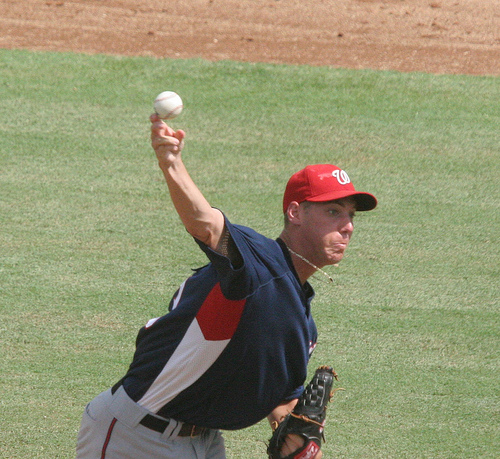
Welcome back Matt Purke. Photo AP/Nati Harnik

With the draft and the big early June roster shakeup and the College World Series going on (I’m apparently the only guy in Nats-land who cares about it), I’m a little late with this monthly quick glance at the Minor League starters.  Here’s April 2013’s version.

For each level, I’ll put out the Rotation members, their “letter grades” per start and then throw in a quick table to show their seasonal stats for context.  As with last month, the top group of Starters per level is the “current rotation” as best as we can figure it, then I’ve got a line for guys who got spot starts or (especially in the lower levels) guys who did long relief or “second start” stints.


AAA Rotation

  • Maya: A,D+,A–>promoted/dfa/back, D-/inc->injury
  • Tatusko: B+,A,C-
  • Ohlendorf: A,C-,D,D-,A,A
  • Torra:  D,D-
  • Rosenbaum: D,A,F,B+,B-,F
  • Roark: A
  • Mandel: B-,D+,A
  • Perry: F,B,F,F -> D/L
  • Young: B,C-,F-,C-,D-/inc -> D/L

Discussion: Syracuse YTD Stats are here for reference

May saw some interesting movement in the underperforming Syracuse rotation.  MLFA signing and supposed MLB rotation insurance policy #1  Chris Young continued to struggle before hitting the D/L.  Similarly, Ryan Perry put in a number of ugly appearances and also landed on the D/L.  This created an opeing for two new guys in the rotation, handled somewhat ably by Ryan Tatusko and somewhat less ably by MLFA Matt Torra.  Ross Ohlendorf righted the ship a bit and put himself in line for an earned callup on the strength of several good outings, only to have the weather in Washington conspire against him.  Yunesky Maya got a long-deserved DFA and outright, and now sits in limbo having not pitched since his aborted 5/31 start.  Lastly Danny Rosenbaum continues to have the best stat line of any starter in Syracuse, but (as often discussed here) he seems destined for life as a 6-year free agent plying his trade elsewhere in this Mike Rizzo-run organization that values power arms over finesse artists.


AA Rotation

  • Gilliam: D,A+
  • Treinen: A,F,D,B+,C-,B+
  • Demny: D+,A+,A-,D,A,B
  • Clay: C-,F,D,A-,A-
  • Jordan B,A+,D/inc->up and back,A
  • Swynenberg C+,C+
  • Holland: B+
  • Rauh: A
  • Holder: released (why?)
  • Broderick: C-,C+->D/L
  • Broadway: A->promoted
  • Karns: A-,B+,F,C+,C+->promoted

Discussion: Harrisburg YTD Stats are here for reference

The Harrisburg rotation continues to house a number of sub 4.00 ERA hurlers and we’re starting to see some movement among the ranks.  First and foremost Nathan Karns “earned” a callup to the big club probably mostly by his placement on the 40-man roster at the time, but also b/c of his excellent K/9 ratio.   Brian Broderick‘s D/L stint (will he return at this point or go straight from the D/L->release?) has opened the door for a couple new names.  Taylor Jordan continues his great comeback from his 2011 Tommy John surgery.  Paul Demny‘s string of excellent starts earned him a brief Syracuse call-up.   Robert Gilliam struggled in his AA debut but righted the ship and (as of this writing) has decent enough AA numbers that he seems to be capable of sticking on.  One odd personnel move was the abrupt release of Trevor Holder, who didn’t have bad numbers on the season and was immediately picked up by San Diego.  I wonder if there’s something to this story.


High-A Rotation

  • Ray: B-,A,A/Inc,A,C-,B+/inc
  • Solis: C+/inc,A/inc (pitch count limited)
  • Cole: A,B+,D-,D,B-
  • Hill: A,A-/inc,B+,F,F
  • Schwartz: B-,A+,B+,A+,C-
  • Fischer: C+,D+
  • Bates A,B+
  • Holt: A
  • Herron: D+,B+ -> Promoted
  • Jordan:  A+->promoted
  • Gillam:  B,F->promoted
  • Dupra: D,B- -> demoted
  • Grace: A

Discussion: Potomac YTD Stats are here for reference

Welcome back Sammy Solis; he’s slowly getting re-initiated to the rotation and spent his last May starts on strict pitch count limits.   After a disastrous 2012 Robbie Ray continues his excellent campaign and may be making a statement for the next promotion (as of this writing: 81Ks in 62 innings as one of the younger guys in high-A?  wow).  A.J. Cole continues to be frustratingly hit or miss; one night he’ll strike out 11 in 6, another night he gives up 5 runs in 5.  Speaking of inconsistent; Taylor Hill‘s last two May starts were awful, then his first two June starts were stellar.  All in all though, Potomac’s rotation has been a bright point for the farm system and has produced a number of promotions before the all star break.


Low-A Rotation

  • Anderson: A,A-,F,A,C-,B+
  • Encarnation: A,A-,C-,D-,B->bullpen for Purke?
  • Lee: B+,F
  • Pineyro: A-,C+,C-,A,C
  • Purke: A
  • Henke: | C
  • Rauh: D,B+->up/down
  • RPena: C-,A for effort,C,F,C-
  • Fischer: A,A–>promoted
  • Turnbull: D+,F,D-,C- ->demoted

Discussion: Hagerstown YTD Stats are here for reference

I’ll be honest; right now its hard to tell what the “rotation” is in Hagerstown.   The arrival of Matthew Purke seemingly had to bump someone, but its hard to tell who.  Purke’s showing some great swing-and-miss stuff in his first pro starts in half-of-forever; if this guy can turn back into the prospect he once was, the Nats will be ecstatic.  DSL grads Pedro Encarnacion and Ivan Pineyro continue to put up good numbers for the Low-A Suns.  As does Dixon Anderson, who is seemingly due for a promotion at this point.

Monthly Check-in with Minor League Pitching Staffs

10 comments

Robbie Ray is having a nice bounce-back 2013 so far. Photo: Natsnewsnetwork.blogspot.com

In 2011, I managed to do “Rotational Review” posts for both the MLB team and the minor league system for the whole summer.   That turned out to be a pretty hefty time commitment, and an endeavor that I couldn’t keep up with.  I managed to do all 33 MLB rotation reviews but gave up on the minor league systems around the all-star break. For the entirety of 2012 I never once published much of an in-season look at any of the minor league teams.  But I want to stay aware of the minor league pitchers; its basically the reason I started this blog.  I wanted to be up on the rising talent, always on the lookout for the next home grown pitching talent.

In 2013, I’ve modified my approach.  With the help of daily doses of Luke Erickson‘s NationalsProspects.com daily looks, I’m taking the time to give a quick “grade” to each Starter’s outing by looking at the stat-line and the peripherals, in order to gauge how guys are looking.  Instead of the previous “good-bad-soso” analysis, I’ve adopted somewhat of a letter grade system, from A+ to F.  It isn’t a hard and fast grading system, but generally speaking we start with a run-of-the-mill quality start being graded a C (lets face it, 3 earned runs in 6 innings for a 4.50 ERA is average) and then go from there.  6 shutout innings gets somewhere between an A+ and an A- depending on # of hits/walks/Ks, while a complete meltdown (e.g. 7 runs in 3 innings) earns an F.  You get the idea.

So, without further ado, here’s the April 2013 look at the starters by team, with grades for outings and some commentary.  We’ll do an expanded view of the MLB rotation in the next post.  The grades are through 4/30’s outings; the stats may be slightly off since I wrote the bulk of this prior to this morning.

AAA Rotation

  • Ohlendorf: A,B,D+,D,C-
  • Young: F,D
  • Maya: C,D,D,F,D-
  • Perry: D-,B+,C-,B
  • Rosenbaum: A-,A,C+,A
  • Roark: A,D,F->demoted to bullpen,A
  • Tatusko: D,A-

Discussion: Syracuse YTD Stats are here for reference

(A quick note explaining the notation; the top 5 pitchers are the current rotation, and guys who have been starters before promotions or demotions, or who have spot starts are noted below the current rotational members.  The rotation is listed in current appearance order).

So far, the AAA rotation (which i like to call the “desperately seeking to find an injury backup starter” group) has been mostly a mess this year.  Former Major league starters Ross Ohlendorf and Chris Young sport ERAs of 5.46 and 9.00 respectively.  Yunesky Maya has been even worse; a 7.45 ERA and a 1.62 whip.  Ryan Perry rebounded after a rough debut outing.  Tanner Roark was holding Young’s rotation spot and was either excellent or awful; even with two grade-A outings he’s sporting an 8.44 ERA in 21 1/3 innings.  Only Danny Rosenbaum has shown himself worthy of a potential call up; after trying out for the Colorado rotation all spring on a Rule-5 invitation, he was returned and has really thrown well in Syracuse.  (side note on Rosenbaum; is he now officially “Daniel?”  Sort of how we went from Tom Milone to Tommy?  I’ll have to update all my tags in the blog system).

In the Bullpen, Erik Davis, Fernando Abad and JC Romero each sport sub 1.00 ERAs in relief; the rest of the bullpen ranges from mediocre to awful.  As noted in a prior post comment, there’s not a lot of relief backup were one of our MLB arms to go down.  Davis is showing why the team protected him last November though.

AA Rotation

  • Broderick: C-,C+,B-,F,B-
  • Treinen: F,D,A,C,B+
  • Demny: A-,D,C,C-,F
  • Clay: D,A,A,C,B+
  • Karns: F,A,A,B+
  • Holder: C

DiscussionHarrisburg YTD Stats are here for reference

As with Syracuse, there’s a lot of up-and-down so far in Harrisburg.  Brian Broderick, who should be in AAA frankly, is barely holding on in AA.  He’s yet to have anywhere close to a dominant outing.  Blake Treinen (throw-in from the Michael Morse trade) started really slow and has clawed his way back to respectability.  Paul Demny has been up and down too.  Caleb Clay (a MLFA signing who spent 6 years in the Boston organization) has been surprisingly sucessful as an Eastern League starter; he was relatively UNsuccessful the last two years playing for Boston’s AA affiliate in the same league as a middle reliever.  We’ll see if he can keep this up.  Lastly Nathan Karns, who in my mind is the “next best Nats starter prospect” to keep an eye on (with apologies to Rosenbaum, AJ Cole and Lucas Giolito) himself rebounded from an awful 2013 debut to put in 3 dominant starts.  He now sits with a 3.80 ERA and 29 ks in 21 innings through 5 starts with nearly a 4/1 K/BB ratio.

Trevor Holder got a spot start and has been otherwise decent.  Ian Krol (the PTBNL in the Morse trade) has been lights out; one run allowed in 13+ innings so far.  Michael Broadway, who we picked up as a MLFA just a few days before the season started, has also been good in short sample sizes.   Aaron Barrett has 4 saves and 15 ks to just 3 walks in his 11 innings this month.  Most of the rest of the Harrisburg bullpen are showing great K/9 rates right now with good numbers thus far.

High-A Rotation

  • Ray: A-,B,B-,A,A
  • Jordan: A,B,B+,B-,B-
  • Cole: D,B,D,D,C+
  • Schwartz: A,A
  • Hill: C+,A-,A+,C,C-
  • Turnbull: D-,D,F->demoted

Discussion: Potomac YTD Stats are here for reference

Potomac is led by a series of guys who are all on good rolls.  Robbie Ray, Taylor Jordan and Taylor Hill each are sporting sub 2.00 ERAs at the end of the month.  Hill’s outings are a combination of excellent and mediocre; his stat line looks better than his Start grade line.  Kylin Turnbull turned out not to be ready for High-A, but his promoted replacement Blake Schwartz certainly looked like he was ready in his first start (6ip, 3hits, zero runs) and followed up that outing with another dominant outing on 4/30.   Only A.J. Cole has really struggled out of this group, a disappointing start so far for the re-captured prospect.   Is High-A going to turn out to be his tripping point?  The California league is tough on hitters, but the Carolina league isn’t; what is going on with Cole?

In the bullpen, Tyler Herron has an amazing 20 Ks in 10 1/3 innings, while Richie Mirowski has given up just 4 hits in his 10+ innings of work for the month.

Low-A Rotation

  • Anderson: B+,B+,A,B,A
  • Turnbull: A
  • Pineyro: D,D,Inc,C-,A+
  • RPena: B,F,D,A-,B+
  • Encarnation: B+,C-,C-
  • Schwartz: B+,A,B-,A+->promoted
  • Mooneyham: B-,A,A->dl
  • Dupra: B,A,B-,D->promoted
  • Rauh: C,C,B-,D-
  • Fischer: A+
  • Hudgins: A,A-

DiscussionHagerstown YTD Stats are here for reference

Hagerstown has a “rotation,” and then they have something akin to a “tandem” pitching plan in place, where the 2nd guy in goes nearly as long as the starter.  Hence the larger number of guys who are given grades on their “starts,” when in reality guys in the lower group don’t have any starts.  If a guy goes 3-4 innings in a game, they generally have a grade here.

Dixon Anderson is leading the way with 5 excellent outings and a 2.25 era/0.87 whip.  Brett Mooneyham had three good starts as well before hitting the D/L.  Schwartz proved too dominant in his 4 outings (21 Ks in 14 innnings) and was promoted; Dupra’s line earned him a promotion as well.  Pedro Encarnation is finally putting it together outside of short-season.  Turnbull looked very dominant in his low-A return as expected.   David Fischer and Wil Hudgins longer outings may have been good, but their other outings have drug down their stat lines.  DSL grad Pineyro is somewhat holding his own in full-season ball, with up and down nights that hopefully will even out.  Lastly Ronald Pena is living up to his “sleeper” potential; the 16th round 2012 draft pick has picked up right where he left off in full-season ball.

Houston’s Farm System Pitching Strategy

2 comments

While listening to the MLB radio broadcast of the 3/31/13 season opener between Texas and Houston on ESPN radio, one of the announcers spoke about a new pitching strategy Houston is employing this year with its minor league rotations: “Tandem Starting Pitchers.”  They’re apparently so stocked at the minor league level with starters from all their prospect acquisitions that they are forced to be creative in order to get everyone the work they need.

The strategy as I understand it (and from doing a bit of Google research) goes like this: instead of having a 12-13 man pitching staff in the minor leagues with conventional MLB-like roles (starters, long-men, closers, loogies, etc) Houston will assign starters in tandem for each game.  Starter A will throw either 5 innings or 75 pitches (which ever comes first), then Starter B will throw either 4 innings or 60 pitches (which ever comes first).  And then four days later the two guys will switch places so that Starter B gets 75 pitches.

This would (theoretically) allow each team to carry 10 starters and get them each 60-75 pitches at least on normal 4 days rest.  You then carry a couple of closer-candidates and perhaps one extra rubber-armed long man and that’s your staff.  If one of the starters gets into trouble and you need extra innings, you just use some of your later starters and get them an inning or two on their normal throw day (for example; on day one of the rotation the day four guys can easily throw an inning or two in a pinch).

Personally, I think this is brilliant.  All relievers are failed starters any way, and developing home-grown starting pitching is one of the hardest things for a farm system to do.  Look at how long the Nats have been working on it, and even then we’re still dipping into the trade market and free agency to fill out 40% of our rotation for the last couple of years.   So if you can try to develop twice as many starters from the onset, why not?  What value does a middle reliever on a low-A ballclub really have?  He’s already failed to be one of the 5 starters on the team, he isn’t being groomed as a closer type … so he’s essentially chaff and just playing out the string, pitching wasted innings until the end of the season and he can be released to make room for the next failed starter next year who gets dropped to long-man status (that may be a tad harsh frankly, but it goes to the point of this article).  Why not manage that staff so that all those long men/spot starters actually get to go 3-5 innings a night to see if they’re worth cultivating?

Now, Houston seems to admit that this tandem strategy may only be for the beginning of the season, until a stronger set of starters “naturally” emerges, and then they may move back to a more conventional staff (with the “losers” then becoming middle relievers).  That’s fair; but I think it’d be pretty amazing if someone tried to pull this off with their entire system for an entire year.

Downsides?

– Do you hinder starter development by NOT allowing them to go deep into games?  If you’re always getting yanked after 75 pitches, do you lose the ability to gain the stamina to eventually go 100-110 pitches?  Possibly.  But I doubt it; if you just go throw for another 30 minutes on the side after finishing up your 75 pitches, you’ll get your work in.

– Do you hinder the development of relievers?  I’d say no frankly; looking at the set of relievers the Nats are using now in the majors: by and large they’re all failed minor league starters who converted to relief and specialized.  This certainly describes at least Clippard, Stammen, Mattheus and Rodriguez.   Duke and Stammen both had shots at being starters in the majors and couldn’t make it happen.  Soriano was great as a minor league starter; he just was even better as a closer.  Of all our relievers only Storen has always been a professional reliever (as he was in college).   So; you’re still going to be able to find relievers by doing this tandem starting … you just have to wait a while for the “losers” to shake out and start working them in relief.

– What do you do if both your tandem starters get shelled?  Good question; keep rolling out the 3-days onward guys?  Keep one mop-up guy?

– What do you do if you go extra innings?  Same thing as if someone gets knocked out early; keep rolling out the 3-days on starters and deal with it later.  You can always call someone up for starts a few days from now.

Coincidentally, looking at the usage of the Nats Hagerstown rotation, the Nats may already be doing something along this line anyway.   In their first few games we’ve seen a starter go 5 then a reliever go 3 to finish up, then two guys basically splitting a 7-inning game 4ip and 3ip, and then another 5ip/3ip situation.

What do you guys think?

Written by Todd Boss

April 12th, 2013 at 9:31 am

Nats Major & Minor League Pitching Staffs vs Predictions

leave a comment

First off, this is partly a post of self-flaggelation, to show how far off my various predictions of what the 2013 minor league staffs would look like by doing 2012 season-ending analysis.  Such is the nature of minor league pitching staffs in the modern day; they’re a combination of spare parts, rising stars and hangers-on and they can change rapidly with trades and spring training performances.  Every trade and every MLFA signing trickles down and fouls up predicitons.

Here’s my End of Season 2012 post with predictions for each of the 2013 minor league pitching staffs.   We’ll use that as a basis for the Opening Day 2013 rosters of the four full-season minor league teams.  Just for fun we’ll throw in (and start with) the MLB prediction.  Note that this early in the season we don’t really know who’s shaking out as starters and relievers necessarily for these minor league teams; i’m just going on first week usage right now.  As always, Luke Erickson and nationalsprospects.com, the Nats Big Board and the tireless work by “SpringfieldFan” is much appreciated here.


MLB Nov 2012 Prediction

  • MLB Rotation: Strasburg, Gonzalez, Zimmermann, Detwiler, FA or other acquisition
  • MLB Bullpen: Clippard, Storen, Mattheus, Stammen, Garcia, a FA left-hander (possibly Burnett), a FA long-man (possibly Gorzelanny).
  • MLB notables Out of Organization: Jackson, Burnett, Gonzalez, Lannan, Wang

MLB April 2013 Actual

  • MLB Rotation: Strasburg, Gonzalez, Zimmermann, Detwiler, Haren
  • MLB Bullpen: Clippard, Storen, Mattheus, Stammen, Duke, Rodriguez, Soriano
  • MLB notables Out of Organization: Jackson, Burnett, Gonzalez, Lannan, Wang, Gorzelanny

MLB Discussion: It wasn’t going to be that difficult to predict the 2013 Nats pitching staff make-up by looking at our staff and their FA status heading into the off-season.  The rotation filled its one spot with Dan Haren.  The bullpen was 5/7ths predicted correctly (if you count Zach Duke as a FA left-hander acquisition).  Christian Garcia‘s injury opened the door for one more season of Henry Rodriguez, and of course nobody could have predicted the Rafael Soriano purchase.  Lastly all 5 of the predicted departures occured, in addition to Tom Gorzelanny being let go.


AAA Nov 2012 Prediction

  • AAA Rotation: Roark, Maya, Broderick, Meyers, Perry
  • AAA Bullpen: Tatusko (swingman), Arneson (swingman), Severino (loogy), Davis, Lehman, Nelo (closer), Martin,  Mandel

AAA Apr 2013 Actual

  • AAA Rotation: Ohlendorf, Roark, Maya,Perry, Rosenbaum ( eventually Young)
  • AAA Bullpen: Tatusko, Mandel,  Davis, McCoy, Crotta, Abad, Romero, Bramhall
  • AAA D/L: Kimball, Bray, Meyers, Torra, West, Garcia (technically XLS), Accardo
  • AAA cut/released/FA: HPena, Mann, Zinicola, Arneson, Atkins, Ballard
  • AAA Missing: none

AAA Discussion

We were 3/5s correct on the rotation, and probably would have been 4/5ths right if Brad Meyers was healthy.  Ross Ohlendorf and (eventually) Chris Young are new faces here, both being former MLB starters who are taking the Zach Duke route of signing on for full seasons as AAA starter insurance for the big club in the hopes of rebuilding value and finding a MLB job for next year.  Brian Broderick is indeed back; its just that he’s starting for AA instead of AAA.  Lastly Danny Rosenbaum was returned to the team after his spring Rule-5 adventure and was put in AAA instead of AA, where (as we’ll see in a second) I would have predicted he would start.  Once Young is ready to go, I see Tanner Roark turning into the swingman/long-man.

On the bright side (pun intended), when was the last time a professional baseball team had TWO Ivy League alumni pitching in its rotation??  Both Young and Ohlendorf went to Princeton.  I wonder if they have NYTimes crossword puzzle competitions instead of (assumedly) video game competitions on off-days in the clubhouse.

As far as bullpen predictions go, next year I’m paying more close attention to who are 6-year free agents.  Arneson, Severino and Nelo were all MLFAs and have either signed on elsewhere or are facing forced retirement.  Tatusko, Davis and Mandel are onboard.  Lehman is (surprisingly?) in AA, perhaps a victim of the numbers game of the Nats signing (and keeping) a number of minor league lefty relievers this off-season.  I would guess, looking at the names in the bullpen, that Erik Davis is the closer but who knows what the usage will be like.  Lastly Bramhall was a MLFA signing over the off-season who just got placed on the AAA roster to replace the injured Accardo.


AA Nov 2012 Prediction

  • AA Rotation: Rosenbaum, Holder, Gilliam, Karns, Grace, Demny (swingman?) or MLFA?  Solis if he’s healthy?
  • AA Bullpen: Frias, McCoy, Selik (maybe high-A again), Holland (setup),  Wort (closer), VanAllen (loogy), Demmin (maybe high-A again), an org arm or two to fill in.

AA Apr 2013 Actual

  • AA Rotation: Broderick, Treinen, Demny, Clay, Karns
  • AA Bullpen: Holder, Frias, Holland, Wort, Barrett,  Krol,  Lehman, Swynenberg
  • AA D/L: Solis, RMartin, Olbrychowski, Selik
  • AA Cut/released/FA: VanAllen
  • AA Missing: none

AA Discussion

We got, well, not much of this right.  Of my starter predictions: Rosenbaum is in AAA, Holder is here but seems to be the long-man right now, Gilliam is hurt, Solis is still on the DL, and Grace is back in High-A.  We do seem to have at least gotten Karns and Demny right.  Broderick was a surprise FA signing, his being a favorite of the Nats organziation per our Rule-5 experiment with him a couple years back.  I’m surprised he’s not in the AAA rotation though.  Treinen was a trade-throw in from the Morse deal and takes a spot in this rotation, while Clay was a 2013 MLFA signing who (surprisingly?) made the rotation over the likes of other candidates.

The bullen prediction is all over the place: We got Frias, Holland and Wort right.  McCoy is in AAA, Selik is on the AA D/L and VanAllen and Demmin were MLFAs who were left unsigned (and per the big board are still unsigned).   I thought Barrett and Swynenberg would be in high-A instead of AA, I (and most others) thought Lehman would be in AAA, and Krol arrived as the PTBNL in the Morse trade.


High-A Nov 2012 Prediction

  • High-A Rotation: Swynenberg, Ray, Meyer (maybe AA?), Schwartz (maybe low-A), Rauh(maybe low-A)
  • High-A Bullpen Competition: Barrett (maybe AA) , Testa, Smoker (loogy), Hill, Meza(perhaps a starter?), Holt, Hawkins, Bates, Mirowski
  • High-A bullpen Release candidates: Olbrychowski, McCatty, Applebee

High-A Apr 2013 Actual

  • High-A Rotation: Ray, Jordan, Cole, Turnbull, Hill
  • High-A Bullpen Competition: Herron, Mirowski, Holt, Hawkins, Meza, Bates, Self, Grace
  • High-A D/L: Smoker, Applebee, Gilliam
  • High-A Cut/FA/Released: Demmin, Consuegra, Samuel, Testa
  • High-A Missing: McCatty, Olbrychowski

High-A Discussion

The Potomac rotation guess was already light; a couple of the guys I was guessing might be in low-A are indeed there (Schwartz and Rauh).  Swynenberg is in the AA bullpen.  Meyer was traded.  Only Robbie Ray returns.  I thought Jordan was going to repeat Hagerstown.   We got Cole back in the Morse trade and bumped up Turnbull from short season (over Mooneyham, interestingly) Lastly Hill seems to have beaten out Grace for the 5th starter spot.

The Bullpen prediction looks pretty good: 7 of the predicted guys are here (Smoker on the DL, Meza, Holt, Hawkins, Mirowski and Bates).  Barrett indeed is in AA.  Testa was released.  Of my release candidates McCatty is in XST, Applebee and Olbrychowski are on the DL.  Lastly both Samuel and Consuegra were off-season MLFA signings who didn’t pan out and have already been released.


Low-A Nov 2012 Prediction

  • Low-A Rotation: Turnbull, Jordan, Purke (if healthy), Monar, Mooneyham
  • Low-A Rotation Competitors: Hansen, Lee (loogy if not), Encarnation, McGeary (if finally healthy)
  • Low-A Bullpen Competition: Anderson, Estevez, Dupra, McKenzie, Henke, Davis, Boyden, Benincasa, Hudgins, Dicherry, Mudron

Low-A Apr 2013 Actual

  • Low-A Rotation: Anderson, Mooneyham, Pineyro, RPena, Encarnation
  • Low-A Swingmen: Rauh, Schwarz, Dupra
  • Low-A Bullpen: Fischer, Harper, Henke, Hudgins, Benincasa
  • Low-A D/L: Estevez, Purke, Simko, Mesa, Weaver
  • Low-A Cut/FA/Released: Kreis, Lucas, Upperman, Hansen, Monar
  • Low-A Missing: Hollins, Hicks

Low-A Discussion

Historically the hardest to predict, the Low-A team.  Of the guesses for the rotation last fall, we only got Mooneyham right.  Turnbull and Jordan were bumped up a level.  Purke is still hurt.  Of the “competitors” the team flat out released Monar and Hansen to my surprise.  Monar was really good in Auburn last year, and while Bobby Hansen wasn’t nearly as dominant as a starter, I thought he’d at least get a shot at being a loogy after so many years in the organization.  Jack McGeary was selected out of the org during the minor league phase of the rule-5 draft.  Lee is in XST limbo right now.

So who are these surprising Low-A rotation guys?  I thought Anderson would be relegated to the bullpen in Low-A; instead he’s the opening day starter.  I thought Pineyro would repeat short-season ball but he made the full-season team.  And lastly I thought Pena was destined for another season in short-A.

Rauh and Schwartz, after I thought they had shots in the rotation in high-A, seem to be taking the roles of “2nd starters” for now, each having gone multiple innings in relief of the starter.  I wouldn’t be surprised to see them becoming full time starters if one of the 5 guys ahead of them falter.

Most of the rest of the predicted bullpen are 2012 signees who are currently amongst a large group of extended spring training guys who will be battling it out for short-season jobs with 2013 signees.   And we seem to have a very large group of them; the big board lists in excess of 30 hurlers who are currently still in the organization, who are not on the D/L officially, but who are not assigned to one of the four full season teams.   That’s a lot of arms for just a handful of spots in short-A and the rookie league after the 2013 draft occurs.

Written by Todd Boss

April 11th, 2013 at 8:41 am

Posted in Majors Pitching,Minor League Pitching,Rule-5

Tagged with , , , , , , , , , , , , , , , , , , , , , , , , , , , , , , , , , , , , , , , , , , , , , , , , , , , , , , , , , , , , , , , , , , , , , , , , , , , , , , , , , , , , , , , , , , , , , , , , , , , , , , , , , , , , , , , , , , , ,

No takers for Carlos Rivero plus Rule-5 returns

2 comments

Carlos Rivero snuck through waivers and stays with the organization. Photo Brad Barr/US Presswire via bleacherreport.com

Great news 3/25/13: the Nats exposed Carlos Rivero to waivers, got no takers and he was outrighted to AAA Syracuse over the weekend.

I know he didn’t have the greatest numbers this spring (8-for-47 for a meager .170 BA), but he seems like he could be a valuable utility guy in a pinch, able to play multiple positions both in the infield and outfield.   I liked what I saw from him in limited TV time this spring.  I’m glad he made it through waivers and remains an option in our farm system for at least this year.

He also clears a spot off the 40 man, leaving us sitting at 38/40.  Plenty of room to make moves if need be.  But not a ton of manuverability; of the 38 guys remaining, you can only really make a case for Corey Brown as being relatively expendible/likely to pass through waivers.  If we get a slew of injuries like last season that cause us to do mass call-ups, we may have to heavily depend on the 60-day DL.

Meanwhile, another year of Rule-5 complaining (see here and here) has essentially proven once again to be wasted breath; both Jeff Kobernus and Danny Rosenbaum have been returned to the team.   Kobernus still seemingly sits behind Steve Lombardozzi, Anthony Rendon and Wil Rhymes on the team’s 2nd base depth chart, meaning we’d have to have a pretty bad slate of injuries for him to sniff the majors this year.  But, it is nice to have him back, considering his draft pedigree and bonus money investment.  Rosenbaum was our AA Ace last year and started out with ace-like stuff, but struggled in the 2nd half.  Given that the team suddenly has a slew of starter arms in AAA (especially if Chris Young sticks around, though he probably walks), perhaps we’ll see Rosenbaum starting in AA again.  Not likely though; would you rather challenge Rosenbaum in AAA or give another year of starts to someone like Tanner Roark at this point?