Nationals Arm Race

"… the reason you win or lose is darn near always the same – pitching.” — Earl Weaver

Boswell Chat 10/3/11: My answers to his Baseball questions

15 comments

The Nats season may be over, and the Redskins may be 3-1 (thus implying that 98% of local sports radio be devoted to the minutae of the team), but i’m hoping Tom Boswell takes some baseball questions still during his normal monday morning chat.

Questions are edited for clarity and space, and I write my answer before reading Boswell’s.  We’ll only address baseball-related questions.

Q: Was the last day of the 2011 baseball season the greatest day in baseball history?

A: Well, considering that baseball’s been played for 150+ years, and we’ve only lived to see and judge 25-30 years of it, and we’ve only had baseball readily available on TV to the extent where we could truly appreciate a night like what happened … its tough to say its the best ever.  Yes absolutely though it was the best in recent memory.  Boswell agrees.

Q: Thoughts on the Red Sox’s parting ways with Franconia and possibly Epstein?

A: The Red Sox spent an awful lot of money … and ended up with an awful lot of injuries to those well-paid players, especially in the rotation.  In September they were basically without 3/5ths at one point of the opening day roster.  No team can survive that, especially one that has traded so many of its prospects lately to acquire the hitting talent it has.  Terry Franconia has been there a while and, while its probably not his fault the team plummeted as it did, he’ll take the fall.  Theo Epstein: I’d think he’d want to stay and try to get one more WS win out of this team.  Unfortunately it probably isn’t happening any time soon: his team still has a bunch of under-performers under contract for 2012 and looks to be stuck with a bloated payroll without many impact players, again.  Boswell thinks Franconia got the short end of the stick, and that any firing of Epstein would be a major over-reaction.  Agreed.

Q: Did the Orioles “over-celebrate” by beating the Red Sox on the last day?

A: Maybe so.  But its hard to fault the team for playing and winning a playoff-caliber game.  Boswell didn’t answer this part, but did talk about Matt Moore and how good he’s looked.  Moore was the subject of an analysis post I did over the weekend.  He looked fantastic and could be a secret weapon for Tampa Bay this playoffs.

Q: Will the Red Sox find someone to manage their club as good as Franconia?

A: Probably not; there’s a ton of good candidates out there but in all likelihood we won’t see a major discipline guy taking over.  Odds are that we’ll see a bench coach or someone within the organization.  Boswell says if Valentine goes, expect even more drama.

Q: (Great Question): should a team’s success factor into the Cy Young and MVP voting?

A: Cy Young: no.  It shouldn’t matter how the team does.  If a guy is the best pitcher in the league, he’s the best pitcher.  Yes “Wins” are a flawed statistic, giving credit to a pitcher for only half the battle in winning a ball game.  But mostly pitching is an individual, mano-y-mano embarkment.   MVP?  Yes I believe the team’s position in the standings has an effect.  Simple question; how can you be the Most Valuable Player in the league for a team that is 20 games under .500?  I just don’t think you can be.  If you’re not leading a team to the playoffs, or playing meaningful games 100% of the time, then it doesn’t matter how valuable you are to your own team, let alone the rest of the league.  Boswell posits an argument i’ve never heard; batters get 650-700 plate appearances but starting pitchers face > 1000 batters.  Good argument; still not enough to get me to consider pitchers for MVP awards.

Q: How did a supposedly great analysis team like the Red Sox err so badly in the Carl Crawford contract?

A: Carl Crawford was a nice player in Tampa, but it was always going to be a risk putting someone who wasn’t used to the pressure cooker of baseball in Boston or New York who wasn’t used to it.  The Red Sox vastly overpaid for Crawford, feeling as if they had to pay him more than the Jayson Werth contract, and they ended up with a lesser player.  Boswell points out some interesting observations; Crawford’s power is to right, he never pulls the ball and his asset in defense is speed.  All three of those points are completely negated by playing in Fenway.  Could get ugly in Boston.

Q: When are the Nats going to re-sign Ryan Zimmerman?

A: I’d guess after NEXT season.  Despite the supposed pressure to get him re-upped on a big contract, he already IS on a big contract.  And that contract runs through 2013.  So he’s still got two years on it, so no point in talking about it or worrying about it.   Boswell says the team should push this, but guesses Zimmerman waits until he has a good start to 2012 to negotiate from strength, not from the weakness following a sub-par year as he had in 2011.

Q: Did Davey Johnson have a bad road split?  Is he going to be the 2012 manager?

A: Just did some quick analysis: the team had 38 road games after Johnson took over and went 18-20 in them.  That’s actually better than their overall 36-45 record on the road all season.  I don’t know why there’s stories about a manager search; why wouldn’t he come back to manage in 2012?  Boswell notes he went 40-40 after the initial 3-game series loss to the Angels.

Q: Thoughts on Jose Reyes’ sitting down to protect his average?

A: Bush league.  Ted Williams, he is not.  If your manager takes you out to give the home crowd a chance to give you one last cheer, that’s acceptable.  To ask out of a game after bunting for a hit is akin to an NBA player purposely missing a shot to get an extra rebound so as to get a triple-double.  Boswell agrees.

Q: Do the Nats need to get a high priced FA starting pitcher?

A: Well.  Lets answer the question this way.  Yes, they need another FA pitcher, but there’s not one available this year that will be worth the money.  This season’s crop of FA starters is weak and the two big money teams both desperately need starting pitching and will be driving prices WAY up on guys like CJ Wilson and Edwin Jackson, far over what they’re worth.  I think the team needs to stay out of these feeding frenzies.  2013’s crop is far better, and we also have enough pitching depth to possibly work a trade.  Boswell says its a tough call then reminds everyone we went after Greinke hard and couldn’t believe the deal was turned down.

Q: What do the Nats do with the leadoff position for 2012?

A: Amazingly, they go into this off-season with pretty much the same issue they had LAST off season.  They need a reliable lead-off hitter, and they need a reliable center fielder.  They’d love to get one guy who can do both jobs.  Personally, I think a trade is happening this off season, with the team going after BJ Upton again, pitching Tampa Bay to save the $6-$7M they’re going to have to pay him in his last arbitration year.  There’s a couple of FA center fielders of note, but they’re under performers or injury risks (David DeJesus, Grady Sizemore being the two names i’d think about).  Might as well roll the dice with one more year of Rick Ankiel. Boswell notes that Goodwin and Rendon could be hitting 1-2 in a couple years.  Not exactly the question that was asked.

Q: Have the Nats considered moving Desmond to CF, and sliding Espinosa to SS and playing Lombardozzi at 2B?

A: Hmmmm.  I havn’t seen this particular formation postulated.  I’d say this is a no-go because Lombardozzi looked 110% overmatched in his September call-up and may have a ceiling of utility guy.   But its an interesting question.  What about Lombardozzi in center?  The question is; can he hit leadoff?  Boswell doesn’t think Desmond can ever be a good enough leadoff hitter.

Q: Do the Nats make a run at Terry Franconia?

A: No way.  Johnson is just as good a manager.  You stick with what you have.  Boswell agrees.

Q: Is CJ Wilson worth giving up our first round pick in free agency?  What about Pujols or Fielder?

A: Yes …. but he’s not going to be worth the sky-high salary that he’ll be offered by the Yankees to come in and help restore their pitching staff.  Both Pujols/Fielder would be great in the short term but would likely be albatross contracts before they’re said and done (as A-Rod’s already looks, and as Ryan Howards looks like it will be).  Boswell says he likes our current arms more than Wilson, and says Morse at $4M is better value than Pujols at $25M.  True.

Q:  What do you make of the way the Nats finished the season?

A: Very promising … with some caution.  Beware September success, since your young guys often times are playing other team’s younger guys.   The only meaningful games we really played in September were against teams in playoff races (Atlanta).  I will say that the big take away from this finish was just how poorly the team fared by giving starts to Livan Hernandez and Jason Marquis.  Once those guys were removed from the rotation and replaced with our upper end prospects, the team won and won frequently.  Boswell agrees, pointing out that this team got to 80 wins, only one of which was by Strasburg!

Q: Were the 80 wins ahead of your expectations?

A: Absolutely.  I can’t find any proof of this, but I think 72-75 wins was considered a great goal for 2011.  80 wins, a 10 game improvement over 2010 (itself a 10 game improvement over 2009) is a huge win for this team.  Another 10-game improvement suddenly puts this team squarely into Wild Card competition, and another 10-game improvement in 2013 puts us as World Series contenders.  I think this is a great path and a great goal.    Boswell predicted 72 at start, bumped to 77 mid-season.

Q: What does the Nats focus on in the offseason? SP or CF/Leadoff guy?

A: I always classify off-season priorities as follows: Fantasy, Reality and Less Likely.  I’ll post a more detailed post about this after the WS is over, but Fantasy for me is Pujols or a frontline Starter, Reality includes attempting to find a center fielder and then filling in some holes in the bullpen and on the bench.  Boswell didn’t address.

Q: Who do you think is on the trading block for the Nats? Lannan has been getting a lot of play lately? Would BJ Upton be the best option for us?

A: The Nats clearly have pitching depth, and have more major league ready starters than they have spots for.  Lannan is an underrated starter and could be a good #3 or #4 starter for a contender.  Problem is, the Rays have zero need for a starter like John Lannan and it would probably cost the Nats a much better prospect to pry loose someone like BJ Upton.  I’d like to have Upton but don’t want to burn a high-end prospect like Norris or Rendon to get him.  Boswell correctly points out that Lannan is undervalued by other teams besides us, who don’t see his improvements and every day accomplishments.  Upton is a wild card for sure.

Q: Could the Nats go after an “Impact” bat, like Michael Cuddyer?

A:  Cuddyer isn’t really an impact bat in the same vein as Pujols or Fielder.  I don’t see a spot for Cuddyer, who can play a bunch of positions but everything he can play is a position we’re ably filling right now (RF, 2B, 3B, 1B).   Boswell thinks our hitters are scheduled for a rebound.

Q: Are the Phillies vulnerable?  Can the Brewers make a run?

A: Phillies don’t *seem* vulnerable, not with 3 shutdown arms and a 4th who would be most team’s best hurler.  The Brewers look like they could go far, with a good balance of pitching and hitting.  Boswell says that the Card’s 3 potent hitters could make things dicey for Philly.

Q: What is the best WS match up for TV?  What’s the best matchup for the true fan?

A: TV: the two biggest markest clearly (NYY vs Philly).   For the fans?  It’d be nice to see two long-suffering franchises go at it (Detroit-Milwaukee).  I’d like to see big money versus little money (Philly-Tampa), which would also match the two best pitching staffs.  For offense-minded teams it’d probably be Texas (or NY) versus St. Louis.  NYY-St. Louis is great for traditionalists; these are the two teams with the most WS victories.  Boswell likes it when non-traditional powers get into the series.

Wow, that was a lot of baseball talk.
Roster Construction of the Playoff teams (and the Nats)

one comment

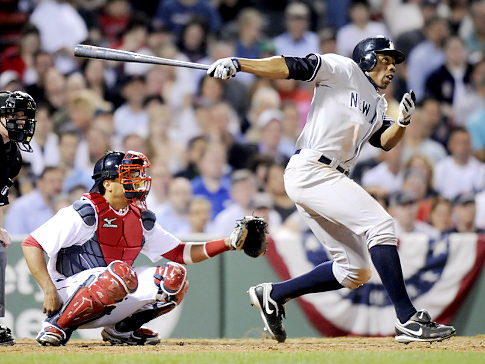
Curtis Granderson was in the middle of a trade that affected 3 of the 8 playoff contenders. Photo unknown credit via baseballsblackheritage.com

One of my pet projects over the years has been to analyze the Roster construction methods that successful teams use, in order to determine if there’s any trends or patterns to be had (some of the 2010 rosters are here in this Google spreadsheet).  Now that we’ve got our 8 playoff teams set for the 2011 season, here’s a quick run down on the way these teams arrived at their core rosters.

In the 2011 spreadsheet (available online via the links section along the right hand side of the blog, with sections cut-n-pasted below), I’m only looking at the core of the roster: the starting 8 out-field players, the 5 man rotation, the setup and closer, and (if in the American League) the DH.  So each team has either 15 or 16 players categorized.  The player acquisition is broken down one of four ways:

  1. Draft: The player is with the original team that drafted him.  In the case of international free agents, if they’re signed as prospects they are considered in this category as well (i.e., Ichiro Suzuki is not a developed player, but an international Free Agent).  It could be better defined as “Club developed players.”
  2. Traded MLBers: The player was acquired by the team by virtue of trading an established MLB player.  Most of the time these days, this means the player was acquired as a prospect (since most trades seem to be of the prospect-for-established player kind).
  3. Traded Prospects: The player was acquired by the team by virtue of trading prospects.  This is essentially the reverse of #2.
  4. FA: The player was acquired in free agency.  This category also includes two other types of acquisitions: waiver claims and cash purchases.  These three categories are lumped together since all three indicate that a team has acquired a player with zero outlay in terms of development or prospects.

Here’s a breakdown of your 8 playoff teams:

Season Team Drafted/Developed Traded Prospects Traded MLBs FA/Waivers Ttl
2011 NYY 7 0 0 9 16
2011 Tampa Bay 9 0 3 4 16
2011 Texas 5 0 7 4 16
2011 Detroit 5 2 3 6 16
2011 Philadephia 9 3 0 3 15
2011 St Louis 7 1 2 5 15
2011 Milwaukee 6 5 0 4 15
2011 Arizona 6 1 6 2 15

A couple of quick notes on these numbers:

  • One of Texas’ “drafted” players was a Rule-5 Draftee (Ogando).   Likewise, Philadelphia has one rule-5 draftee as well (Victorino).   I probably should re-classify rule5 draftees as FA acquisitions, but for now it counts in the draft.
  • Just in case anyone forgot, the Mark Teixeira trade netted Texas their #2 pitcher (Harrison), their starting SS (Andrus), their closer (Feliz) and Boston’s current starting catcher (Saltalamacchia).  This is lesson 1-A in why teams should really rethink deadline deals.  Imagine if Atlanta still had all these guys..
  • Tampa’s roster did NOT include Matt Moore initially but it wouldn’t have changed this analysis; all 5 of Tampa’s primary starters this year were Drafted and developed in house, as was Moore.

From looking at this data, and looking at some of the ways other near-playoff teams have built, there’s some clear strategies for building rosters.  I’ll summarize them as follows:

  1. Method #1: Build from within 100%: (Tampa Bay).  Tampa’s current owners bit the bullet, started over from scratch in terms of the MLB roster, invested in player development and now have a perennial playoff team with the lowest payroll in the majors.  9 of their core 16 players were developed in house, with another 3 acquired by flipping veterans for prospects.  They augmented their core with 4 fringe FAs (Kotchman, Damon, Peralta and Farnsworth) to complete the squad.  Note those four FAs are playing 1B, DH, setup and closer.
  2. Method #2: Ride your developed Core and use your prospects to acquire big names: (Philadelphia, Milwaukee): 3/5ths of Philly’s vaunted SP core was acquired through prospect trades (Halladay and Oswalt) or through free agency (Lee).   They also burned high-end prospects on Hunter Pence to fill the RF hole left by the departing Jayson Werth.  They may now be a big payroll player, but lots of that payroll is spent to lock-up home-grown players, giving the team credit where credit is due for building from within.  Meanwhile Milwaukee went all-in this year, burning their own prospects to acquire Greinke, Marcum, Bentacourt, K-Rod and even bit-player Nyjer Morgan.   These guys add to an excellent crop of home-grown players (Braun, Fielder, Weeks, Hart and Gallardo) that will slowly start to break up over the next few years, likely leaving Milwaukee thread-bare and in last place for a while.  So be it; they made the playoffs this year and still look strong for 2012.
  3. Method #3: Go Young and grow up strong (Arizona, Texas): both these teams went on a trading spree, flipping established major leaguers for up and coming talent.  Now they’re starting to see the benefits of this talent.  In Arizona’s case, they’re young, cheap and cost contained.  Texas added $30M of payroll from last year and will continue to rise as local TV deals start to pour money into their coffers.
  4. Method #4: Spend what it takes to win: (New York, St Louis, Detroit).  Clearly the Yankees are in this boat, with their $200M payroll.  They have 7 home-grown players, but three of them (Jeter, Posada, Rivera) have been around for 15+ years.  When they retire, look for more FA acquisitions to back-fill.  Detroit may not seem like they’re in the Yankee’s category, but make no mistake they’re a big payroll player.  They also made a very shrewd trade and acquired 3 core guys (Jackson, Scherzer, Coke) in the 3-team trade involving (among others) Curtis Granderson, Ian Kennedy and Edwin Jackson.   Lastly the Cardinals; they bought their two biggest hitters not named Pujols (Holliday, Berkman) in the FA market, they bought their ace starter (Carpenter) and two other starters.

Here’s a quick look at some other targeted teams, to see how they fit into my four construction theories above:

Team Drafted/Developed Traded Prospects Traded MLBs FA/Waivers Ttl
Boston Red Sox 7 3 0 6 16
Atlanta 10 1 3 1 15
New York Mets 7 1 0 7 15
Florida Marlins 6 0 6 3 15
Kansas City Royals 9 0 2 5 16
Seattle Mariners 5 1 6 4 16
  • Boston: they’re a combination of Method #2 (trade prospects for stars) method and the “spend what it takes” method #4.  They can afford to basically do both since they’re rolling in cash and have a fantastic player development system.  What has to really burn Theo Epstein though is just how badly they’ve done in the FA market; their 6 FAs of the core are: Scutaro, Crawford, Drew, Ortiz, Lackey and Wakefield.  Scutaro was bought to replace another FA shortstop, Crawford had a rough first season, Drew puts up good numbers but you’ll definitely hear about his lack of clutch play, and Lackey has just been a disaster.
  • Atlanta: Amazingly, they’re in Method #1 mode and even have more home grown players than the Tampa Bay Rays.  They depend on exactly one FA in their core 15 players (Derek Lowe, who is clearly replaceable from within from one of several rising starter prospects the team has).  Atlanta’s entire pitching core is home grown, young and cost contained.  This is the nightmare NL east executives keep having at night; after 2012 they’ll shed most of their payroll but have more-than-able replacements for the most part, putting them in position to be the team to beat for a while.
  • NY Mets: They’re attempting to be in Method #4 but have shown themselves to be so incompetent on the FA market that they were one of the worst under-performing teams by payroll this year.  The numbers above (7 home grown, 7 FAs) would look more skewed if one took into account the lost years of Johan Santana and Oliver Perez, two more failed FAs in their arsenal.  The Mets that took the field towards the end of the season looked more like a AAA team than a team with a $140M payroll.
  • Florida: seems like they’re perpetually in Method #3 mode, but not for the same reasons as Texas.  Florida routinely trades away its rising veterans to save a buck, not necessarily to try to win.  They’ve cruised along for years pocketing untold millions in revenue sharing while barely trying to improve on the field.  Dumping Cody Ross on a waiver claim just to save a few million in salary?  Par for the course.  Demoting Logan Morrison because you didn’t like something he said on twitter?  Sure.  Releasing a respected player in Mike Cameron over something petty?  No surprise.  Bud Selig should have a tough time looking at himself in the mirror for gifting this franchise to Loria and his snake partners.
  • Kansas City is one of the few teams in Method #1 mode right now; they’ve got no less than 9 spots filled with developed players, most of them rookies or near rookies this year.  If these guys pan out like they should, KC could be a monster.  They still need more pitching to develop though; their track record developing pitchers isn’t nearly as good as the positional player development.
  • Seattle is transitioning to Method #3 as we speak.  They’ve acquired guys like Smoak, League, Vargas, and Carp by trading off established vets in an effort to go younger and cheaper.  They’ve also got a fantastic young core of starting pitchers to build on and a rookie-of-the-year candidate in Dustin Ackley.  They may be a force to be reckon with once Suzuki hangs them up and they can replace his spot and payroll with someone younger and better.

Lastly, here’s three looks at your Washington Nationals.

Team Drafted/Developed Traded Prospects Traded MLBs FA/Waivers Ttl
Wash (2011 opening day) 6 2 1 6 15
Wash (primary Roster for season) 6 2 2 5 15
Wash (end of season) 9 1 2 3 15

The opening day roster (line 1) depended on stop-gap FA signings (LaRoche, Pudge, Ankiel, Marquis) but also featured a strong core of home-grown players.  The core of the season (line 2) though saw LaRoche on the DL, Pudge on the bench and an all-FA outfield of Nix, Ankiel and Werth.  This should tell you what you need to know in terms of how the Nationals are developing outfielders lately.  We’ll likely be in the same boat next year as well, until Harper arrives and/or Rendon either moves to LF himself or forces someone else out there.  However, the bulk of the team that went 17-10 in September (and, more tellingly, 16-7 after Livan was shut down for the season) was (per line 3) heavily home grown, especially on the pitching corps.  Our best 2012 starting 5 could all very well be drafted and developed in house in the last 5 years.

So what “method” does the Nats fall into?  They are trying to be the next Method #2 team to make it big, following clearly in the footsteps of Philadelphia, building from within but not afraid to spend money when its needed.

Written by Todd Boss

October 4th, 2011 at 9:44 am

Tampa Bay’s Matt Moore: wow

5 comments

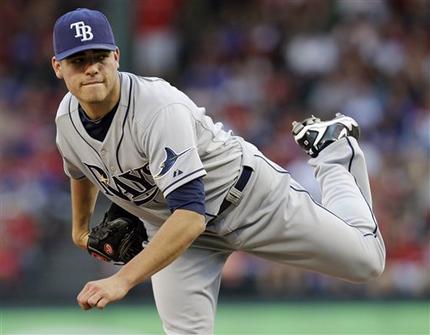
Matt Moore pitched far beyond his experience on Friday. Photo AP Photo/Tony Gutierrez via baynews9.com

When word came out that Tampa Bay’s manager Joe Madden had announced that his playoff game #1 starter on 9/30 (box/gamer) was recent minor league call up Matt Moore, I had a couple of quick thoughts:

  • I wonder how this played out in the Tampa clubhouse; you have starters that labored all year and helped earn the team the playoff appearance, and suddenly your game #1 starter is a guy with a grand total of 15 major league IP?
  • I especially wonder what this says about Jeff Niemann, who in my estimation was the scheduled starter for game #1 and now seems like he may be skipped altogether?

Nonetheless, Moore took the mound in game one against the Texas Rangers, by most measures the best or 2nd best offense in the league.  The game start was mid-afternoon, meaning the stadium shadows would be giving the pitchers a significant advantage.  However, this didn’t seem to bother the Tampa hitters, who battered CJ Wilson for 8 runs (6 earned) and knocked him out in the 6th.

Meanwhile, Moore was nearly as unhittable as he was in his first MLB start, an 11k, 5 inning start against the Yankees B-team.   His line against the Rangers in game 1: 7 shutout innings, giving up 2 hits, 6 k’s and 2 walks.  The two hits were both to Josh Hamilton, who stroked a first-pitch fastball in the first for a single, then nearly hit a solo-homer in the 4th.  Otherwise, Moore was dominant.   Despite “only” getting 62 of his 98 pitches for strikes, he was all over the plate and had numerous pitches called balls that were clearly over the plate.  Pitch F/X, which routinely has difficult times classifying new hurlers and properly categorizing their arsenal, lists Moore with 6 pitches but to me he looks to be a 3 pitch guy so far.  He has a 4-seamer that he commands amazingly well and that he can bring up to 98mph (technically, max of 97.9).  He sits a bit slower, averaging 94.37 on the night.  He also featured a decent changeup, with a 10-12mph difference off his fastball and which he uses as his secondary pitch.  Lastly he has a large off-speed overhand curve that may be a bit too loopy for now; he only threw it four times all night.  He has a very smooth, easy motion and it doesn’t look like he’s throwing nearly as hard as he does.  It isn’t surprising at all that his minor league numbers were so amazing (specifically, 210 Ks in 155 innings between AA and AAA this year).

He predominantly pounded fastballs on the night; 76 of his 98 pitches were fastballs that he moved in and out and commanded effectively.  I wonder if this heavy fastball use is indicative of his normal game plan, or if he was just so overpowering that his catcher just kept calling for the #1 until the Rangers proved they could hit it.  I have a tendency to think it may have been the latter; major league starters who have to go through the lineup three times will only show you one or two pitches if they can, saving the rest of his arsenal for later innings.  If you can get guys out by just using one pitch, you stick with that strategy until proven otherwise.

What does this mean for the rest of the playoffs?  Bad news for opponents: if the Rays could line up Moore along side their top 3 starters (Price, Shields, Hellickson) and skip their less effective starters (Niemann, Davis) then suddenly this is a much more dangerous team than what was predicted a week ago.

What does this mean for the Rays next season in terms of payroll and roster management?  Scary.  The Rays made the playoffs despite shedding $30 MILLION from their 2010 payroll.  Price is on a team friendly contract, Hellickson is pre-arbitration and will make near the MLB minimum.  Sonnanstine and Niemann are both arbitration eligible and could be trade bait to save some cash.  More likely is an off-season trade involving Shields.  He’s coming off a career year and has a $7M club option (along with relatively affordable options for 2013 and 2014).  $7M for a Cy Young candidate pitcher is a bargain and clubs would be lining up to trade prospect depth for him.

Written by Todd Boss

October 3rd, 2011 at 10:03 am

Nats Rotation Cycle #33: good/bad/soso.

2 comments

31 and Done for Michael Morse, capping a fantastic breakout season. Photo Jacqueline Martin/AP via federalbaseball.com

This is it; the last rotation cycle of the season.  And it will be a shortened one; with just 3 games remaining.  But we do get one more start out of Stephen Strasburg as the team improbably has a chance to finish the season with a winning record.  To do it, they’ll have to go into the lion’s den and beat a Florida team that has had its number over the past few seasons.  Here’s the Nats record against Florida over the past few seasons:

  • 2011: 5-10 (not including last three games)
  • 2010: 5-13
  • 2009: 6-12
  • 2008: 3-14 (!)
  • 2007: 10-8
  • 2006: 7-11
  • 2005: 9-9

That’s a total (since moving to Washington) of 45-77.  This clearly needs to improve, especially since in 2011 the team beat or was even with the rest of their NL east opponents.

Good

  • Stephen Strasburg finished off the season with a bang on 9/28 (box/gamer), absolutely dominating the Marlins over 6 innings.  Final line: 1 hit, 0 runs, 2 walks and 10 Ks in just 79 pitches.  Wow.  How’s that for a teaser for 2012?

Mediocre/Inconclusive

  • Tommy Milone labored through 4 1/3 innings before getting an early hook on 9/26 (box/gamer), leaving it for later heroics (aka, Michael Morse’s 9th inning 3 run shot) to get the win.  The mediocre start caps off a pretty good September for Milone, who has certainly staked his claim for the 2012 rotation.
  • John Lannan‘s final 2011 start on 9/27 (box/gamer) wasn’t too bad; 6ip 3 hits and 3 walks resulting in 2 earned runs and a no-decision.  As has been typical in September he was yanked an inning too early (he sat on 89 pitches) and could have gone 7.  None the less, he caps off a great season, his best as a pro, and is clearly the #3 starter on this team going into 2012.

Starter Trends

2nd half
Milone    bad,soso,good,good,soso
Lannan    good,good,bad,soso,good,bad,bad,good,soso,good,bad,soso,soso,soso
Strasburg    great,soso,good,bad,great
Detwiler    soso,soso,good,good,bad,bad,soso,great,good
Wang        bad,bad,great,soso,soso,good,bad,soso,soso,soso,good,good
Peacock    good,good,great

Relievers of Note and other News

  • Mike Rizzo was quoted on 9/25 as saying the team was “an outfielder and a starting pitcher” away from real contention in 2012.  This could be an indicator of the off-season plans of the team (definitely a future blog post).  Adam Kilgore guesses the team could sacrifice some of its starter depth to obtain a center fielder (perhaps again going after someone like BJ Upton).
  • Bryce Harper will play all three OF positions in the AFL, and presumably next season, in preparation for positional flexibility once he arrives in the majors.  This makes sense to me; he’s athletic enough to play some center and has a big enough arm to play right.  Meanwhile Jayson Werth is in the same boat.  Only Michael Morse has positional inflexibility.
  • Stephen Strasburg probably will have a similar 160ip limit in 2012 that Jordan Zimmermann had this year, per various national reports.  What may be interesting is this; if this team, which has already won 78 games and surpassed most people’s predictions of between 72 and 75 wins, continues its improvement into 2012, they very well may be in the thick of the wild card race right at the time when Strasburg is set to shut down.  Would the team shelve him for a month to save innings?
  • With the 9/28/11 victory, the team officially dropped to the 16th draft pick in the first round (here’s your Reverse Standings).  Adam Kilgore commented on this same topic here.  This officially means the team had an unprotected first round draft pick for the first time since the team moved here.  This automatically and drastically changes the nature of our off season FA plans.  Knowing we have to give up the 16th overall pick (even if its a weaker draft) certainly will give pause to the draft-pick coveting front office.  Is CJ Wilson worth losing this pick?
  • Hey, here’s a shock; Doug Slaten blew another game for the Nats on 9/27  This time it was the 2nd to last game, giving up a walk-off homer to a lefty who nobody’s ever heard of to lose the game.  I don’t get it; why was Slaten even in the game?  Here’s his game-log for 2011; since returning from the DL he has had exactly ONE “successful” outing (a one-pitch, one out appearance against Houston).  Every other time he’s given up hits, walked the guy he was brought in to face, or otherwise disappointed.  Here’s hoping the team has learned all they need to learn about him and gives him his walking papers as soon as the season is over.
  • The team and Laynce Nix have “exchanged salary figures” for 2012.  Interesting; if the team locks up Nix for 2012, suddenly there’s one less outfield position available for the slew of guys potentially in the mix.  That most likely means the end of Jonny Gomes tenure here (one that probably was guaranteed by his poor batting average anyway).  The problem is that we likely won’t get the benefit of Gomes’ compensation pick now; he probably would accept an arbitration offering, sticking the team with the player for 2012 and locking up two backup outfielder positions.  Nix had a pretty good year, mostly working in a platoon situation against RHPs, and has some positional flexibilty to play LF, RF and 1B.  He’s also played CF in the past, though he seems too bulky to really be a Rizzo-preferred defender there now.

Now that the season is over, I’ll do a wrap-up of the MLB pitching similar to the other levels, and follow that up with projected 2012 positions throughout the entire system.

My DC-IBWA Ballot…

leave a comment

Nationals News Network blogger Dave Nichols runs a few polls beginning and end of season, hitting up all the Nats bloggers out there for opinions.  Here’s the 2011 post-season results.

Here’s how I answered his questions, with some thoughts added in.

  • Nats MVP: Morse, Clippard and Zimmerman.  For me clearly Morse was this team’s most valuable player this year, going from 4th outfielder to 30 homer clean up hitter in short order.  Clippard was your all-star but Morse was the more deserving candidate.
  • Starter of the Year: Zimmermann, Lannan, Marquis.  I think Zimmermann’s come-back was fantastic, and he was clearly your best arm in the rotation (at least until September).  Lannan continued his boring-if-effective career, and everyone seems to forget that Marquis was pretty good the first couple of months.
  • Reliever of the Year: Clippard, Storen, Coffey (though it pained me to say it).  Finding the first 2 was easy; finding a third reliever candidate who wasn’t mostly awful this season was really tough.  Burnett struggled mightily but turned it around.  Henry Rodriguez has been lights out in September, but September only.  Slaten was awful all year.  Broderick and Gaudin couldn’t exit quickly enough.  Perhaps Mattheus was more deserving of the year-long award.
  • All around Hitter of the year: Zimmerman, Morse, Hairston.  Probably could have switched the first two here as well, based on Morse’s excellent BA with power.  Hairston’s contributions over the course of the season were pretty understated, but he was a solid member of this team.
  • Slugger of the year: Morse, Espinosa, Nix.  Morse is obvious.  Espinosa showed some pretty rare power for a 2nd baseman.  And Nix’s homer/ab ratio puts him on nearly a 30-homer pace for a full season.  Can’t beat that.
  • Defensive player of the year: Zimmerman, Espinosa, (amazingly) Desmond: pretty obvious candidates.  However UZR/150 was not kind to this team generally this year.   Espinosa is a plus defender at 2nd and Desmond made huge strides.  Probably in retrospect should have included Ankiel, who has the best UZR of any near-regular in the lineup.
  • Comeback player of the year: Zimmermann, Wang, Flores: 3 pretty obvious candidates.  We’ll save Strasburg for the 2012 version.
  • Humanitarian of the year: Zimmerman, Desmond, Storen.  I’m only even aware of Zimmerman as someone who has a charity or a foundation.  Desmond was the team’s Clemente nominee, so he must be doing something right.

Lastly:

  • Minor League player of the year: Peacock, Lombardozzi, Moore.

The phrasing of this question threw me off.  The minor league “player of the year” is DIFFERENT from “player most destined for big league success,” which was the explanatory text Nichols put into the survey.  Clearly Peacock and Lombardozzi were our minor league players of the year and were so awarded by the team, but I’m not sure either is really a top-ceiling MLB prospect.   Our three best prospects most destined for success in the majors (<2011 draft version) are probably Harper, Cole, and either Solis or Ray.  Throw in the 2011 draft and that list probably becomes Rendon, Harper, Purke.

Additional Questions: here’s a few add-on survey questions.

1. Players we’re parting ways with after 2011: Livan, Coffey, Balester, Slaten, Pudge, Cora, Gomes, Elvin Ramirez.  This implies we’re going to keep Gorzelanny, Wang, Bixler, Nix, Ankiel and Bernadina.  I’m guessing Bernadina passes through waivers and stays.  Gorzelanny becomes a long reliever.  Wang resigns, Nix stays on as the 4th outfielder and Ankiel sticks in CF.
2. Does Zimmerman sign an extension this coming off season?  No; he’ll sign it AFTER the 2012 season.
3. Biggest Surprise: Morse clearly.
4. Biggest Disappointment: LaRoche.  Maya 2nd.  Lots of people will say Werth, but in the end we all kinda knew the contract was a mistake and he’s struggle to live up to it.  LaRoche was supposed to at least contribute, and he did nearly none of that.
5. Favorite pro beat writer: Zuckerman
6. Favorite Nats blogger: Love Sue Dinem’s work; my blog would be twice as hard without it.

MLB Divisional Series Predictions

5 comments

After a pretty unbelievable 6 minutes last night, where the Red Sox snatched defeat from the hands of victory and then the Rays had a walk-off win to an amazing comeback (not to mention the Braves losing a heart-breaker to finish off their own September collapse earlier in the nigth), we have a completely different playoff picture than most people predicted just last week.  Lets take a look and put up some predictions.

First off, 3/8ths of these teams were in such scramble mode just to make the playoffs, they havn’t really even declared probable pitchers yet.  But i’ll put in some guesses.

GM# Home-Visitor Visiting Starter Home Starter Advantage
1 Det-NYY Verlander Sabathia Det
2 Det-NYY Fister Nova NYY?
3 NYY-Det Garcia Scherzer Det?
4 *NYY-Det Sabathia Porcello NYY
5 *Det-NYY Verlander ? Det
1 TBR-Tex Neimann Wilson Tex
2 TBR-Tex Shields Holland TB?
3 Tex-TBR Lewis? Price? TB
4 *Tex-TBR Harrison Hellickson? TB?
5 *TBR-Tex Neimann? Wilson Tex
1 Ari-Mil Kennedy Gallardo Ari?
2 Ari-Mil Hudson Marcum Mil
3 Mil-Ari Greinke Saunders Mil
4 *Mil-Ari Wolf Collmeter Ari?
5 *Ari-Mil Kennedy Gallardo Mil?
1 Stl-Phi Lohse Halladay Phi
2 Stl-Phi Garcia Lee Phi
3 Phi-Stl Hamels Jackson? Phi
4 *Phi-Stl Oswalt Carpenter Stl
5 *Stl-Phi Lohse Halladay Phi

By Series Thoughts:

  • Detroit-New York: Detroit took the Season series 4-3 and is on a roll.  New York basically has no idea who is going to pitch the 3rd game (Garcia?  Colon?  Burnett?) or the 5th game, and the 4th game would be Sabathia on 3 days rest.  Detroit is essentially a 1 1/2 pitcher rotation right now, with Verlander unbeatable and Fister just as good.  Game 3 is the toss-up; which 4+ ERA starter will cave first?  Prediction: Detroit in 5.  Supplemental prediction: New York over-reacts and gives CJ Wilson $180M in the off season after having zero pitchers left in game 3.
  • Tampa Bay-Texas: Texas took the season series 5-4, but Tampa is obviously hot entering the post-season.  Tampa’s pitching staff was shredded just to get into the playoffs, leaving them at a disadvantage.  They burned their ace Price last night (and he got hammered), meaning they likely can’t use him til game 3.  Meanwhile, arguably their 5th best starter (Neimann) looks likely to get two starts because of the scheduling.   Unless the team puts uber-prospect Matt Moore on the roster and puts him into the rotation.  Despite all that, the Rangers themselves have a conundrum in that the matchups don’t really favor them, at all.   I don’t think the Rangers can beat Shields in game2, and may struggle to beat Price with their #5 starter Colby Lewis going in game 3.  The pivotal game is game 2: can Texas hold serve at home?  Prediction: Tampa in 4.
  • Arizona-Milwaukee: Arizona took the season series 4-3.  This is a strange series; if Arizona’s pitching is for real, this could be a great series.  If not?  It could be a quick sweep for Milwaukee.  Arizona needs to win both of their Ace Ian Kennedy’s starts to have any shot, but both will be on the road.  The pivotal game could be game 4, with the veteran Randy Wolf going against the surprising elder rookie Josh Collmeter.  Prediction: Milwaukee in 5.
  • St. Louis-Philadelphia: the one team Philly didn’t want to see in the post-season; St. Louis took the season series 6-3.  However, Chris Carpenter was burned just to get into the post season, meaning they likely won’t see him until game 4.  By which point Philly may very well have swept this series.  St. Louis’ pitching isn’t that great this year, with all their starters posting good ERAs but not really dominant lines.  Philadelphia really struggled down the stretch; we’ll find out soon enough if its because they were tired or just complacent by having locked up the #1 seed so early.  I’m guessing their 4-game winning streak to end the season (including the dagger-like 3-game set in Atlanta to cost them the WC) means they’re geared up.  Prediction: Philadelphia in 3

If this plays out, we’re looking at Milwaukee-Philadelphia and Tampa-Detroit for ALCS.  Not as compelling as MLB wants, but some good story lines none the less.  Could be a Philly-Tampa 2008 rematch world series.  We’ll revisit predictions after the divisional rounds are complete.

Wild End to the season; WC race predictions…

2 comments

Who in the world would have thought the Wild Cards would come down to the final day?  Just a few weeks ago columnists were lamenting the lack of any pennant races when all 8 playoff spots looked locked up.

Now we have FOUR do-or-die baseball games tonight.  All going on at roughly the same time (three 7:10 and one 8:10 start).  Get your MLB network channel listed (its 213 on Directv) because it will probably do drop ins all night ala the Red Zone channel.

Anyone want to offer predictions on these four games?  Here’s your probables tonight per si.com and mlb.com (since si.com doesn’t list all the games).

  • Boston at Baltimore: Lester vs Simon.  Boston gets its ace, and its one remaining halfway decent starter, with the season on the line.  But he’s *really* struggling down the stretch and has gotten more or less hammered in his last three starts.  And will be going on 3 days rest.  Simon is only marginally better in September and had a mediocre season.  Prediction: Boston in another 8-7 drama-filled slugfest.
  • New York Yankees at Tampa Bay: TBA vs Price.  The Yankees are probably starting a Sept 1 call up, prepping their rotation for the playoffs, while Tampa gets its ace.  Prediction: easy win for Tampa.
  • St Louis at Houston: Carpenter vs Myers.  Another “ace versus ace” in name only; Carpenter is clearly the superior pitcher here.  However Myers is finishing very strong.  St Louis unloaded on Houston pitching last night for 13 runs an 17 hits, but tonight’s game will be low-scoring.  Prediction: Cardinals get to the Houston bullpen and win a low-scoring one on Carpenter’s complete game.
  • Philadelphia at Atlanta: Blanton vs Hudson.  Philly starts Blanton, who is not even in the rotation any longer, in what will be a bullpen, get guys some work, setting things up for the playoffs.  Meanwhile Atlanta sends out its Ace.  Advantage Atlanta.  If the Braves get 3 runs early, Hudson gets the win (he’s something like 146-1 in his career with a 3run lead or more).  Prediction: Atlanta in an easy victory.

So, i’m predicting two ties and all four teams in the WC chase to win.  Probably won’t happen this way, but so be it.  If all this happens, here’s what would probably go down for 1-game playoffs:

  • Boston would travel to Tampa Bay: Either Wakefield or Lackey would go on 3 days rest versus (likely) Neimann for Tampa.  I say likely since Neimann only went a couple innings in his last start.  Tampa could also go with Matt Moore, who only had 15 kis in his first 9 1/3 innings pitched in the majors.  Advantage clearly to Tampa Bay here; Boston can barely put together a playoff rotation right now, let alone guarantee a couple more wins this week.
  • Atlanta would travel to St. Louis: It would probably be Brandon Beachy vs Kyle Lohse.  Young strikeout guy versus crafty veteran.  I’d say advantage goes to St. Louis.  If St. Louis makes the playoffs watchout; they beat the Philles 6 out of 9 in the season series, have the pitching and have the managerial advantages to go far.

No matter who takes either wild card, they’re all at major disadvantages heading into the playoffs.  All four have burned their aces this week just to get to the final game and thus are only guaranteed one start in a playoff series from their best guy.  Meanwhile the division winners they’d likely face are all setting up their playoff rotations well.  Something to take into consideration for those that want to predict a wild-card divisional series winner.

I’m pretty excited for tonight actually.  How about you guys?

My Answers to Boswell’s Chat questions 9/26/11 edition

2 comments

After a week’s break (vacation?), Tom Boswell was back with his weekly chat on Monday 9/26/11 on all things DC sports related. He went at it for hours, starting around 9:30am and still taking questions well into the 1pm hour.

Here’s how I would have answered his Baseball/Nats related questions, with the “questions” edited for clarity here and with me answering prior to reading down to see his answer.

Q: Did Davey Johnson pull some bush-league moves by replacing his pitcher with 2 outs in the 9th inning of a 6-0 game?

A: Yeah, probably a little.  There had to be some context to the move unknown to the casual viewer.   Boswell didn’t know either, but will follow up.

Q: Is our young pitching going to be another Braves 1989 situation?

A: Man one can only hope so.  They say to “beware of results in September” and I agree, but man it isn’t hard to get excited watching 4 guys who were pitching in the minors in April throwing quality starts night after night.  And not just Quality starts, but 5-6 innings of shutout ball.  2012 looks to be more and more interesting by the day.  Boswell chides not to get tooooo excited, and quotes the FIPs of all these pitchers.  Fair enough.

Q: Just how close is this team, given its recent run over teams like Atlanta and Philadelphia?

A: Closer than we may have thought.  I think most of us were predicting 72-75 wins.  78 Wins with a hot baseball team going down to visit a not-so-hot one to finish out the season could very well end up with an 80-81 season.   Here’s this team’s record since arriving here:

  • 2005: 81-81
  • 2006: 71-91
  • 2007: 73-89
  • 2008: 59-102
  • 2009: 59-103
  • 2010: 69-93
  • 2011: 78-80 (with 3 games left)
The team improved 10 games from 2009 to 2010, and looks set to improve another 10 games or so in 2011.  If you turn in another 10 game improvement in 2012 suddenly you’re a 90 win team and you’re challenging for a wild card spot (The Braves are 89-70 and lead the NL wild card race by 1 game as of 9/25/11).  Now, improving from a .500 team to a .560 team is much tougher than going from a 59 win team to a 69 win team.  So 2012 may be really promising.  Teams can vastly improve; The Brewers may improve 20 games over last year.  But generally its a slow moving process.  Boswell talks about the vast pitching improvement and spends a lot of time talking about average mph of fastballs over the years.

Q: Thoughts on Moneyball?
A: Havn’t seen the movie but read the book.  I concur with a lot of Buzz Bissinger‘s anti-moneyball rant.  The book and its premise fail with two basic facts:
  1. There is scant credit given to the real source of the early 2000 A’s success; Their starting pitchers of Zito, Mulder and Harden Hudson.  All three home grown sure, but all 3 predating Billy Beane.
  2. The 2002 A’s “moneyball draft” was an abject failure, resulting in one decent-to-good player (Nick Swisher), one mediocre starting pitcher (Joe Blanton), one utility player (Mark Teahen) and 4 guys who never even made the majors (I am including Jeremy Brown here, who did make the majors and had a grand total of 10 at-bats).  I’m sorry; 7 first rounders or supp-1sts should have resulted in FAR more than what it did.  If anything the money-ball approach they took in this draft was proven to be absolutely wrong.

Thankfully, Boswell agrees.

Q: Can players like John Lannan be perpetual exceptions to stats guys, not the rule?

A: In certain cases sure.  Nyjer Morgan (a heavy bunter) will always have an artificially high BABIP.  Mariano Rivera (because he’s so frigging good) will always have artifically low BABIPs.  John Lannan?  Its hard to explain.  Year after year we have watched him put together decent-to-sneaky good seasons of > 100 ERA+, sub 4.00 ERAs.  But what about his advanced pitching stats?   Year after year his FIP has been a point or more higher than than his ERA.  This year is lesser so, but still the case where his Fip and xFip trend higher.  His k/9 is up, his bb/9 is up, his BABIP is normalized for the league (if anything slightly high).  I’m agreeing with the questioner; Lannan seems to be an exception outside the normal rules of FIP.  Boswell says that stats don’t get ground-ball pitchers who get a lot of GIDPs.  Hmm good point.

Q: Will the Nats win the World Series in 2013?

A: That’s a bold, bold prediction.  My personal prediction is just playoffs in 2013.  World Series is a tough draw; the first time this team hits the playoffs you’re going to see some starry-eyes, some “just happy to be here” moments.  It usually takes the 2nd time through the post season to give guys some stability.  Boswell agrees, and later on says that the team needs to extend Ryan Zimmerman.

Q: Would the Nats consider trading Clippard and/or Storen?

A: I personally hope not as a fan; these two guys are a huge part of why the bullpen has suddenly become one of the game’s best.  But, the truth is relievers are fungible assets that can be replaced rather easily (especially on the FA market, where there’s a TON of closers available this off season).  Boswell didn’t answer this part of the question.

Q: If Strasburg is going to have an IP limit, why not just wait to start him in June?

A: Because if you’re already 10 games under .500 by June, you’ve wasted your season anyway.  Boswell’s answer made me laugh: “you really need to become a Redskins fan.”

Q: Predict the Nats infield in 2013?

A: Morse at first, Rendon at 2nd, Espinosa at short and Zimmerman at third.  I’m guessing that Espinosa can ably cover shortstop while hitting 20-25 homers consistently, while Desmond will fetch a decent trade return.  Boswell predicts the exact same lineup.

Q: What do you make of David Ross (Braves catcher) quitting against Henry Rodriguez? [facing an 0-2 count, he attempted a bunt, tacitly admitting he had no shot of actually hitting his fastball]?

A: I don’t know what to make of it.  A major league hitter should be able to hit a 100mph fastball, and shouldn’t be playing if they couldn’t.  Maybe not hit it consistently, but at least have a puncher’s chance.  I havn’t seen someone so blatantly give up against a pitcher since high school (when we faced Pete Schourek and our lowly #8 and #9 hitters just flailed at his upper-80s fastball).  Boswell agrees.

Q: Comment further on Harper’s “being slowed” by AA pitching in the latter half of 2010?

A: I’d say that he finally got promoted to a level commensurate with his skills.  It makes you wonder if he started in the wrong level of A-ball.  AA pitchers are generally your team’s rising stars, your best prospects.  They’re the cream of the 4 levels of minor league ball below it.  It isn’t that big a worry that Harper struggled; lets just see how he adjusts next spring.  There could also be some fatigue factor going on; day in and day out baseball grind can be awful tough to adjust to for younger guys who are used to playing (at most) every few days in high school, or weekends only in amateur/traveling leagues.


GCL/Rookie Pitching Staff year in Review; 2011

leave a comment

We’d like to get Jack McGeary back on the field, pitching. Photo via capitoldugout.com

The GCL rotation is always one of the most difficult to follow, with pitchers flowing regularly in and out of rehab sessions and starters sometimes throwing fewer innings than their relievers.  Our GCL roster was filled with 20-somethings, a result of a large influx of college pitchers via the draft the past couple of years.  Its also the natural entry point for DSL grads, who graduate from the island to Viera each spring.  And this year, our GCL team was *bad*.  We were just a half-game better than the worst team in the league and didn’t name a single player to Baseball America’s season-end top 20 prospects list.  Picking a name-sake was difficult, to say the least.

Here’s the status of the GCL pitching staff at the end of the season (ages are as of 9/30/11)

  • Rotation: Baez 19, King 21, Encarnation 20, McGeary 22, Mieses 21
  • bullpen: Ferrer 21, Heredia 19, Herrera 21, Lucas 24, Simko 22, JSmith 21, CDavis 21, Peters 20, ASantana 20, Williams 21, Harper 21, Lee 21, Monar 20
  • Spot Starts: Medina 21
  • promotions: Cole and Ray (sort of), Meza, Karns, Hanks, McKenzie, Hawkins
  • Up-and-back: Medina
  • dl: Marcelino 18, Anderson 22
  • missing: Brazoban, Paredes

GCL starters.  The “rotation” started the season with Karns, Baez, Mieses, King, and Meza.  Here’s how these guys and the rest of the pitchers fared in 2011.

    • Nathan Karns finally looks healthy and spent most of the season in Auburn.  See the Short-A post for his review.
    • Gregory Baez is a DSL grad who looked pretty good this year; in 13 appearances (11 starts) he posted a 3.72 era.  Outlook for Next Season: rotation in Short-A.
    • Adalberto Mieses is another DSL grad who struggled this year, putting up a 6.75 era in 8 appearances and four starts.  Outlook for Next Season: repeating the GCL, perhaps in the rotation.
    • Brandon King struggled for the third consecutive year in GCL (though I believe he was hurt in 2010) after signing out of high school as a 27th rounder.  Outlook for Next Season: Back in the GCL or out of the system.
    • Christian Meza got a “start” (one of the early games where two guys each threw 4 innings), pitched well and was promoted up to Auburn, where he played most of the season.  See the Short-A post for his review.
    • Pedro Encarnation finished his 2nd straight year in the GCL, failing badly in short-A and not posting very impressive stats in the rookie league.  Outlook for Next Season: Back in the GCL or out of the system.
    • Silvio Medina appeared in short-A briefly but had 9 appearances (5 starts) for GCL.  He posted a 6.61 era in 32 2/3 innings.  Outlook for Next Season: Back in the GCL.
    • Jack McGeary was probably the most important name to pass through the GCL, coming back from Tommy John surgery after a ballyhooed career thus far with the team.  On the bright side he looked sharp in 5 starts (2.81 era in 16 ip), and on the bad side he suffered a small injury that sent him to the DL to end the season.  He’s rule-5 eligible this off season but clearly is a reclamation project.  Lets just hope he can regain some form that earned him the big bonus out of high school.  Outlook for Next Season: Back in the Hagerstown rotation for one more shot at resurrecting his career.
    • Anthony Marcelino had a spot start and 3 appearances before going on the season-ending DL after graduating from the DSL.  Outlook for next season: get healthy, back in GCL.
    • Other starters who appeared: Matt Chico had a couple of starts while the team decided what to do with him.  Chris McKenzie had two ineffective starts before ending up back in Hagerstown to end the season.  Doug Slaten had one rehab start.


GCL Relievers: taking a look at the relief corps at the end of the season, and talk about other hurlers on the team.  Most of these sample sizes are so small (most of the relievers in the GCL only threw between 5-10 innings all summer), its hard to really pass judgement.  So we’ll group them by age/experience mostly.

  • SmithLee, Williams, Davis, Monar, Simko, and Harper should all be in the Short-A pen in 2012.
  • Herrera, Santana, Peters, Ferrer, Ramirez, and Schill probably all end back up in the GCL pen in 2012.
  • Bobby Lucas is a 2011 draftee out of GW who came out of college very old (he turned 24 in August).  He was very effective in the GCL but is well behind in his advancement based on his age.  Based on this we may see him pushed to start higher than his other GCL bullpen compatriots (probably low-A).
  • Mark Herrera is an interesting case; he was effective in short-A in 2010 but missed out on the level (perhaps coming off injury?)  He should clearly be in the mix to move higher than his other GCL teammates next year.
  • Patrick Arnold was demoted from Hagerstown out of spring, pitched a few effective innings then was released.  He was in his 4th pro season and just wasn’t advancing like he needed to.
  • Garrett Mock may have really been rehabbing, but his “assignment” to GCL and his extended stay said more about the pitcher’s future in the organization than one might think.  He was eventually DFA’d and accepted an assignment to AAA.
  • Other relievers (non-rehab) who put in GCL innings: Tyler Hanks ended the season in Auburn and should go back to Hagerstown for 2012.   Ben Hawkins did the same.  Christian Meza quickly moved up Auburn, where he ended the season in the short-A rotation mix.
  • Trevor Holder put in a bunch of “rehab” innings and was hit hard, indicative of his relative skill level once he returned to Potomac.

The further away from the majors, the harder it is to project these guys.  But hopefully we’ll see some GCL grads making their way up the system and having an impact.

Auburn/Short-A Pitching Staff year in Review; 2011

6 comments

Nathan Karns looks to resurrect a promising career. Photo via perfectgame.org

Because of life changes and lack of spare time, I stopped doing the daily reviews of the minor league pitching rotations in early august.  This was too bad, because I didn’t adequately track which 2011 draftees were placed with which team.  We’ll do some quick catch-up here.

Here’s the status of the Auburn pitching staff at the end of the season (ages are as of 9/30/11)

  • Rotation: Estevez 19, MRodriguez 22, Meza (L) 21, Dupra 22, Karns 23, Hill 22
  • Bullpen: Kreis 22, Henke 22, Mirowski 22, Barrett 23, MRivera 24, Grisz 21, Hawkins (L) 21, Hanks 21, Bates 23
  • spot starts: Jenkins(L) 22, KLopez 21
  • promotions: Holland, Bronson (down and back), Holt, Demmin, CGarcia
  • up-and-back: Hanks, Bates
  • demotions: McKenzie (sort of), Encarnation, Monar

Auburn starters.  The rotation started the season with Demmin, Estevez, Encarnation, KLopez and Bates.

  • Ryan Demmin‘s short-A career was “short,” lasting 5 mostly good starts before being promoted up to high-A.  He eventually settled in Low-A and was reviewed thereOutlook for next season: (from high-A post): Potomac middle reliever.
  • Wirkin Estevez was the workhorse of the short-A squad, making 14 appearances (13 starts) and posting a respectable 4.01 era as one of the younger pitchers in the league as a 19yr old.  He was up and down in his starts; some good to great, some bad to awful.  He’ll need to be more consistent going forward to stay in the rotation.  Outlook for next season: The 2010 Dominican Summer League (DSL) grad should graduate to low-A, though I’m not sure there’s room for him in the rotation.  I’m guessing he’s a bullpen arm there.
  • Pedro Encarnation had three mostly bad starts before getting demoted to GCL.  We’ll review him there.
  • Kelvin Lopez, despite being one of the first starters through the rotation, was really just putting in a spot start and pitched mostly out of the bullpen.  He was relatively effective in the short season, posting a 3.65 era in 10 games and 24 2/3 innings.  Outlook for next season: Entering his 4th pro season he should feature in the Hagerstown bullpen, but the competition there will be crowded.  He had better numbers than most of his 2011 Hagerstown competition and should stick.
  • Colin Bates started hot in the rotation, got promoted after 7 starts, then floundered in Hagerstown before getting dumped back to Auburn in late august, where he worked out of the bullpen.  His ERA was good in short-A (2.25) and was an improvement over 2010, but he’s already old for the level and needs to improve for next year.  Outlook for next season: Potomac middle relief on a short leash.
  • Manny Rodriguez was one of the first 2011 draftees to appear in our system, signing quickly as a 10th round pick and pitching 50 innings over 14 appearances and 12 starts in Auburn.  Results?  2-3 with a 4.65 era in his first pro season.  Like a lot of guys coming off full college seasons, he seemed to tire in his late August starts.  Outlook for next season: Repeats Short-A as a starter.
  • Christian Meza started the season in the GCL, then was promoted after two appearances to join the Auburn rotation.  He had 10 starts and posted a 5.68 era in them.  Outlook for next season: with all the starter prospects we drafted in 2011, I think Meza drops to the bullpen and repeats Short-A in 2012.
  • Brian Dupra was another 2011 draftee (a Senior out of Notre Dame) who featured as predominantly a starter in Auburn.  He had better results than some of his draft day compatriots, posting a 4-4 record with a 3.46 era in 54 2/3 innings.  Outlook for next season: he starts the season in the Short-A rotation after staying behind in extended spring training.
  • Nathan Karns has been an enigma so far in his Nats career.  A 2009 draftee, he never appeared professionally after signing, then missed all of 2010 with an injury.  The team started him slow in 2011, giving him 5 starts in the GCL (where he didn’t allow a run over 18 innings while giving up just 2 hits), and then giving him another 8 good starts in Auburn, where he was a respectable 3-2 with a 3.44 era.  He was rather wild on the season, with nearly as many walks as strikeouts, but the promising arm drafted 2 years ago seems to be back.  Outlook for next season: He’ll compete for a rotation spot in Potomac but may settle for a bullpen role.
  • Taylor Hill was another 2011 draftee who featured in the Auburn staff, getting five late season starts after pitching out of the bullpen after signing.  His control was impeccable; 27Ks against just 3 walks in 31 innings, and his 5 starts were stellar; a 2.38 ERA in those appearances.  Outlook for next season: He was a college senior draftee and will play next year as a 23 yr old.  I think he’ll win a spot in the Potomac rotation out of spring.

Auburn Relievers:

  • A slew of 2010 and 2011 draftees pitched out of the Auburn bullpen and struggled.  Kreis, Henke, and Barrett each posted eras in the 4-5 range for the 2011 squad.  None of these guys were high round draft picks and were always meant to be primarily organizational guys unless proven otherwise.  Barrett was mostly used as the closer and had 32 ks in 26 innings, but also had a ton of walks and a 4.05 era.  Outlook for next season: All 3 back in Short-A bullpen.
  • Chad Jenkins survived his third pro season and put up good short-A numbers in a combo role of loogy and long relief.   Unfortunately he had more walks than strikeouts, and time may be running out for the 2009 17th rounder.  Outlook for next season: another shot at the Hagerstown bullpen, with the firing line if he can’t cut it in his 4th pro season.
  • Manuel Rivera is a long serving DSL grad finishing his 5th pro season in our system.  He put up good short-A numbers in a relief mode (3-0, 2.81 era in 20 appearances) and may be a Dominican Republic find.  Outlook for next season: he moves up to the Hagerstown bullpen to give full-season baseball a shot.
  • Mirowski, Grisz, Hawkins and Holt all pitched really well in the Auburn bullpen after being 2011 draftees (or in Grisz’ case a non-drafted FA find).   Holt was promoted up to Hagerstown and finished the season there.  Outlook for next season: all four could be in the mix for a full-season bullpen job, or could find themselves back in Short-A if they don’t make the team out of extended spring.
  • Tyler Hanks bounced around the low minors this year, pitching lights out in the GCL before struggling in low-A and ending the season in the short-A bullpen.  Outlook for next season: he should get another shot at the Hagerstown bullpen.
  • Others who appeared briefly: Christian Garcia was a waiver claim mid-season from the Yankees; he threw a bunch of good innings in Auburn before moving back where he belonged; AAA.  Blake Monar threw a few innings then decamped back for the GCL.  Lastly Silvio Medina did the same as Monar, pitching mostly out of the GCL.

Its hard to predict where a lot of these guys will end up; the team drafted SO many arms in 2011, mostly older college guys, that we may very well see a ton of churn in the bullpens of Hagerstown, Potomac and Auburn for next year.  Plus we’ll have a new wave of rizing DSL stars and 2012 signees to consider once these teams are put together.  So predictions are tough.