Nationals Arm Race

"… the reason you win or lose is darn near always the same – pitching.” — Earl Weaver

Archive for the ‘Majors Pitching’ Category

NL East Rotation Preview

3 comments

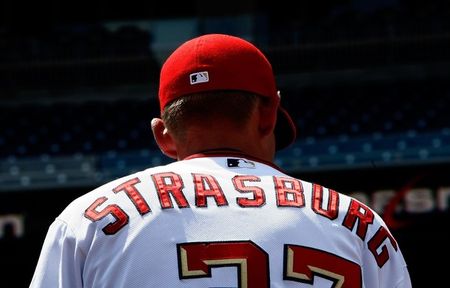
Remember this guy? He’ll be 100% for next spring and may spell a changing of the guard in the division. Photo via AllansGraphics.com

With major moves being made this off-season for the rotations of the NL East teams, we seem set to be in store for some serious pitching duels intradivision in 2012.  How do the rotations stack up, right now?  If the season started tomorrow, here’s what we’d be looking at for rotations:

Philadelphia Atlanta Miami Washington New York
#1 Halladay Hudson Johnson Strasburg Santana?
#2 Lee Jurrjens Buehrle Gonzalez Dickey
#3 Hamels Hanson Sanchez Zimmermann Pelfrey
#4 Worley Beachy Nolasco Jackson Niese
#5 Pineiro Delgado Zambrano Wang Gee
In the mix Blanton, Kendrick, Willis? Minor, Teheran Vazquez?Volstad, LeBlanc Lannan, Detwiler, Gorzelanny Young? Schwinden?

By team, some observations:

  • Philadelphia plans on replacing Roy Oswalt‘s 2011 starts with a call-up who looked pretty good last year in Worley. Joe Blanton looks like the odd-man out and his $8.5M salary may be wasted by virtue of an underrated but saavy acquisition of Joel Pineiro.  The Oswalt trade didn’t give the team what it seeked (a World Series title) but it didn’t cost them a ton in prospects either (JA Happ didn’t exactly light it up for Houston).  They’ve signed Dontrelle Willis for rotation depth.  Still, you can’t argue with three Cy Young candidates at the top of your rotation, and this team remains the team to beat in the division despite injuries (Ryan Howard) and aging (every single projected starter not named Hunter Pence is 30 or older, and Pence will be 29).   The pitching staff was #1 in ERA in the NL and I can’t imagine them dropping far from that.    If Worley performs like he did in 2011, and if Pineiro returns to his St. Louis form, then this is just as tough a 1-5 as last year.
  • Atlanta should have won the wild card last year and seems set to roll out a rather similar rotation this year.  They’ll replace their worst starter Derek Lowe with starts from one of three up-and-coming rookies (I’ve got Delgado slated there now but likely Mike Minor wins the #5 spot in spring training) and should be improved.  Hudson is a year older and hasn’t missed a start in 2 years, but is slow coming back from off-season back surgery and may or may not be ready for opeing day.  The staff was #4 in the NL in team ERA and should do nothing but improve … but there’s some serious injury question marks.  Their incredible SP minor league depth should get them through.
  • Miami has a some major question marks, despite acquiring Mark Buehrle to slot into their #2 spot.  They will cross their fingers on Josh Johnson; if he’s not healthy this team will be really hurt.  Nolasco can be brilliant or awful from start to start.   We still don’t know if Vazquez is retiring or returning; my initial guess would have been that he was too good in 2011 (3.69 era, 106 era+) and too young (reportedly 34 but i’ve never heard of any age-questioning here) to retire.  To provide cover though, the team traded for the volatile but possibly still talented Carlos Zambrano to slot in at #5.  Which Zambrano will they get?  And will his notorious clubhouse antics gibe with new hot-head manager Ozzie Guillen? On paper, a 1-5 of Johnson, Buehrle, Nolasco, Sanchez and Zambrano spells an awful lot of power and a lot of Ks.  They could be tough.  They should improve on last year’s #10 team ERA ranking.
  • Washington just got a lot better, replacing 29 mostly awful Livan Hernandez starts with a healthy Stephen Strasburg and likewise replacing 35 combined mediocre starts out of Jason Marquis and Tom Gorzelanny with newly acquired power lefty Gio Gonzalez and power righty Edwin Jackson. They were 6th in the NL in team ERA, have mostly the same bullpen in place (5th best in the league in ERA in 2011) and seem set to improve.   Chien-Ming Wang seems set for the #5 spot, leaving John Lannan potentially being the most expensive pitcher in Syracuse.   The jeopardy the team now has is an utter lack of starting pitching depth; Peacock and Milone WERE our 2012 rotational safety nets; now we have just Detwiler, Gorzelanny and a couple guys who clearly seem to be AAA starters.  For this reason the team probably keeps Lannan around with the eventual goal of having him provide cover until our next wave of high-end pitching prospects develop.  Either way, this rotation and bullpen look to be improved from 2011.
  • New York faces a grim 2012, not only in the rotation but also in the front office.  We’re hearing reports that Johan Santana is still too hurt to make opening day (though he’s since spelled some of these concerns with his first spring training outing).  Converted knuckleballer R.A. Dickey spent his off-season in a nasty fight with management over his charity climb of Mt. Kilimanjaro.  All their other starters posted ERAs in the mid to upper 4’s (or worse) with ERA+ figures in the 78-82 range.  And there doesn’t seem to be help coming on the Free Agency front (since the team can’t afford to keep operations running without bank loans) or on the prospect front (a quick glance at their AAA and AA starting talent resulted in ONE starter who had a minor league era in the respectable range, an 18th rounder in AA).  I think this team is finishing dead last in 2012 and may lose 100 games despite their payroll.  And to add insult to injury, the owners were just forced to cough up $83 million in a pre-trial settlement over their Madhoff scandal involvement.  Tough times are ahead for the Mets.

What do you guys think?  In terms of Washington, more than a few pundits have stated that the addition of Gonzalez makes the Nats a wild card contender, right now, and that was before the Jackson move finally brought some plaudits from typically cynical national baseball writers when considering signings by this franchise.

Do you think the Nats have now supplanted the Braves as having the 2nd best rotation in the division (as ESPN’s Buster Olney is opining?)  I think they have; I think Atlanta’s starters may be taking a slight step back while our quintet looks to be a solid, young but relatively experienced core.

Can we put the “Bryce Harper will make the team” stories to rest?

8 comments

We all know what Harper’s potential is; but shouldn’t we wait until the ramifications of early promotion have passed? Photo unknown via curlyw.mlbblog.com

Davey Johnson inadvertently has started a storyline that just won’t go to bed; by saying that he wants Bryce Harper to break camp with the 25-man team, national writers and local beat reporters keep reporting about the possibility of Harper playing RF for the team on opening day.

Here’s the facts that that these reporters conveniently forget:

  1. If Harper starts the season with the big league club, then he reaches Free Agency one year earlier.
  2. If Harper joins the big league club after mid April but before mid-to-late June, then the financial penalties to the club are severe.

In case you weren’t aware of these two issues, lets discuss.

1. Reaching Free Agency a year early: See this excellent Service Time Consideration post from Ben Nicholson-Smith at mlbtraderumors.com.  Simply put, if the Nats start Harper with the big league club as of April 1st, then he will be eligible for free agency at the end of the 2017 season.   If we wait a few weeks, then that buys the club an entire extra season of Harper’s time for the 2018 season.  As has been put simply by other writers, a few weeks of Harper’s rookie season at age 19 is absolutely not going to be worth the value he will provide to the team during an entire 2018 season, by which point he looks to have many full seasons of experience and should be nearing his baseball peak at age 25.

2. Super 2 Status implications: As we should all know by now, the financial implications of bringing up super stars too early can be severe.  Dave Sheinin did this analysis best back when we were asking the same question about Stephen Strasburg, looking at the Tim Lincecum case as a lesson learned.  The Giants called up Lincecum about two weeks prior to the Super-2 status deadline and it has roughly cost them $18million in unneeded salary.

Lots has been said about how Davey Johnson broke camp with two young superstars in Dwight Gooden and Daryl Strawberry during his time with the Mets in the mid 1980s, with the narrative being that he’s not afraid to give young players a shot early.  That’s a great story but it omits one key point: the Super-2 status didn’t exist when Johnson made these decisions!   The Super-2 status didn’t exist in the Collective Bargaining Agreement until 1990, when the players negotiated in the status as a way of getting more money earlier to their union members.  A great idea at the time, but it has had the unintended effect of teams now keeping their best prospects in the minors until the mid-June time-frame as a way of gaming the system and keeping their pay low.

Frankly, I’m tired of reading stories about Harper that don’t at least tacitly acknowledge these two important points, and to me any story that talks of Harper making the team blindly without addressing these two modern baseball issues is lazy sports writing.  Johnson may want the guy now, but Mike Rizzo is the guy who has to answer to fans as to why the Nats won’t be able to get a free agent in 3 year’s time because of the payroll implications (upwards of $18M in some cases) of screwing up these decisions.  $18M in payroll generally buys you two starting players on the free agency market, and those two players can make the difference far more than a few weeks of Harper hitting .200 as a 19-yr old.

Honestly, everyone thought that this issue would have been addressed in the latest version of the CBA, negotiated ad-naseum over the past off season.  The clause helps no one; players are kept in the minors longer to game the system, teams have to wait to bring up players that could help them win now, and fans are forced to wait to see the best young stars.  Instead the two sides managed to make the situation WORSE, by increasing the percentage of players that qualify for Super-2 and now forcing teams to keep players in the minors even longer.  It was an inexplicable decision by both sides to further exacerbate the problem.  I realize that no matter what you do, there has to be a cutoff date for service time deadlines to qualify for free agency and/or super-2 status, but why no just make that date early in the season and fix all the problems caused by super-2?

As a fan of the team this season, yeah I’d love to see Harper up and starting in RF.  Who wouldn’t?  But as a long term fan, I want this team to have the best chance of winning for years to come.  And thus I want Harper in the minors until these two issues are non-issues any longer.

Updated Minor League Rotation Predictions for 2012

11 comments

Solis’ TJ surgery news thins our already-too-thin starting pitching minor league depth. Photo via Natsinsider blog/Mark Zuckerman

With Spring Training in full swing, most of the focus is on the Nationals 25-man roster and who may or may not make it.  Even with the additions to the major league roster, our minor league starter development is still incredibly important to this team for the long run.  Despite having Strasburg, Zimmermann and Gonzalez each locked up for many years (roughly, 2016, 2016 and 2018 respectively with options exercised), the rest of the rotation is not exactly set in stone for the long run.  Wang and Jackson are on one-year FA contracts and Lannan doesn’t seem a lock to be tendered this coming off season (where he’ll face arbitration for the third time and, if he stays here and puts in 30 starts, could be in line for something close to $8M in 2013).  That is, if Lannan is still even with the team in a year’s time (he seems surplus to requirements right now and may be a trade candidate).

Even more importantly, three key starters in our farm system went the other way for Gonzalez.  Our 2012 AAA starter safety net of Milone and Peacock is now set to be the 4th and 5th starter in Oakland, and our most electric younger arm (Cole) is now one of Billy Beane‘s best prospects.

That being said, lets talk about what the 2012 minor league rotations may look like, and where interest may lie with up and coming arms.  Experienced readers will note that, by and large, I only focus on minor league starters.  That is because, for the very large part, that pitchers rise up in the minors as starters and only get converted to be relievers upon failing as starters.  If you look at our current bullpen; Clippard, Rodriguez, Burnett, Gorzelanny, Detwiler and Lidge are all former starters, converted to being relievers either because of poor performance or for physical reasons.  Only Storen has grown up entirely as a reliever.  Therefore, the odds of a guy who is already pitching in relief in the lower minors rising up to be a part of the MLB bullpen is relatively slim.  Loogies?  Another matter, but still a difficult path (just ask someone like Josh Smoker).  Therefore, I tend to focus on Starters with occasional lip service given to closers per level and other relievers who are pitching their way into promotions.

Luke Erickson has posted some predictions (for AAA, AA, high-A and low-A), I put in an updated guess on Syracuse’s rotation post Gonzalez trade, and I had a series of posts at the end of last season wrapping up each level with predictions for 2012.  From all those posts, here’s my preliminary guesses on the rotations for the minor league rotations:

  • AAA: Stammen, Maya, Arneson, Ballard, Buschmann

I wouldn’t be surprised to see Erickson’s guesses of Atkins and Hernandez though replacing the last two; I’m guessing there’s going to be a wide-open competition for this rotation in this year’s spring training.  And, I specifically did not include John Lannan here; I just cannot believe the team is going to stick him in Syracuse by virtue of his option after signing on to pay him $5M.

First man promoted: I’d guess Stammen, who did have some successes in last year’s call-up, but it’ll take a swine-flu epidemic in the Nationals clubhouse for him to get called up to make some starts.  The MLB staff looks to have two former starters in their bullpen who will get the ball before Stammen gets a shot in 2012, and that doesn’t include the Wang/Lannan 5th starter conundrum.

First man demoted to the bullpen: Arneson; he’s bounced our system around like a pinball lately, and the team seems to use him as a multi-level handy-man instead of a starter prospect.

  • AA: Rosenbaum, Bronson, Demny, Gilliam, Olbrychowski

This list did have Sammy Solis until his TJ surgery was announced, and I put in Olbrychowski, who was halfway decent in a bunch of 2nd half starts in 2011.  I do think Roark is done being a starter in this system but I could be wrong.  Gilliam was the little-known make-weight player in the Gonzalez trade and I think he makes it to the Harrisburg roster.

First man promoted: Danny Rosenbaum, who aced Potomac last year and has the same make up as Lannan.  But, unfortunately there’s no top-10 stars on this list that could make an immediate impact.

First man demoted to the bullpen: Obrychowski, who started 2011 in the pen and may be on a short leash if someone in Potomac lights it up.

  • High-A: Purke, Meyer, Selik, Grace, Hill

I think Purke is advanced enough to start here, as is Meyer.  Of course, I also think Purke’s injury history could work against him and he ends up in extended spring for a bit.  Either way, I think both would be poorly served by sticking them in Low-A.  They’re both first round talents and need to be going against older, more advanced hitters right now.  This rotation is the future for the Nats; if they can’t find a 2014 starter out of this group, then we’ll be spending a ton in the FA pitching market for years to come.  This rotation is hurt by the loss of Taylor Jordan, who will be out the entirety of 2012 with TJ surgery after pitching very effectively for the first half of 2011 for Hagerstown.  Hill is the name i’m least confident in, only putting him here by virtue of his being a senior draftee in 2011, thus he’d be at least 3 years too old for low-A this year.

First man promoted: Cameron Selik; the phenom from 2011’s Hagerstown staff already has a ton of Potomac experience and could move up soon.  Despite their promise, I think both Purke and Meyers will be in Potomac for at least a half a season to get their professional legs.

First man demoted to the bullpen: Grace: he wasn’t entirely convincing as a starter in low-A, but his numbers were skewed by one or two really bad outings.

  • Low-A: Turnbull, Hansen, Ray, McGeary, Karns?

Maybe the 5th would be Karns, who if healthy could be a quick riser after so many injuries have derailed what was a promising young arm.  I think Ray starts here again with the idea of quickly promoting him, despite his success here last year.  He’s still young.  Of course, I could also see Ray and Hill switching places between low- and high-A.

First man promoted:  Robbie Ray: he out pitched AJ Cole last year without any of the Baseball America top 100 love.  I think he’s the next in a long line of lower velocity but higher result lefty starters that the system has been developing (see Lannan, Detwiler to a certain extent, Solis, Rosenbaum and McGeary for comps).

First man demoted to the bullpen: Karns, if he’s here.  I’m guessing Karns has this season to show that he continues to be a starter prospect, with a back-of-the-bullpen job waiting if he can’t show he’s durable enough to go 6 innings every 5 days.

  • Short-A: MRodriguez, Dupra, Baez and 2 draft picks.
  • GCL: Mieses repeating plus 4 guys from DSL and the 2012 draft.

There’s almost no point of trying to predict the short season rotations, but I do believe that the names listed here aren’t going to make the Low-A roster but are still worth keeping as starters in extended spring.  We had almost no starter talent in the GCL last season, with only Mieses making enough of an impression to keep him in that role.

Lastly, Taylor Jordan and Sammy Solis start the year on the DL, unfortunately, both with Tommy John surgery.  They would have both been prominent members of their rotations after great seasons last year, and their injuries further thin our starting pitching depth post Gonzalez trade.

Is a hidden Wang injury the real reason the Nats signed Jackson?

12 comments

Is there something wrong with Chien-Ming Wang? Photo Washington Nationals official

I can’t say that I was surprised when the team signed Edwin Jackson a couple months ago; Mike Rizzo very openly coveted Jackson at the trade deadline in 2010, with wide spread rumors of a 1-for-1 trade straight up for Adam Dunn falling through at the last minute.  Then, with almost no leading rumors during the waning weeks of the Hot Stove league this past off-season, the Nats swooped in for a relatively affordable $11M deal for the hard-throwing Jackson.  Rizzo likes power arms and Jackson is that power arm, and save any other reason for signing him, he makes the team stronger (especially if they can fix his windup/stretch splits).

Absent any other proof, I (and many others) figured that Jackson’s signing meant the end of the road with the team for John Lannan, who seemed set to lose out on the race for the Nats 5 rotation spots for 2012.  The logic seemed pretty clear to me:  Strasburg and Zimmermann are your home-grown 1-2 punch, newly acquired Gonzalez cost the team a ransom in terms of farm system depth, and now you had Wang and Jackson on newly signed one-year FA contracts.  The implication of the last point is thus: newly signed Free Agents, by rule of the CBA, cannot be traded without their consent in the first year of a FA contract until at least June 15th.  That’s 5 starters for 5 spots.

This didn’t seem to make sense; the team has an underrated talent in Lannan, a sturdy lefty who hasn’t missed a start due to injury in his career here and, save a mid season swoon in 2010 has been a better-than-replacement starter for this team.  Why purposely replace him?  Wouldn’t most every team trade their 5th starter for someone like Lannan, who (even at $5M) is a pretty good, cheap option?

A 5th paragraph item buried in Pete Kerzel‘s latest report on Wang may have a hidden detail; Wang has reportedly been dealing with “shoulder stiffness” early on in spring training.  Stiffness and limitations in the shoulder of someone coming off of shoulder surgery is not exactly the news you want to hear, though every other beat reporter spoke today of Wang looking “sharp” and his sinker showing “exceptional movement.”

Maybe that’s incredible over-analysis of an off-handed, probably benign comment.  Maybe the real answer is that Rizzo is at a point with this team where he can afford to buy too many starters and have depth above replacement starters in case someone goes down with injury.  I’ve said in this space Lannan is odd-man out if everyone is healthy and I still believe that (he has a minor league option but his relationship with the team likely will be ruined if he gets assigned to Syracuse).  Or perhaps Rizzo has a trade up his sleeve for the long-elusive center fielder.  Or, just perhaps, there’s a 15-day DL trip for Wang in our future with Lannan slotting right in where he has been for several years; in our opening day rotation.

Written by Todd Boss

February 27th, 2012 at 7:35 pm

Is there any Spring Training pitching competition for the Nats?

7 comments

Is it too early to guess who starts the Home Opener? My guess is newly acquired Gonzalez. Photo Thearon W. Henderson/Getty Images via cbssports.com

We’re getting reports of players getting to Viera early, and we’ve had a slew of off-season moves.  Beat reporters are starting to talk about the 25-man roster (here’s WT’s Amanda Comak‘s take).  The Nats pretty much took care of every off-season need the had:

  • Top-end Starting Pitcher: Gonzalez
  • Backup Outfielder: Ankiel and Cameron (though, apparently Cameron is retiring instead of competing for a spot…)
  • Lower-end Starting Pitchers: Re-signed Wang, signed Jackson
  • Utility Infielders to replace Cora, Bixler, Hairston: signed DeRosa, claimed Rivera
  • Bullpen arm depth (to replace Coffey, Kimball): signed Lidge, traded for Perry

The notable exception to the off-season shopping list, of course, is a lack of a proven center fielder.  Perhaps one could quibble that a shortstop should have been on that list; it seems the team is giving another year to the Ian Desmond experiment, hoping he builds on the strong end of 2011 (he hit .294 in Aug and Sep of 2011).  The backup infielders and backup outfielders listed here, to go along with a slew of minor league/invite to spring training signings, should be where most of the competition for roster slots occurs.

The big question for me is; Is there any real competition for pitching spots this spring?

Starters

We all know the narrative; we now have 6 starters with multi-million dollar commitments for 5 spots, and someone has to give.  The Edwin Jackson signing has pretty much made John Lannan the odd-man out of this rotation.  Mike Rizzo likes power arms, and has gone to great lengths to acquire guys who throw more than 89-90 to replace what he inherited in 2009.   Wang and Jackson can’t be moved until June 15th without his consent by virtue of the FA signing rules (as discussed in this article here), Gonzalez just signed a long-term deal, and Strasburg/Zimmerman are our future.  To me, there’s no mystery who’s going to be in the rotation, and frankly articles that say there’s going to be a competition for the 5th starter between Wang, Lannan, Detwiler and Gorzelanny are not really paying attention to the contract realities of the situation.  Barring injury, your opening day rotation will be (in this order):

  • Strasburg, Gonzalez, Zimmermann, Jackson and Wang.

Should someone go down with injury, Lannan steps in to take the 4th or 5th rotation spot (depending on whether Davey Johnson likes to mix up LHSP/RHSP in any fashion).  Otherwise, Lannan is trade-bait and should be moved during the spring.  There are plenty of teams that could be trade partners if we wanted to focus on a center fielder (see this article I did in November talking about the CF market for the whole of baseball for some thoughts).  Barring a trade, it seems inconceivable but Lannan does still have a minor league option left and could be sent down, but a $5M pitcher toiling in Syracuse (to go along with $2M bust Yuniesky Maya) could make the Nats AAA team the most expensive minor league rotation in the league.  (We won’t say “most expensive ever,” since the Yankees kept Kei Igawa and his $46M commitment in the minors for most of his contract).

Relievers

A recent post on option status at Nationalsprospects.com (the option status of every player is now kept on the Big Board, which is good for me since I did this work last year and its a nightmare to keep track of), as well as a question asked of Bill Ladson leads to this conclusion: there literally is no question right now who your 7 bullpen members will be.  Tyler Clippard, Sean Burnett, Henry Rodriguez, Tom Gorzelanny and Ross Detwiler ALL are out of options.  Brad Lidge can refuse a demotion based on his service time and Drew Storen is your closer.  There’s your 2012 bullpen; not much room for anyone else.

The only wiggle room may be with someone like Detwiler: he’s clearly a starter and seems set to be the first Spot starter to fill in for an injury (assuming we trade Lannan of course).  Does the team keep him in the bullpen, where he basically fills the exact same role as Gorzelanny (ex-left handed starter long man/spot starter in a pinch)?  Or does the team cash him in to fill a hole?

This configuration leaves newly acquired Ryan Perry, Ryan Mattheus and Atahualpa Severino in AAA.  Cole Kimball starts on the 60-day DL (and, frankly, probably stays there; the odds of him coming back from that shoulder injury are low).  Lastly Craig Stammen joins Maya in AAA as deep-need emergency starters.

So, here’s your bullpen:

  • Closer: Storen
  • Setup: Clippard
  • 7th inning guys: Lidge, Rodriguez
  • Loogy: Burnett
  • Long Men: Gorzelanny and Detwiler

What’s nice about this bullpen is that, despite my naming players to roles, there’s lots of flexibility.  Rodriguez on a good day has 8th or even 9th inning stuff.  Lidge is a former closer and clearly can do the setup or closing roles.  Clippard excels in the 8th inning role and doesn’t seem to aspire to replace Storen.  Burnett is far more than just a one-out guy, but can serve that role in a pinch.  Lastly both Gorzelanny and Detwiler can be anything from a one-out lefty to a 3-4 inning mop-up guy, given the day.  I like the way this sets up and I think we go into 2012 with a better bullpen than in 2011 (when, if you recall, we wasted a spot on Brian Broderick, had the failure of Doug Slaten in the loogy role and watched Chad Gaudin pitch horribly).

Who starts the Home opener?

Quick guess: based on the way the schedule plays out it looks like our home opener will be thrown by our #2 starter Gonzalez.  We play two 3-game series away to Chicago and New York, then open at home with what should be the #2 rotation spot up.  There’s only one off-day in between, meaning the starters most likely stay on normal rest.

Who is going to start for Syracuse in 2012?

14 comments

Craig Stammen looks set to lead a potentially weak 2012 AAA rotation. Photo unknown via sabermetrics.com

We all know who went the other way in the Gio Gonzalez trade; A significant portion of our starter depth, especially at or near the majors.  Both Tommy Milone and Brad Peacock got a few starts in September last year, and both fared relatively well (albeit against somewhat weakened or dis-interested opponents).

Prior to the Gonzalez signing, one would have thought that the MLB 2012 rotation was mostly set, with Ross Detwiler taking the 5th spot over Milone and Peacock by virtue of his (lack of) options status.  That would have left both these younger starters in AAA waiting for their opportunity.  With them now in Oakland’s organization … who is going to start for Syracuse in 2012?  Who represents our starter depth in case someone gets hurt?

At the end of the 2011 season, if one had to guess Syracuse’s 2012 rotation you would have probably guessed it to be Milone, Peacock, Brad Meyers, Craig Stammen and Yuniesky Maya.  This would essentially be the same rotation Syracuse ended their regular season with (replacing spot starter JD Martin with Milone, who by that point had departed for the majors).  Now consider this same group:

  • Milone: traded to Oakland
  • Peacock: traded to Oakland
  • Meyers: picked up by New York in the rule 5 draft
  • Martin: signed a minor league FA deal with Miami

Only Stammen and Maya now remain, and frankly I’m not sure who else the team is going to get to start in Syracuse in 2012.  Here’s a list of every one who made starts in 2011 at Syracuse: Red means they’re no longer with the organization, Blue means they were making re-hab starts or were starts by guys who are out of options for 2012 and aren’t appearing in Syracuse:

Name W L ERA whip G GS
Tom Milone 12 6 3.22 1.03 24 24
Craig Stammen 10 7 4.75 1.43 25 24
Yuniesky Maya 4 9 5 1.24 22 22
Brad Meyers 6 5 3.48 1.31 17 16
Ross Detwiler 6 6 4.53 1.49 16 16
J.D. Martin 3 7 3.93 1.13 30 14
Brad Peacock 5 1 3.19 1.25 9 9
Garrett Mock 0 3 6.28 1.67 16 4
Erik Arnesen 0 2 3.57 1.42 3 3
Ryan Tatusko 3 4 4.54 1.79 23 2
Chad Gaudin 0 2 4.38 1.62 6 2
Chien-Ming Wang 0 1 6.75 1.59 2 2
Stephen Strasburg 0 0 1.8 0.4 1 1
Tom Gorzelanny 0 1 9 1.5 1 1

So, by category of starts:

  • 69 were made by players no longer with Washington (including Rule-5 draftee Meyers, who may very well be returned but for now is a New York Yankee)
  • 20 were made by Detwiler and other MLBers on re-hab assignments.
  • the remaining 51 games made by guys who may or may not feature in 2012.

That’s 63% of your AAA starts made by guys who won’t be making any 2012 AAA starts for this organization.

Well, you may say, perhaps we should just be expecting all those AA pitchers from 2011 to be rising up.  Except that our AA rotation was filled with reclamation projects and minor league free agents in 2011.  Here’s a comparable look at those who made AA starts for the franchise in 2011 (again, with red and blue indicating the same as above):

Name W L ERA whip G GS
Shairon Martis 8 6 3.05 1.22 23 23
Tanner Roark 9 9 4.69 1.4 21 21
Erik Davis 5 7 4.79 1.61 19 18
Erik Arnesen 8 4 2.43 1.1 26 16
Oliver Perez 3 5 3.09 1.39 16 15
Brad Peacock 10 2 2.01 0.86 16 14
Ryan Tatusko 2 4 5.94 1.83 12 9
Daniel Rosenbaum 3 1 2.29 0.97 6 6
Brad Meyers 3 2 2.48 0.96 6 6
Jimmy Barthmaier 5 3 5.05 1.55 39 2
Carlos Martinez 3 4 5.34 1.42 32 2
Chien-Ming Wang 2 0 0 0.73 2 2
Garrett Mock 0 1 13.5 2.05 2 2
Luis Atilano 0 1 13.5 2.5 2 2
Stephen Strasburg 1 0 0 0.17 1 1
Evan Bronson 0 0 2.25 1.75 1 1
Henry Rodriguez 0 0 0 0.75 3 1
Doug Slaten 0 0 0 1 1 1

AA Start Summary:

  • 67 were made by players no longer with Washington (including all minor league Free Agents for the time being, even though some may re-sign eventually)
  • 4 were re-hab assignments by current MLBers.
  • the remaining 71 games made by guys who may or may not feature in 2012.  This includes a few starts by Arneson

That’s 50% of your AA starts made by guys no longer with the organization or re-hab starts.  Arneson pitched well enough, but he’s no prospect; he’s 28 and starting his 6th minor league year.  Roark and Tatusko both struggled in 2011 and seem destined for the bullpen.  Davis was demoted, Bronson only called up for a spot AA start, and Rosenbaum pitched well in 6 late season starts but needs more AA seasoning.  So not a lot of help coming up from Harrisburg.

Luckily, the Nats have been adding minor league free agent signings left and right, guys who probably will feature.  By my notes, here’s the arms we’ve added so far this off season:

  • Matthew Buschmann, rhp: taken in the rule5 draft (AA phase) from San Diego, he was reasonably successful in 2011 in the AA Texas league before getting pounded in 20 appearances (15 starts) in AAA.  By virtue of his rule-5 drafting, he’s pretty much guaranteed to be on the AAA roster in some capacity.  He is a starter; will be be one of Syracuse’s starters?
  • Joaquin Waldis, rhp, signed to a 1yr ML FA (former club: San Francisco) with an invite to Spring Training.  He was a reliever all of 2011 and was most likely signed to provide some depth in the middle relief phase.  Not a starter option.
  • Jeff Fulchino, rhp, signed to a 1yr ML FA (Houston), invite to ST (split contract).  Was relatively mediocre for Houston and San Diego last year, again signed for some reliever depth/spring training competition.
  • Robert Gilliam, a rhp thrown into the Gonzalez trade, is a starter but only was at Oakland’s Class-A entry in the California League last year.  He seems set to be in the AA rotation in 2012.
  • Mike Ballard, a lhp starter given a 1yr ML FA (Baltimore), invite to ST.  He was relatively effective for Baltimore’s AA affiliate in Bowie, but less so at AAA Norfolk, where he started the season.  He is a full-time starter and seems a likely candidate for our AAA rotation.

Ok, It seems like we may have our answer.  It looks like your AAA rotation will be Stammen, Maya, Arneson, Buschmann and Ballard.  Here’s a quick rundown on these 5 guy’s AAA numbers for 2011:

Name Age as of 4/1/12 W L ERA whip G GS CG SHO SV ip H R ER HR hb bb so
Craig Stammen 28 10 7 4.75 1.43 25 24 1 1 0 142 163 80 75 18 1 40 127
Yunesky Maya 30 4 9 5 1.24 22 22 1 0 0 129.2 133 73 72 14 5 28 98
Erik Arnesen 28 0 2 3.57 1.42 3 3 0 0 0 17.2 22 7 7 2 0 3 15
Mike Ballard 28 2 4 4.91 1.624 10 9 1 1 0 51.1 66 31 28 7 17 38
Matthew Buschmann 28 6 5 7.31 1.837 20 15 1 0 0 88.2 129 75 72 11 33 60

Without sounding too judgmental … that’s not a lot of AAA depth in case something happens.  Only 2 of these 5 are even on the 40-man, and those who are have either proven to be ineffective at the major league level (Maya) or seem destined to be used as middle relief/organization filler (Stammen).  If Meyers gets returned, look for him to replace Arneson one for one (since Arnesen seems destined to be the minor league utility guy, as he was used last year).

I’d have to say; if someone goes down with injury, we’ll most likely look from within the MLB bullpen (in the form of Gorzelanny or Detwiler) for starts.

Gio Gonzalez: Big Trade, Big Risk

28 comments

Nats go all-in for Gonzalez. Is it worth the cost? Photo Jed Jacobsohn/Getty Images via nydailynews.com

Well, the rumors turned out to be true.  The Nats today traded four major prospects for Oakland’s Gio Gonzalez.  Early reactions from fans on MLBtraderumors were all over the road; some said this will give Washington the Wild Card in 2012, others said Oakland fleeced Rizzo on the deal.  Predictably, Keith Law said that the Nationals over-paid in terms of prospects, calling AJ Cole the gem of the deal but paying little attention to the other three players.  Law is obsessed with ceiling arms and would rather have a projected #1 in Low-A versus a bird-in-hand guy like Peacock who has already debuted, so you have to take his opinion with a grain of salt.

First things first, how good do you think Gonzalez really is?  Without having done major analysis of the guy, I’ve considered him in the past to be one of a slew of “#2 pitchers” on Oakland’s rotation.  He’s put in two straight solid seasons pitching in Oakland, but we all know that Oakland’s a pitcher’s park with massive foul grounds that turn souvenirs into outs.  However, even I was surprised when checking the Park Effects of Oakland; it only rates as a 97 or 98 in the Park effect measurements on baseball-reference.com for the last couple of years.  By comparison, San Diego’s Petco Park (notoriously the best pitcher’s park in the league) was a 92/100.  Other known pitcher’s parks in San Francisco, Tampa, Anaheim and Seattle all scored well below Oakland’s park this year.  So, maybe the Oakland effect is over-stated by the media.

A quick glance at Gonzalez’s 2011 splits give me a bit more to go on; yes he was good in Oakland (10-5 with a 2.70 era) but he was more than servicable away (6-7, 3.62 era).  When he’s winning, he’s fantastic (1.37 ERA in 16 wins), but his ERA in his no-decisions was BETTER than in his wins (1.09 in 4 no decisions), indicating that he had a few unlucky no-decisions and could have been a 20-game winner with a bit better run support.  Looking a bit deeper at his advanced pitching stats shows that there’s nothing surprising; he’s got a normal BABIP of .287, his Fip was a pretty good 3.64 last year, and his xFIP was just slightly higher at 3.73.  All good signs; there’s nothing that really indicates that his conventional numbers were really “lucky” in any way.

He’s a low ERA, so-so WHIP (1.32 last year), high walk, high strikeout lefty arm that should benefit from coming to the NL.  Simple as that.  He’s going to put guys on base and depends on a good defense to bail him out, but he also strikes out a ton of guys and can get himself out of jams.

One last thing that is a huge plus on Gonzalez; he’s under team control for FOUR more years.  He’s heading into his first arbitration year this spring, is going to be a super-2, meaning the club controls him THROUGH 2015.  Honestly, when you look at the cost of our prospects given up, a lot of that has to do with this fact here.  A strong young guy who isn’t hitting FA for years to come?  That’s pretty valuable in this league.

Ok, I’ve talked myself into being excited to see this guy in our rotation.  Now, can I stomach the prospect loss?  Here’s the four guys we sent over.

  • AJ Cole
  • Brad Peacock
  • Tommy Milone
  • Derek Norris

Or, put another way, Baseball America’s #3, #4, #9 prospects from our system, plus a 4th guy in Milone who didn’t rate but was relatively successful in a couple of late season 2011 stints and who has been successful at every level of the minors.

We have a tendency to over-rate our own prospects.  I do especially, as someone who follows the minor leagues and has been tracking our pitching as it has risen for years.  And especially for a team like Washington, that has struggled in recent years to develop talent.  So when it comes time to cash them in for a pitcher like Gonzalez, sometimes it can be difficult to be objective about what we give up to get something we value in return.  So, lets play best case/worst case for these four guys:

Best Case

  • AJ Cole turns into a near #1 starter with an electric arm, in the mold of Justin Verlander.
  • Brad Peacock finds a reliable third pitch and maybe even a 4th, and peaks as a #3 starter.
  • Tommy Milone turns out to have 80 control and becomes this generation’s Tom Glavine, a serviceable back-end starter for years.
  • Derek Norris recovers from Hamate bone surgery to become a .260/.410/.550 catcher with 20-homer capability.

Ok.  Now what about worst case?

  • AJ Cole burns out as a starter and turns into a hard-throwing middle to late innings reliever.
  • Brad Peacock never harnesses a 3rd pitch and becomes a 2-pitch pony destined for middle relief.
  • Tommy Milone gets routinely pounded in the majors as a guy with no out pitch and becomes a 4-A guy.
  • Derek Norris never reaches his potential and settles in as a backup MLB catcher.

The reality will, of course, fall somewhere inbetween these two scenarios when all is said and done.  Norris was always going to be traded; we have found the catcher of the future in Wilson Ramos, Norris has seen his stock fall with two consecutive sub-par offensive seasons and he’s got little chance to supplant Ramos in our organization.  So I have no issues turning him into another player.  Its the pitchers we have to worry about.  In my Prospect Ceiling post I thought that Cole was a future #2, Peacock a future reliever and Milone a 4-A guy, somewhat mirroring the “worst case” scenario above.  If that’s the case, then we’ve essentially gambled on Cole or Peacock turning into something more valuable than they appear to be capable of right now in return for Gonzalez.

Yes, the price of pitching has skyrocketed this off-season, and a lot of analysts will say that we’ve over-paid.  But clearly the team has made a determination that Norris was expendable, Milone is topped out, and that Cole and Peacock are replaceable with guys like Meyer and Purke from the 2011 draft.  Fair enough.  For all the griping in yesterday’s post about how the Nats have “missed” on their starting pitcher goal, how the tides turn.

Can’t wait for 2012!

http://insider.espn.go.com/mlb/blog/_/name/law_keith/id/7380907/oakland-athletics-get-quality-quantity-gio-gonzalezhttp://insider.espn.go.com/mlb/blog/_/name/law_keith/id/7380907/oakland-athletics-get-quality-quantity-gio-gonzalez

Written by Todd Boss

December 23rd, 2011 at 8:47 am

Ladson’s inbox: 11/29/11 edition

leave a comment

Lannan gets no respect. Photo via prorumors.com

Another edition of mlb.com beat reporter Bill Ladson‘s inbox, dated 11/29/11.

As always, I write my response before reading his, and sometimes edit questions for clarity.

Q: Do Ross Detwiler or Tommy Milone have a chance to beat out John Lannan for a rotation spot?

A: Doubtful.  Lannan may not throw as hard as Detwiler but he’s a more complete pitcher.  Lannan is underrated; look at his career numbers; never missed a start, no injuries, and sits right at 4.00 for his career.  His K/9 numbers are ticking up, as is his velocity.  Milone needs to show that he has Maddux-level control before really showing that he can stick in a major league rotation.  I know Milone looked pretty good in September, but if you look closer at his game log, he didn’t exactly go against the best competition; the Mets twice (fielding a AAA lineup), Houston (worst team in the league by 10 games), Miami in the last week of the season, and Philly during their September swoon.  I’d give Detwiler more love, but he has yet to show during 3 different MLB stints the ability a) stay healthy and b) stay consistent.  He throws too much across his body, making his delivery difficult to repeat and his breaking stuff too flat.  I think Detwiler makes the rotation as a #5 unless we sign another FA; at which point we DFA Gorzelanny and turn Detwiler into a long man-spot starter.  Milone starts in AAA.  Ladson says Lannan is in the rotation, unless he’s traded for a CFer.

Q: What is your opinion on center fielder Yoenis Cespedes, and do you think Rizzo will go hard after him?

A: He looks promising; comparisons to Sammy Sosa without the steroids.  However, he’s not projecting as a true CFer (more of a corner) and this team doesn’t need a corner outfielder.  Plus, the Cuban league isn’t exactly equivalent to the high minors, so he’s not a 2012 option for teams.  He’s looking at at least 1 full year in the minors, perhaps two.  That’s a lot for a reported $30M price tag (or higher).  I think he goes to a team looking for the longer term.  Ladson agrees with the above, but says the Nats are interested.

Q: Trying to acquire Roy Oswalt is lacking any real logic. Oswalt had a losing record last year. His balky back meant he had the fewest starts in his career. He will be a year older next season. It would be risky at best to acquire Oswalt. Why do it?

A: The questioner really should look at Oswalt’s career stats; yes he had an injury last year but it was the first of his career.  In fact, for an 8-year stretch he was among the most durable (and best) starters in the league.  Who cares about his record; look at his performance.  3.69 era in a hitters park, 1.33 whip not great but not terrible.  K/9 down slightly, but his bb/9 is consistent with his career.  How much of this was due to his pitching with the injury?  I’d much rather have Oswalt on a 3-year deal than Buehrle.  Ladson agrees, noting the same items I did and throwing in some glowing quotes from Jayson Werth.

Q: Do you think Coco Crisp could help the Nats? He is a free agent and I don’t think he would cost a lot of money for even a two-year contract.

A: NO.  Look at my CF-only post, where you find that Crisp had a 91 ops+ and a negative UZR/150.  So, he can’t hit AND he’s a defensive liability.  Why do we want him again?  I’d rather stick with Werth in center and get a one-year alternative for a corner OF.  Ladson says the Nats aren’t interested in any FA not named Cespedes, and will pursue a trade.

Q: Is Michael Cuddyer an option for the Nats? He’s got a good bat and is good defensively. Would the Nats consider starting Werth in center and let Cuddyer take over in right?

A: Presumably this was written before Cuddyer was linked with the Phillies.  I’m not sure i’d entirely say he’s good defensively (he was marginally positive UZR/150 in RF, his primary position, after two years of being awful, and is mostly horrible at 2B, 3B.  Only at 1B is he ok … but we have two guys for 1B already).   But he did pound the ball in 2011.   I’d be up for him in RF and Werth in CF, if for a short time.  He is right-handed though, adding to a very RH heavy lineup (Ramos, Zimmerman, Desmond, Werth and Morse all RH-only).  Ideally we’d find some LH-hitting outfield options to help balance things out.  Ladson though says he’s not a fit, that Harper would be considered before Cuddyer.

Should Pitchers be eligible for the MVP award?

6 comments

Virginia native Justin Verlander is your unanimous AL Cy Young Winner for 2011; is he also an MVP candidate? Photo unknown via rumorsandrants.com

In honor of the AL MVP vote, set to be announced today 11/21/11 ….

Justin Verlander had one of the better starting pitcher seasons in the past few years.  He compiled a 24-5 record with a 2.40 era, a sub 1.00 whip and a 9.0 k/9 rate.  Pitchers getting to 25 wins in the modern 5-man rotations is exceedingly rare and, no matter what you think of the “win” category is still indicative of a stellar season.

Verlander was your unanimous 2011 AL Cy Young Award winner.   He led the AL in a slew of traditional and non-traditional statistical pitching categories, including your “pitching triple crown” categories of Wins, ERA and Strikeouts.  He also lead the AL in bWar and Whip, and is in the top 5 in a number of other categories (k/9, k/bb, fWar, FIP, xFIP, and SIERA).  He wasn’t nearly as “far ahead” of some of his AL competition (in most other seasons any one of Sabathia, Weaver, Shields, and maybe even Beckett before he got hurt would be serious Cy Young candidates), but it’s no surprise that he was the unanimous Cy Young winner.

So, is he also your AL MVP?

In a year where most of the candidates for the AL MVP seem to have “warts” of some sort, is Verlander in line to be the first pitcher since Dennis Eckersley in 1992 to win both the Cy Young and the MVP?

Lets talk about reasons having a starting pitcher win your league’s MVP does not make any sense:

  • A SP only plays in 34-35 games a year, about 20% of a team’s total starts.  How can the “most valuable player” only play in 20% of a team’s games?
  • Even if your SP wins 25 games (as Verlander nearly did), or the team goes 27-8 in your pitcher’s starts (as Detroit did for Verlander this year) … that’s still only at best representing 25-30% of your team’s victories.

On the other hand:

  • If you have an ace starter and switch places with a replacement-level player, how much of an effect would that have on your team’s success?  If you assume the Tigers replaced Verlander’s 27-8 record in games he started with a .500 pitcher, suddenly the Tigers are looking at potentially 10 fewer victories and missing the playoffs.  But then again, this probably overstates the capabilities of any one pitcher winning games all by himself.
  • Tom Boswell once argued that pitchers may only pitch every 5th day, but they face nearly 1000 batters in a season (Verlander faced 969 batters this year).  That’s nearly 300 more batters faced than positional players get plate appearances.  The converse is that if you’re looking at impact strictly on a plate appearance basis, you have to then factor in every single play in the field that a positional player takes part in.  Using an MVP competitor as comparison:  Jacoby Ellsbury (an outfielder) had 388 putouts in center field while playing 1358 innings.  He also had 729 plate appearances.  So those two figures add up to eclipse direct involvement on a per-at bat level.  Depending on where you play in the infield, your involvement on a per-at bat level is about equivalent to an outfielders (for 3rd basement), significantly higher (for middle infielders) to exceptionally high (for 1st basemen and catchers).  The difficulty of a center fielder catching a fly ball for a putout isn’t nearly as much as a pitcher recording a strikeout with the bases loaded … but then again, when you’re already expecting roughly 75% of hitters to make outs without you (as a pitcher) even really being considered anything much above replacement … the law of averages, averages out a bit.

To me, pitchers are not a large enough part of a team’s success on a day in/day out basis to be the “most valuable player,” in the accepted working definition of the title.  I believe pitchers have an award for accomplishment (the Cy Young) and the MVP, while perhaps poorly named or poorly defined, really should be for positional players.  Perhaps this argument comes back to the pure definition of an MVP, and on this point I’ll have disagreements as well, since I basically consider the MVP to be realistically defined as “the most important positional player on a playoff team.”  I generally don’t believe that the best player on a 4th place team really can be the MVP.

Of course, all this being said, I did predict that Verlander would win the AL MVP.  Why?  Because every one of his primary competitors seems to have some narrative that will prevent them from winning.  Ellsbury‘s team folded in September.  Bautista‘s team didn’t play a meaningful game for months.  Cabrera was only the 2nd best player on his own team.  Granderson had a 40-homer season but he hit .260 and wasn’t even in the league top-10 in bWAR.

What do you guys think?

Why did Rizzo expose Kimball to Waivers?

16 comments

Fare the well Cole Kimball. Photo Robb Carr/Getty Images via zimbio.com

Surprising news hit today: per story-breaker Mark Zuckerman, both Cole Kimball and Corey Brown were waived off the 40-man roster earlier this week.  We got word today that Kimball was claimed by Toronto, while Brown passed through waivers and is now assigned to our AAA squad.

Why would the team choose to expose Kimball to waivers?

Possible reasons:

  1. The team figured they could gamble and slip Kimball through waivers by virtue of his surgery.  (Except that we have former employees scattered around the league who know our personnel, including one in Toronto)
  2. The team figures he won’t be ready by mid-2012, so he wasn’t worth keeping on the roster (hard to believe given his pre-injury performance for the team).
  3. Rizzo knows something the rest of us don’t.  Maybe Kimball’s injury is worse than we thought.  Maybe he’s assuming (a good assumption frankly) that hard throwers with shoulder surgeries don’t really come back that often.

However, what I don’t get about the move can be summarized in these points:

  1. The team was already sitting with 6 open slots on the 40-man roster, more than enough to add in what I figured would be most of their off-season work (adding a few rule-5 eligible players and signing a few free agents).
  2. The team could have easily shed a few more people off the 40-man by non-tendering Doug Slaten, designating Roger Bernadina or non-tendering Tom Gorzelanny.  Even Atahualpa Severino seemed to be less valuable than Kimball.
  3. Kimball could be stashed on the 40-man roster til April 1st of next year, then stuffed onto the 60-day DL until you needed him, thus freeing up the roster room at that point.

A curious move.  Either Rizzo was gambling and had his bluff called, or he knows something that the rest of us don’t.

Written by Todd Boss

November 16th, 2011 at 5:12 pm