Nationals Arm Race

"… the reason you win or lose is darn near always the same – pitching.” — Earl Weaver

Archive for the ‘Baseball in General’ Category

Ask Boswell 3/5/12

4 comments

Here’s Tom Boswell‘s weekly Monday chat from 3/5/12.  Of the baseball questions he took, here’s how I’d have answered them.  While lots of questions pertained to the recent Gregg Williams “bounty” issues and whether or not the Redskins partook during his time here, the starting of spring training has got Nats fans pretty excited.

As always, questions are edited for clarity and I write my own answer prior to reading his.

Q: What do you think the Nats w/l record will be?  Can they win 90 games?

A: For a team that won 80 last year (though their pythagorean W/L record was slightly worse), I don’t think its a stretch to assume they can improve another 10 games.  Mark Zuckerman did a nice little WAR analysis and showed that full seasons from Zimmerman, LaRoche and Strasburg, along with the new additions of Gonzalez and Jackson *should* give the team at least another 10 wins, perhaps a bit more.  That’s assuming basically that everyone else performs at the same levels they did last year, and it assumes that the WAR stat directly translates to wins on the field.  In reality, you have to plan for some people to step up while others step back.  Can we assume that Morse will hit 30 homers again?  Its a tough one to assume; he could break a leg and suddenly our offense is in tatters.

That’s why I’ve been a bit more conservative, predicting 8 more wins for this team and have them at 88-74 with this squad.  If the team is in the WC hunt, and they augment the offense, or if Harper comes up and produces … suddenly that’s a 90-91 win team.  Boswell didn’t really answer this question, just went off on Strasburg tangents.

Q: Who is your opening day starter?

A: barring injury it has to be Strasburg.  I think your initial 5-man rotation goes like this, in this order: Strasburg, Gonzalez, Zimmermann, Jackson and Wang.  This gives you a decent righty-lefty matchup at the top.  Perhaps you replace Wang with Lannan and have Jackson go out 5th to get a true R-L-R-L-R rotation.  Or perhaps Davey Johnson doesn’t care about lefty/righty matchups.  I’m more interested to see who the home opener starter is, since it happens 7 games into the season.  Right now it looks to be Gonzalez, which would be great, but early season rain-outs can greatly affect rotation orders.  Boswell says Strasburg but had a good caveat; if its 30 degrees and snowing in Chicago on opening day Strasburg probably won’t go.

Q: Where is this team’s Lenny Dykstra-esque scrappy mean streak player?

A: Honestly, the Mets-to-Nats comparisons may not ever bee 100%.   I don’t see a Dykstra type on this roster.  Mostly because this roster still does not have a center fielder/lead off type, which is exactly what Dykstra was.  Boswell says that Werth may still fill this role.

Q: Why didn’t the team keep Bixler and Nix?

A: Bixler is a good question; for reasons unknown the team designated him for assignment in the off-season while still possessing 40-man room (inexplicably; they did this a number of times, losing Kimball at one point but also losing two decent players in the Rule 5 draft).   Nix they probably thought was replaceable on the FA market … or at least obtainable for cheap.  There does always seem to be a number of halfway decent corner outfielders on the market who are available for less than what Nix got.  Boswell says Nix’s 2yr contract was the problem … the Nats want flexibility for 2014.  No mention of Bixler.

Q: If Tyler Clippard is our “MVP,” why isn’t he being paid more?

A: Two reasons; clearly the questioner doesn’t understand the whole arbitration process.  Just because Clippard is our best pitches doesn’t equate to him being the highest paid player.  Veterans always make more than pre-arb guys; don’t forget the players belong to a Union, and Union members reward longevitiy.  Secondly; Clippard unfortunately is a commodity player; he’s a non-closer reliever who doesn’t rack up saves and thus won’t ever be compensated like a Jonathan Papelbon or a Mariano Rivera, despite his value to the team.  Its an unfair world in some respects, and I just hope that the Nats do him right and keep paying him while he’s productive for the team.  Boswell mirrors my two thoughts but then also says that relievers are starting to become aware of newer stats like WPA that value Clippard highly (1st in the NL last year, above big name starters like Roy Halladay).

Q: What are your thoughts on the extra wild card?

A: Baseball purists may whine and complain, but the modern professional sports scene in this country, fortunately or unfortunately, places a ton of emphasis on playoffs versus regular season accomplishment.  Even with these two additional WC teams, Baseball still has the fewest of its teams reaching the regular season of any of the four major sports.  And, in a sport where payroll disparities may not determine the World Series victor every year they clearly help predict the playoff contendors (Yankees: one missed playoff appearance since 1994), having more teams in competition for the playoffs is good for the sport.  Frankly I’d like to see Baseball go to a 32-team/8-division structure similar to the NFL and adopt the NFL’s exact playoff structure.  The problem there is finding two more markets without cannibalizing the NY or LA market.  Boswell says “time will tell,” but also admits that he hated the first WC round initially but likes it now.  He also points out something I hadn’t thought of; the importance of your #3 starter with a new round of playoffs.

Q: Should the team just skip Strasburg’s start every few times to extend his 160IP limit until the end of the season?

A: It isn’t a bad idea; Zimmermann skipped one start and hit his 160IPs at roughly September 1st.  So skipping a few more starts for Strasburg would put him well into September.  But I don’t think he’ll be served well by jacking around his days rest.  Starters depend on getting into routines in order to pitch their best.  Honestly I think this situation may very well play it self out naturally; even in 2010 Strasburg had two separate DL stints; if he spends 30 days or so on the DL at various times we’ll get a full season out of him.  Boswell agrees with me on the not-skipping-a-start theory.

Q: How secure is Ramos as the #1 catcher?

A: I’d say he’s pretty secure.  Flores may have had a good winter, but winter leagues aren’t exactly MLB quality.  Flores’ injury history has more or less derailed his career, and that’s unfortunate.  The team has found a solid #1 in Ramos and will stick with him, with Flores getting his typical 1 or 2 starts a week.  The inclusion of Derek Norris in the Gonzalez package also spoke volumes about where this team thinks it is in terms of catcher depth, as does the 40-man addition of Maldonado, a journeyman catcher who now benefits from a distinct lack of upper-level minor league catcher depth.  Look for the team to make catcher a focus in the 2012 draft to start back up the catcher pipeline.  In the mean time, I doubt Flores will be trade bait even if he performs amazingly well, at least until we find another catcher in the wings.  Boswell says Ramos is as #1 as any #1 can be.

Q: Who are the best catchers ever?

A: For a combination of defense, calling games, arm strength as well as offense, i’d go with Johnny Bench.  But you also have to throw in Ivan Rodriguez in his prime.  Mike Piazza was notoriously bad defensively.  Jorge Posada was subpar defensively in his later years but was a monster bat.  I’d include other names from the past few decades like Carlton Fisk. Before Fisk and Bench, there was a dearth of HoF inductees from the catcher position for some 30 years, to Yogi Berra who is probably the benchmark for all-around catchers (with Bench).   Boswell says Bench as well, but mentions Varitek with Posada.  Interesting.

Q: What is the team going to do with Ian Desmond?

A: I’d guess that 2012 is the make it or break it year for Desmond.  If he’s hitting .220 at the all-star break without significant value proven at the SS position, the team may make a change.  Move Espinosa to SS, install DeRosa as starting 2B, look to move Desmond and perhaps make Lombardozzi the utility guy.  I also find it very interesting that Anthony Rendon is getting reps at both 2B and SS; if that kind of hitter can slot in at short stop on even an as-needed basis he could be even more of a dangerous prospect than he already is.  Boswell agrees; this is a big year for Desmond.

Q: If catcher is so important, why did we move Bryce Harper away from the position?

A: one word: longevity.  Yeah he was a catcher growing up but catchers get the crap beat out of them, have constant injury concerns, and the wear and tear of catching affects their hitting.  With such a bat potential, he needs to be on the field and playing 162 games.  That being said, I was slightly surprised that he didn’t at least try to stick at C for at least a little bit of his career … but understand the reasoning stated.  Boswell said the same things I said, but added that scouts didn’t really think he was a natural catcher anyway, so he got moved to the OF quickly.

Q: What would MLB’s response be to the same “bounty” scandal going on in the NFL?

A: Hard one; its not like purposeful bean-balls without context are common in the MLB.  And the game is just too random to purposely try to spike someone, or slide into them on purpose, or to purposely hit a catcher.  These plays are so bang-bang and so naturally occurring to baseball players who have played all their lives that they’re hard to script.  If it was found out to be happening?  Long suspensions.  Boswell thinks such a situation would be lifetime bans, if proven.

Q: Strasburg has never pitched more than 7 innings, at any level, ever.  Is this a concern?

A: I have a hard time believing this, but won’t challenge the questioner since I’m not entirely in a position to go searching through the guy’s college career.  Is it a concern?  eh.  Its modern baseball.  No more 150 pitch games, no more 38 start seasons.    Little leaguers have pitch count/innings limits, high school teams only play twice a week.  College rotations you go once a week.  I’d only be concerned if he showed any inclination of slowing down later in games, which he doesn’t.  Boswell isn’t concerned.

Why is baseball so intent on killing their international talent pools?

7 comments

Bud Selig continuing to ignore the facts to save a buck. Photo via ajc.com

Bud Selig continues to push for an international draft.

Why can’t he see what irrevocable damage this would do to the game of baseball??  The cause and effect of including Puerto Rico into the domestic rule-4 (aka amateur) draft is pretty clear; when the province (a former hotbed of baseball prospects) was added to the US draft, MLB teams no longer had any incentive to host baseball academies on the island, which then led to almost no money being sent to develop amateur players, which has led to a startling drop-off of talent being drafted out of the territory.

If the same is done for the ENTIRETY of the world, what do you think will happen in developing baseball countries like Venezuela, Dominican Republic and the like?  Every MLB team will close up shop, stop spending money to develop and scout players, and we’ll stop seeing the massive inflow of foreign talent.  Its that simple.  An international draft works in Basketball because it is far more of an international sport than Baseball; there’s significant pro leagues world wide and a massive interest in developing players.  So there’s no need for NBA teams to setup basketball academies in places like Germany or Spain; they already exist and are funded by international amateur/olympic organizations.

The same situation doesn’t exist in baseball, and our sport has already suffered for Selig’s blatant pandering to tight fisted owners.  Clearly Jerry Reinsdorf was behind the limits of amateur bonus money negotiated into the last CBA and clearly is behind this international draft effort as well; for reasons unknown Reinsdorf and Selig are so myopic they cannot see the long term damage this will do to the sport: in order to save just a few million dollars here and there in signing bonuses they want to do billions of dollars in long term damage to the sport.

The most recent CBA already took the first steps towards hurting small-market teams and shutting the door on two-sport stars by putting in artificial and (in my opinion) unneeded limitations on bonus monies.  In a sport that clearly has massive revenue discrepancies between big city teams in New York, Los Angeles, Chicago and the like versus places like Kansas City, Pittsburgh, Tampa Bay and Oakland, why would the league purposely eliminate the primary way that these small market teams can improve themselves?  Its as if Selig called up the owners of large market teams with incompetent GMs and said, “Hey guys, how can we screw these teams to overcome our own incompetencies that we’re paving over by spending $150M/year in payroll?”

It really is infuriating…

How could we fix this issue, if an international draft was forced upon the sport?  I’d be ok with an international draft if, somehow, the draft rules were modified so that teams that developed talent in their own private academies were somehow given the ability to keep their own talent.  Perhaps a modified draft where international prospects were graded by independent talent evaluators and teams could burn one of their own amateur draft picks by taking one of their own?  How about an expansion-type draft situation where teams could protect a number of players ahead of each amateur draft, and then at the end of each round they could protect one additional player?

Written by Todd Boss

March 3rd, 2012 at 9:38 am

Braun appeal: Opinion and a part of the story few are talking about…

9 comments

Braun eloquently defended himself but left out a key part of the story that would have changed a lot of opinions. Photo Norm Hall/Getty Images via bleacherreport.com

(editor’s note: I updated and clarified two points in this post on 2/29/12 at 14:00 after receiving feedback from Will Carroll; apologies for misrepresentation.  He does not work for Baseball Prospectus and Braun’s testosterone RATIOs were elevated, not his testosterone levels).

I suppose I have to put my 2 cents in on Ryan Braun.

Here’s what I think; I’m less concerned about the fact that Braun got off on a supposed technicality (though that opinion has now changed given the information discussed further down below) than I am about the breaches in the process.  He suffered a career-damaging leak during what was supposed to be a confidential process and to that I say, shame on whoever leaked the information and double shame on ESPN for their TMZ-style reporting on the matter.  You want to be so cavalier with a person’s life and credibility?  I say you should be 100% culpable to your divulgions and should face financial punishment when Braun inevitably sues you for your leaks (as he has said he will do).

My view on drug testing and these self-appointed anti-doping organizations is incredibly skeptical; much like the NCAA, they self-aggrandize and preach about how they’re trying to keep sports clean, but then don’t acknowledge the irreversable damage done to athletes reputations when false positives, confidential leaks, and mistakes in the process come about.  Braun’s test was supposedly 10 times higher than what had EVER been measured before in baseball testing, and he had tested clean dozens of times before; why isn’t anyone talking about these two points together and asking the question, “gee, maybe something was actually wrong in this case?”   Why is everyone focused on how Braun “beat the system” but not questioning why, as he’s pointed out, he didn’t change his performance, didn’t gain a pound, and tested clean dozens of times previously?  Testing organizations TRY to find people who are cheating because it validates their existences, and when questionable evidence or results arise, instead of looking at things dispassionately they will always take the viewpoint that best supports their corporate missions.

This is related to my problems with the ongoing witch hunts surrounding Lance Armstrong as well; you have banned and proven liars in Tyler Hamilton and Floyd Landis who conveniently claim that Armstrong has cheated, yet you have Armstrong’s body of literally hundreds and hundreds of clean tests with absolutely no evidence of any positive test, ever.  At some point I’ve just kinda said, “Enough.”  Come to me with incontrovertable proof of a positive test or stop talking.  Interviews and “he said, she said” evidence is just that; hearsay.

(Note that the collector has released a statement describing what he did that fateful night and it sounds like he did nothing out of the norm, but his admittance that he stored the samples “in his basement” as opposed to a refrigerator certainly gave me pause).

We’re also seeing ridiculous theories on why the appeal was successful.  Deadspin is reporting that the arbitrator purposely blew the appeal to keep getting work (if i’m reading the article right).  I’ve read a theory that somehow Selig engineered this because of his relationship with Milwaukee.  I guess in the absence of anything besides what we learned from MLB’s ridiculous statement (saying they were “incredibly disappointed” in the arbitration finding seems to be unneccesarily vindictive) and Braun’s attack on the process (which also seemed over-stated; I don’t think its “fatally flawed,” just poorly worded), we’re left to our own imagination.


Now, that rant being said, check out this link at Hardballtimes from writer Mat Kovach. Apparently, Braun’s lawyers decided to see what would happen to Braun’s urine if they repeated the exact same scenario that led to the positive test … and after replicating the 3-day storage conditions before the samples were FedEx’d they found that a different urine sample showed the same elevated testosterone ratio levels!  I think a LOT of the outrage over Braun would disappear if this fact was more widely known.  In fact, frankly if this IS the case i’m not sure why Braun’s camp isn’t leading with this fact.  The narrative behind this story would go from “he got off on a technicality” to being “he got off because his sample was tainted” in a hurry.

Other sources on this topic include this link at Chad Moriyama‘s blog but apparently the person who really discovered this is Will Carroll.  Carroll has published a Kindle-reader story for 0.99 on Amazon and, well, its worth the 99 cent fee to buy and read (proceeds go to the Jimmy V fund).  You don’t need a Kindle reader; if you buy it right now you can read it via Kindle’s “cloud reader.”  For any of you who still have doubts on the case, you MUST read this story.

In fact, I’m still amazed that Carroll’s findings aren’t more well known.  The kindle article says that Carroll wrote it on behalf of si.com, so perhaps this is a future Sports Illustrated article (either in print or online or both).  I hope so; this story needs to have more traction.  To any the holier-than-thou baseball columnist or blogger stating that they “still think Braun is guilty,” I say simply, “read this article.”  To me its 100% incontrovertable proof that Braun’s sample was clean and that the conditions of its handling led to the positive test.

I just wish this was part of the narrative, instead of the tired “he beat the system” reporting that has dominated the story.

(Post-story update: Apparently Braun’s sample contained Synthetic Testosterone at advanced levels.  This particular fact puts a different spin on the entire defense of Braun above, honestly.   I’m less inclined now to defend the process and more at odds with the synthetic positive test.  That’s unfortunate.)

Written by Todd Boss

February 29th, 2012 at 9:15 am

Nats Off-season News Items Wrap-up 2/19/12 edition

2 comments

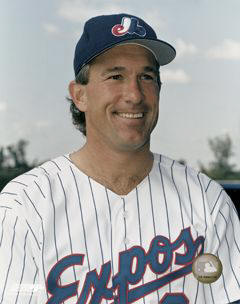
RIP Gary Carter, one of only two Montreal Expos enshrined in Cooperstown. Photo via garycarter.org

This is your semi-weekly/periodic wrap-up of Nats and other baseball news that caught my eye.  I try to publish this about weekly or if it gets up to about 1500 words, so that it’s not to voluminous.

Nationals In General

  • Mark Zuckerman writes about a favorite topic of mine w/r/t the current Nats 40-man roster and its construction.  See here for a similar discussion of the 2011 Nats (along with analysis of the 8 playoff teams) from last October.  Clearly the more players you’re using as your “primary 15” that were developed in house, the better you’re doing as a player development machine.  But there’s also the measure of cashing in those prospects in order to acquire resources.  (Coincidentally the “primary 15” of a team means its 8 starters in the field, 5 rotation members, setup man and closer).  By last year’s end, the Nats were starting 9 of these 15 as players developed in house and were down to just three acquired via FA/Waivers.  That’s a massive step up from just a few years prior, when most of the team was FA/Waiver pickups.  We’ll revisit this topic once the 25-man rosters for teams are finalized and play starts in April.
  • The Washington Franchise leads the league in employment of Negative WAR players over the past decade.   A staggering 31% of our players in this time have shown negative WARs per season.   This is not surprising given what we know of the construction of the first few iterations of the Nationals; Zuckerman has done studies in the past related to the staggering number of players the Nats have played at the MLB level who, after leaving us, never appeared in a major league game again.   The last time Zuckerman did this study that I could find was Nov 2010, when he identified 59 such players just since 2005.  I don’t know what percentage that is of all players who appeared for us in that time-frame, but it seems high.  (note: I just did some analysis and will return with a blog posting on this topic soon).
  • Back to the negative war topic, here’s a list of such negative WAR seasons for the 2011 iteration of the team: Alex Cora, Jesus Flores, Chris Marrero, Steve Lombardozzi, Matt Stairs, Livan Hernandez, Doug Slaten, Brian Broderick, Yuniesky Maya, Collin Balester and Chad Gaudin.  That’s 11 of the 44 players who appeared in the majors for us last year, or exactly 25%.  So we’re not exactly out of the woods yes; clearly we continue to employ a ton of players who end up hurting the team.  (For the record I used bWAR instead of fWAR for this, since its a bit easier to see that data.  But i’d guess the analysis would come out the same for either measurement method).
  • Another article on Edwin Jackson and pitch-tipping.  Is it possible that a player could play for years and never have a hitter teammate tell him he’s tipping his pitches?  I think it depends on what team the pitcher plays for.  Mike Mussina infamously was told he tipped his change up once he moved to the Yankees, and he made the adjustment that enabled his stellar 2006 season.  Maybe the team should have just kept its mouth shut about their thoughts and not told every reporter in every press conference that they think their new $11M pitcher is flawed.

Free Agents/Player Transaction News

  • Interesting thoughts on whether “4-A” players really do exist and how to quantify them from Fangraphs.com.  Read through the comments for some better thoughts.  For me, this issue touches on two opinions I’ve been growing.  1st; yes there does exist 4-A players; the Nats have shown to have a slew of them recently.  Guys whose minor league performance literally disappears upon reaching the majors.  I don’t know how to quantify it but there’s clearly guys who bounce freely between the two levels and seem destined to max out as such a 4-A player.  2ndly: Is AAA now a “lesser” league than AA?  Perhaps not with all systems (for example, Tampa Bay insists all their prospects play full seasons at each level, as does Atlanta), but for the Nats we’ve seen some interesting promotion behavior lately.  Stephen Strasburg got hit harder in AA than in AAA during his brief minor league apprenticeship, but the difference is rather slight.  But watching the games you got the distinct feeling that his AA competition was getting decent wood on the bat, while in AAA it was like he was pitching to little leaguers.  This goes to my theory that AAA is morphing into a “spare parts” league, where teams stash backup utility players (mostly catchers, middle infielders, relief pitchers) who are on the 40-man and can quickly be recalled to fill a spot, while AA is the place where your rising prospects play full seasons in preparation for promotion to the majors.  Jordan Zimmermann never pitched a AAA inning, rising from a full season in Harrisburg straight to our rotaton.  Strasburg probably could have done the same.  Will we see Bryce Harper jump straight from AA to the Majors or will the strategy of Mike Rizzo going forward be more Tampa-esque, requiring each prospect to “master” each level rising upwards?
  • A surprise team lands Yoenis Cespedes, namely the penny-pinching Oakland A’s in a 4yr/$36M deal.  4 years and $36M!?  That’s more than they will spend in payroll on their entire TEAM in 2012.  Maybe.  That’s a lot of cash for a completely unproven, if talented player who I’d say is not entirely MLB ready.

General Baseball News

  • Excellent article on the Demise of the Spitball and other Doctoring techniques from Grantland’s Jonah Keri, whose writing I’ve always liked and who is working on a historical retrospective on the Montreal Expos franchise.   Keri’s article talks about the Kenny Rogers pine-tar incident in the 2006 World series, but I don’t consider that “doctoring” the baseball.  That was simply using pine-tar to get a better grip on a cold, wet night.  Not that its legal; just different from the more conventional definition of a “spitball.”   Keri’s conclusion as to why the spitball has disappeared is attributed to the invention of the modern split-fingered fastball (attributed to Bruce Sutter) and to the lack of proper teachers (the craft of doctoring the ball has been handed down generation to generation by pitching coaches).  But honestly I believe the decline is more attributable to two other factors; the lingering stigma of getting caught being higher now post-PED era than every before, and the fact that the true “spitball” is damn difficult to throw (imagine trying to “throw” a baseball with the same motion you might use to squirt a pumpkin seed from your fingers?  That’s what throwing a spitball is like to a certain extent).
  • In typical modern day sabrematrician blogger nerd fashion, someone at a stats-oriented site goes about attacking another writer’s observation column.  In this case, it is someone at Baseball Prospectus attacking the Verducci Effect.  I can’t argue with his stats (other than to quibble with the lack of publication of his control group for comparison), but I suspect he misses the point.  I don’t think Verducci passes this list off as a statistical study; i think its passed off as a subjective list of candidate pitchers who HE THINKS may regress.  See, there’s the rub.  He’s already done the breakdown from the “control” group of pitchers who may be candidates for his study but whom he thinks may not be in jeopardy.  So I’m presuming that, because of this pre-selection and expression of opinion this is no longer a statistical study but an opinion piece.  I’d liken it to analyzing statistically the results of an amateur scout’s player recommendations; sure you could run one in order to judge a scout’s prognostication ability, but there’s so much variation in what happens to players once they sign that it wouldn’t be meaning ful.  I guess my take away is this: Verducci does a pretty durn good job of predicting red-flags for these pitchers (84% over the past 5 years), that maybe we should just recognize his study for what it is, and not overanalyze it to try to discredit it.
  • A nice article about another favorite topic of mine: the relationship between Wins and salary.  The familiar narrative is that payroll discrepancies are killing modern baseball, and to a certain extent I do agree; its no coincidence that the high payroll Yankees have only missed one playoff appearance in the nearly-20 years since the wild card era began.  But the ratio of wins to salary is dropping.  Why?  Because several teams have sacrificed several seasons to basically reset and start over.   Tampa Bay and Texas are the best recent examples, but we’re also seeing remnants of this theory here in Washington and starting anew in Houston and Chicago.
  • Nice little Intro to Sabremetrics from Espn-W.  The author doesn’t go into the real in-depth stats that a lot of people are gravitating to but does cover the basics.  OPS, Fip, UZr, wOBA, Vorp and WAR.  Now if we could only decide on a standard WAR.  🙂
  • Another classy move from baseball’s classiest organization; the Miami Marlins.  Yeah, lets un-retire the number of a former employee who died tragically since, well, he didn’t work for the current ownership group.

General News; other

  • Excellent article at Grantland.com on the Effects of CTE and the possible future (end?) of Football as we know it.  This is something I have been saying for a while and agree with; the increased awareness of concussions and their relationship to the longer term effects (the affliction known as Chronic Traumatic Encephalopathy or CTE) may soon start to really change the way that people think about the sport.  More to the point, as a parent does the thought of repeated concussions inflicted on your young football-playing son give you pause?  It would for me.  Read this article and it makes some very good points.  90,000 recorded pre-collegiate concussions per year?!


What does it really mean to be “In the Hall of Fame?”

3 comments

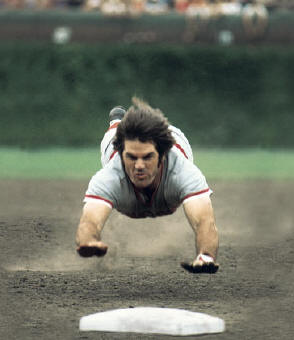
Here's a question for you; Is Pete Rose "in" the Hall of Fame? Photo unknown via luminousroc.com

(Editor’s note: I wrote this more than a month ago but got sidetracked.  So apologies for the content being a bit dated).

A post-mortem thought to the overwhelming number of baseball columns, blog postings and sabrematrician rants against Jack Morris but emphatically for Jeff Bagwell in the weeks swirling around the 2012 Hall of Fame elections.

What exactly does it mean to be “in” the Hall of Fame?

Yes, I know what it really means; if you’re elected to the HoF,  you get a bronze plaque in the Hall of Fame gallery, listed among all others that have been elected and selected over the course of the past 80 years or so.  (Of course, if you go an look at the names on the plaques I’ll challenge you to recognize all the names enshrined; there’s been so much revisionist history of players from the 1930s done by veterans committees, as well as an almost apologetic enshrinement of nearly every halfway decent Negro Leagues player from the early part of the century, that the actual “Hall” contains mostly names that are unknown to most mainstream baseball fans.  But I digress…).

But here’s the thing; for all that is spoken about the fact that Shoeless Joe Jackson and Pete Rose “are not in the hall of fame” …. they really are!  Both players have their images and discussion of their impact on the game in the various decade-specific exhibits, and nearly every other player who has been of significance has a picture or part of an exhibit at some point within Cooperstown’s walls.  Both players are bio’d, discussed and have their accomplishments documented.

So, in some ways I don’t really “get” the argument.  All these players we argue about endlessly ARE in the Hall of Fame.  As is Mark McGwire, Barry Bonds and most of the steroid-era players by virtue of their mention in the “Records” exhibit about 2/3 of the way through the museum.

For me, the Hall of Fame is a museum dedicated to the history of the game; certainly that’s how its set up and configured (If you’ve never been … you’d probably be surprised if you visited).  All these aforementioned players are a part of that history, whether we like it or not.  And the Hall recognizes that, not shying away from listing players who have known warts or who have had their candidacy for the enshrinement section banned by a current or former Baseball Commissioner.

Maybe all these arguments surrounding whether or not Player X belongs “in the Hall of Fame” need to be tempered, or at least modified to say “in the specific enshrinement exhibit.”

Written by Todd Boss

February 16th, 2012 at 7:04 pm

Nats Off-season News Items Wrap-up 2/11/12 edition

2 comments

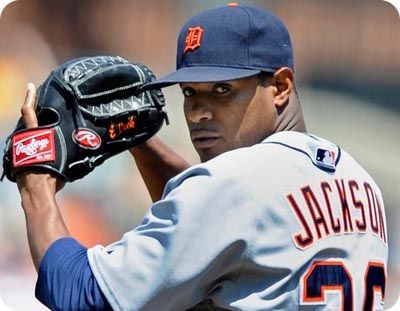
Mr. Jackson Comes to Washington. Photo unknown via sportsbank.com

This is your semi-weekly/periodic wrap-up of Nats and other baseball news that caught my eye.  I try to publish this about weekly or if it gets up to about 1500 words, so that it’s not to voluminous.

Apologies for the delay on this; life sometimes intervenes into blogging :-).  Most of this news is at least a week old.

Nationals In General

  • John Lannan presses his luck, goes to arbitration with the team and “loses,” meaning he’ll only get $5M in 2012 instead of the $5.7M he was seeking.   I thought $5M was rich frankly; using my 40/60/80% theory on arbitration salaries (as in, your first year arbitration salary is roughly 40% of your open market free agent value, 2nd year 60% and so on…) I thought Lannan’s salary would be roughly $4.8M (equating to an $8M salary on the open market).  Still, he nearly doubles his 2011 salary of $2.75M despite having a sub .500 record (yes I know that’s relatively meaning less but still).
  • In the out of nowhere department, Edwin Jackson signs with the Nats.  1yr, $11M (with $2M deferred to 2013).  Scott Boras finds employment for another client in Washington DC.  Mike Rizzo immediately had to comment on the future of John Lannan, who clearly seems like the odd-man out despite being guaranteed a $5M salary in 2012.  I should do a more in-depth post on this situation … Rizzo mentioned at the press conference a “flaw” in Jackson’s delivery that they’ve identified; its not often you invest $11M into a guy just to say he’s flawed.  But the splits are pretty obvious: As noted by Joe Lemire with no-one on base the league had an astounding .868 OPS (slash line: .339/.390/.478) against Jackson but with runners on that figure dropped to .665 (slash line: .239/.292/.373).  However most every other pitcher in the league experiences the reverse of this situation, faring better out of the wind-up than from the stretch.  Maybe Jackson needs to pitch from the stretch all the time…. For context, a Batting Average Against (BAA) of .239 for an entire season would have ranked Jackson around 30th for all qualified Starters in the league, better than supposed Aces Matt Garza and Zack Greinke.  Maybe we didn’t get a 4th starter; maybe we got something close to a #2 starter in disguise.
  • Very good Nats starting pitching option analysis post Jackson acquisition from David Shoenfield, who does some trade analysis for Lannan and comes up with some good options.  And Joe Lemire does a 5-point analysis of the Nats and concludes
  • Si.com‘s very detailed article on Venezuelan baseball, safety concerns and details on the Wilson Ramos kidnapping case.
  • A link to try out for the Racing Presidents.

Free Agents/Player Transaction News

  • Reports from both Craig Calcaterra and Jon Heyman that JD Drew may retire based on the lack of interest this off-season.  See, I have a big problem with this.  Drew’s career numbers are very under-rated; he’s got a career .873 OPS and a career 125 OPS+.  Yes he tailed off badly in 2011, and has struggled with injuries the past several seasons; but look at his OBP  figures; he could be the solution to the Nats outfield problem!  I think I need to write a post on this.

Hall of Fame leftovers

  • More interesting Jack Morris articles; this one talking about the fact that he was the “winningest pitcher” of the 80s.  Which he was, by a fairly large margin (20 wins if memory serves).  Here’s the pertinent fact: EVERY single pitcher who has led a “decade” in wins is in the Hall of Fame, prior to Morris and the 80s.  The leader for the 90s was Greg Maddox, who may become the first unanimous first ballot hall of famer (unless of course someone makes a “statement” vote by mailing in a blank ballot or something stupid).  The leader for the 2000 decade?  Andy Pettitte, who I think will struggle to make the Hall just as Morris has.  Now, does this mean that Morris and Pettitte are automatically hall of famers by virtue of leading their decades?  No, probably not, but just because a pitcher is a “borderline” candidate doesn’t mean they don’t deserve consideration.  I’ll bet we’ll be arguing about Pettitte the same way we’re arguing about Morris in about 10 year’s time.  The other interesting takeaway from this article was this google doc spreadsheet, where someone went through and calculated the leader of every 10-year period to see how the “leader of the decade” worked on rolling 10 year scales.  You’re hard pressed to find a non-hall of fame pitcher on this rolling scale no matter what the 10 year period.
  • An interesting article that says that certain legendary hitters are “overrated” when looking at career WAR.  This is something I’ve been saying for years, especially with those that think Bert Blyleven is one of the best pitchers ever to play the game.  WAR is an accumulator stat, overrating mediocre-but-extremely-healthy players who rack up a ton of stats over time.  My simple case in point: Blyleven’s career WAR of 87.6 ranks him 44th of all time, while Pedro Martinez‘s career WAR is 73.5.  Anyone who looks at me with a straight face and says that Blyleven therefore is a better pitcher than Martinez needs to consider both this article and my statement.  Stats are what they are; they are tools that help people analyze and consider behaviors.  They’re not be-all, end-all statements.
  • The above article led me to create this interesting trivia question; what baseball player has the highest career WAR but who is not enshrined in the Hall of Fame (counting these caveats; the player can’t be currently active, pre-Hall of Fame eligible or currently ON the hall of fame ballot)?  The answer is Bill Dahlen, with a career WAR of 75.9 and who played from 1891 to 1911.  He played mostly short stop, which explains why his WAR is so high considering his career OPS+ of 109.  Pete Rose, coincidentally, is just behind him on the career WAR leaderboard and would probably be most people’s guess.

General Baseball News

  • Adam Dunn talks about his “one stupid year” in 2011 to the Chicago Sun-Times (h/t to Craig Calcaterra).  I do feel sorry for Dunn, who seems to have caught a perfect storm of adjustments (switching leagues, switching teams, switching positions, moving cities and going to a unique on-field manager just to name a few) just at the wrong time, leading to his historically bad season.  I hope he figures out what he needs to do to return to his prior form.
  • Interesting NYTimes article by Tyler Kepner (h/t to Calcaterra again) on the Identity Fraud problem for baseball players in the DR.  This of course is a follow up to the latest scandal, this time involving all-star Cleveland pitcher Fausto Carmona, or as we now know his real name to be Roberto Hernandez Heredia.  He paid off someone 3 years younger to assume his identity, and was outed when he stopped paying the bribe.  (side note: if you pay someone to help you do something illegal … chances are you’ll probably be outed on your illegal behavior 100% of the time if you remove the sole incentive for keeping that person quiet.  Duh).   Anyway; the interesting takeaway here was the anonymous quote that more than “a dozen such cases” could soon get exposed.  I hate anonymous quotes like this, but on this topic it isn’t surprising.  Age disputes have dogged Albert Pujols for years (though I doubt them personally; if he really is 2-3 years older than he says, then he would have been a MUCH bigger prospect out of high school).
  • An article at Cleveland.com (but which is of severe interest to Washington fans as we re-negotiate our MASN deal) talking about Regional Sports Network TV money highlights an interesting point that nearly every team in a major market soon will have tens of millions more dollars in their pocket, thanks to renegotiated TV deals.  We squawk about how the big market teams over spend now?  How about when suddenly teams that are “mid-market” but spending $100M on payroll get an extra $30-$40M to play with?  I wonder if the solution for the betterment of the sport (considering that a team in a small market like Milwaukee only gets about $12M total in TV money) is going to be to go to a NFL-style TV revenue model where all 30 teams share the same pool equally.  That last sentence of course will never happen; the Steinbrenner family isn’t about to give up HUNDREDS of millions of dollars of their own money to help tight-fisted owners in other cities pad their bottom line.
  • I hate seeing this story blown so far out of proportion: Josh Hamilton had “a few drinks” at a bar and now there’s headlines talking about a “relapse” and holier than thou stories about how this is going to cost him tens of millions of dollars.  This post on sbnation.com asks the right question; “Is this any of our business?”  I had 3-4 drinks one night at dinner last week; am I I a relapsed alcoholic?  Of course not.  I guess this is the price of fame.

General News; other

  • Months ago, when Tyler Hamilton had his gripping appearance disclosing all sorts of supposedly incriminating facts about Lance Armstrong on 60-minutes I had a rather heated discussion over email with some fellow sports-fanatic fans talking about whether that interview was really “proof” of Armstrong’s having cheated his way to 7 tour de France wins.  I guess not: Federal prosecutors closed the inquiry into Armstrong after a 2-year witch hunt.  I was much more vehement on this topic before but my general stance is this; Armstrong took hundreds of drug tests in his life and never ONCE tested positive.  There’s allegations of cheating by former teammates who themselves lied about cheating (and were eventually caught), and there’s allegations of covered-up tests (which can’t be corroborated), and there’s rumors and innuendo.  But nowhere, ever, has anyone actually found anything close to concrete “proof” that Armstrong cheated.  So to anyone who still thinks he’s a cheater, I’ll say this: “Innocent until proven guilty.”  And nobody will ever find any proof, because (as is noted in this column) if Jeff Novitzky couldn’t find the proof, nobody will.
http://espn.go.com/mlb/story/_/id/7533216/edwin-jackson-agrees-washington-nationals

Nats Off-season News Items Wrap-up 1/31/12 edition

6 comments

Will the team extend Zimmerman, now that Fielder is off the table? Photo AP via tbd.com

This is your semi-weekly/periodic wrap-up of Nats and other baseball news that caught my eye.  I try to publish this about weekly or if it gets up to about 1500 words, so that it’s not to voluminous.

Nationals In General

  • Nats continue to talk about a contract extension with Ryan Zimmerman, according to this and other sources.  I’m not arguing against re-signing him; in fact he’ll be at a discount by virtue of missing so much time last season and being relatively injury-ridden as of late.  The question is whether Zimmerman’s camp would accept anything less than what Troy Tulowitzki got (10/$157M) or Ryan Braun (13/$150M between current and extension contracts) signed.  Here’s a case against re-signing him (though to be fair, the same blog posted a “case-for” earlier).  Lastly on the topic; this fangraphs.com article looking for a good comparable for Zimmerman based on his production and value (the answer?  Matt Kemp‘s 8yr/$160M deal).
  • Nats miss out on Prince Fielder, as he signs a 9yr, $214M deal with Detroit.  Quick hit thoughts: Thank god there’s no more rumors about Fielder to the Nats.  I wanted him and his bat, but not at that price and for that length.  The team dodges an albatross of a contract in a few years time.  Lastly; how in the world is Detroit going to manage that payroll?  Its not as if that city is an up-and-coming, wealthy place.  Makes you wonder just how well-off these baseball owners really are.
  • I guess FA rumors are just meant to be with this team; suddenly we’re in the Roy Oswalt mix.  Now, I’ve said in the past that I like this guy and think he’d be a great fit for the team … but that was before we traded the farm for Gio Gonzalez and offered arbitration to John Lannan.  I’ll ask a simple question; if we sign Oswalt, who makes way?  Last time i checked this team has 5 starters, each signed for 2012 and each with a multi-million dollar commitment.  So this rumor doesn’t make any sense any longer.  Oswalt makes a ton more sense for a team like Texas or Boston, as is noted in the many columns on the subject posted recently.
  • LOVE the Brad Lidge acquisition.  The team needed a middle relief replacement for Todd Coffey and just got one, and for almost no money ($1M base with incentives).  He’s struggled with his health, but when he has been healthy he’s been lights out for the last two seasons (not to mention the rest of his career).  He can close in a pinch, he can help offload high-leverage innings off of Tyler Clippard.  And he can mentor the bullpen guys.  Fantastic signing by Mike Rizzo.
  • Nats will play Georgetown U in an exhibition for the 2nd year running.  Knowing how weak Georgetown’s program is, I wonder just how badly the scoreline will look (last year’s score was 15-0).
  • MLB daily dish is attempting to replicate the Big Board and throw in contract details at this site here.  We’ll see how uptodate this site is kept during the turbulent season of player movement in the minors.

Free Agents/Player Transaction News

  • Jamie Moyer signs a minor league deal with Colorado.   He sits at 267 wins for his career, so the chances of him getting to 300 are relatively slim, but his chances of making Colorado’s rotation aren’t too bad.  Roto World lists their depth chart right now at Chacin, Hammel, Pomeranz, White and Moscoso.  Lots of youth there; White and Pomeranz are both 22-23 and were both relatively awful last  year.  De La Rosa is coming off injury but may not be ready for opening day.  He very well could feature for this team in 2012.


General Baseball News

  • Yes I know these “top 5 lists” are mostly national columnists fulfilling writing requirements during the slow January baseball news period, but if the Nats are listed, i’ll post it.  David Schoenfield lists his “Top 5 rotations” in the game and he goes Philly, Angels, Texas, New York and Arizona.  I gotta say; i think he’s vastly overrating the Yankees rotation and I think he’s overrating the Arizona crew as well.  Arizona’s pitchers were more or less awful in last year’s NLDS; not sure I’d count on them in a pinch.  I’d easily put Tampa Bay and San Francisco’s rotations above these two teams, not to mention the possibility of Atlanta’s group gelling and helping that team win 95 games.
  • Marlins apparently ready to sign up for Showtime’s the Franchise, which featured San Francisco last year and was Showtime’s answer to HBO’s Hard Knocks football weekly documentary.  The show was great in 2011, showing the human side of many of the Giants players and was a must-watch in my house.  Of course, showing Miami could be an interesting endeavor; most of the baseball industry speaks badly about Miami’s ownership and senior management group and these documentary shows usually go to great lengths to humanize and gain empathy for all the participants.
  • Jose Bautista claims to have been “random drug tested” 16 times in the past two years, despite any single player’s chances of being randomly tested only being about 3 times in two years (according to the number of tests MLB is authorized to run versus the number of pro players).  As is noted in the link, it looks to me like MLB is taking no more chances with its big home-run hitters.


Collegiate/Prospect News

  • First College top 25 posted by Baseball America (more discussion on each team here), and there’s no surprise who’s #1: Florida by virtue of its absolutely stacked lineup (two first team and two 2nd team pre-season all americans by this publication).  No surprise Stanford is #2 behind their presumptive 2012 #1 overall pick Mark Appel, but surprised that Texas and Texas A&M are so low.  I think by the time the CWS rolls around we’ll be seeing these teams, plus South Carolina back in the mix behind their returning friday and saturday starters.
  • The great Kevin Goldstein unveils his top 20 Nationals prospects on Baseball Prospectus.  We all know who went the other way in the Gio Gonzalez trade; what’s more interesting is who now resides in places 16-20.  Clearly he has to struggle to find “prospects” worthy of ranking there, based on his inclusion of Jason Martinson, Matt Skole, Sandy Leon, and David Freitas.  Otherwise the top 12 or so reads as expected.
  • MLB’s Jonathan Mayo announces their top 100 for the whole game.  Bryce Harper #2 behind Matt Moore; no argument there.  Surprised Mike Trout didn’t get more credit.  Most scouting pundits consider the big 4 (to include Atlanta’s Julio Teheran) as almost interchangeable.   The rest of the top 10 are well known; I’d never heard of #7 Jurickson Profar, a shortstop in Texas’ organization who is really young but really promising.  Other thoughts: surprised to see Danny Hultzen so high; I know he was dominant in college but is he slated to be that dominant in the pros?  Other Nats/ex-Nats on the list: Anthony Rendon at #27, Brad Peacock at #75, Alex Meyer at #83, Sammy Solis at #86, AJ Cole at #88.  No mention of Matthew Purke, but no surprise; he needs to have a healthy, strong season to regain his former 1-1 status.
  • My alma-mater JMU is #1 pre-season CAA baseball.

General News; other

  • Those of you who know me may know that i’m also a pretty passionate Soccer fan.  So here’s a fantastic look at the history of soccer through an “All-time fantasy soccer player draft.”   The first round was rather surprising; I know Lionel Messi is a great player now, but he’s got a bit of work before he supplants Pele, Maradona, Ronaldo or even Zidane in my book.  Of course, he’s already a 3-time world player of the year at the tender age of 24, so by the time he retires he may very well have 3 more awards.  Still, the selections (especially from the non-US based journalists who have a better sense of soccer’s history) are a great read.
  • Speaking of soccer, here’s a Grantland article on the conventional wisdom among most American fans that Soccer is boring.  I’ve tired of trying to argue this point with people who have never actually SEEN a live soccer game.  I have a good friend, born and bred in Pittsburgh and who is a die hard Steeler’s fan (in other words, the complete anti-thesis of a typical soccer fan) who I drug to a US Men’s national team game at RFK about 15 years ago.  He fell in love and now follows the european game with similar gusto as I.  I think American sports fans are too impatient, and have been even before the rise of cell-phones, the red-zone channel and highlight shows, to appreciate the beauty of Soccer.  They devolve the game, without really having any personal experience watching a big match or seeing one in person, into the common phrase, “how exciting can a 1-0 game be?”  I’d say to that; imagine a professional football game where there was no field goals allowed, the end zone was only 24 feet wide and there was a player positioned at that end zone at all times whose sole job it was to stop break away runs and passes.  Its simply that much tougher to score.  So most soccer fans know that the excitement of the game is the tactics, the breakdown of individual skill of the attacker versus the individual skill of the goalkeeper, and the near miss.


Ladson’s inbox: 1/16/12 edition

17 comments

Lest anyone forget, Zimmerman is under contract for not one, but TWO more seasons! Photo unknown via fantasyknuckleheads.com

Another edition of mlb.com beat reporter Bill Ladson’s inbox, dated 1/16/12. Man you know I’ve been busy at work if I’ve had this canned and ready to publish for more than a week but couldn’t get online to do so.

As always, I write my response before reading his, and sometimes edit questions for clarity.

Q: Why are the Nationals wasting time talking to Prince Fielder when they should be signing Ryan Zimmerman to a long-term contract before it is too late?

A: *sigh*  Why, why, why is it going to be “too late” to sign Ryan Zimmerman to a long term contract if it doesn’t happen right now?  Someone please check Cot’s before asking this question.   He’s signed through 2013!  I don’t believe Prince Fielder has anything to do with Zimmerman; we’re talking about a franchise that has been underspending on payroll by $35-$40 MILLION dollars the past few seasons.  People who claim that the Nationals “can’t afford both” Fielder and Zimmerman are expressing unsubstantiated opinions.  Ladson thankfully notes the fact that Zimmerman is signed through 2013.

Q: What role will Roger Bernadina play on this year’s team? I love the kid’s heart, but the people in power don’t seem so encouraged.

A: Hopefully none.  Nothing personal against Bernadina, but what more can we learn about the guy at this point?  1000 major league plate appearances, an 81 OPS+.  About the only thing he has going for him is that he’s pre-arbitration and is cheap.  This team is offensively challenged and needs outfielders who can slug something higher than .350.   Ladson thinks he’ll be the 4th outfielder, competing with Mike Cameron for center field.  I hope not; can’t we sign a stop-gap right fielder??

Q: Have the Nationals thought about moving Danny Espinosa or Ian Desmond to center field?

A: I doubt it.  What would that solve?  As soon as we moved one to CF, we’ve lost a plus defender in the middle infield with no assurance that they’d be any good in center, and we’d still need to find a solution for whatever position they’ve vacated.  We need to find an outfielder who can hit and put him in play.  Its that simple.  Ladson says nope.

Q: I am still a believer in Desmond although his batting average and power numbers declined last year. He is a big, strong kid who can hit 15 home runs and steal 30 bases if he can be more selective at the plate and figure out how opposing pitchers are trying to attack him. What do you see for Desmond in 2012?

A: 2012 is make it or break it season for Desmond.  Two full time seasons at the plate and he’s regressed each time.  You just cannot put a guy out there who’s 20% worse than the MLB average (i.e., an 80 ops+, his figure for the 2011 season) and be successful in the modern game.  What do I predict?  I think he’ll be similarly poor, will feature 7th or 8th in the order most of the year, and will force the team to look at replacement options starting in the trade season.  Ladson thinks Desmond’s late season surge bodes well for 2012; indeed he was great in the last two months of the season.  Lets hope he’s right.

Q: Assuming the Nats will not sign Fielder, would it be a good idea to sign an outfielder like Johnny Damon? Can you see him as a fit in Johnson’s lineup?

A: No; Damon is limited to playing LF in an easy-to-defend ball park (like Fenway) or a DH at this point.  His outfield arm is beyond weak.  He can hit though; but he has no position on this team.  If we’re going to go with Jayson Werth in CF, I think we should sign one of the good hitters still available in the RF marketLadson agrees with me that Damon is an AL-only player now.

Q: If the Nats acquire Fielder, would it be best for Adam LaRoche to be traded for a bench player who might start once a week?

A: Sure, if they could trade him.  Problem is, if LaRoche needs to be traded there’s not an awful lot of teams that would be interested.  See my post about the Prince Fielder market; maybe we could trade him to a team like Baltimore or Houston, but they’re not going to give us much in return, and we’ll be forced to pay most of his salary in make-weight.  If we sign Fielder, you might as well just release him.  Ladson points out that we’re not even sure LaRoche is healthy at this point.

Q: In all the talk about 2012, I haven’t heard a word about the status of catcher Ivan Rodriguez and right-hander Livan Hernandez. What are the Nats’ plans for those two fan favorites?

A: The wise fan would correctly assume that the lack of discussion about both Hernandez and Rodriguez would indicate that they are no longer in the team’s plans.  Because they’re not.  Both guys are probably out of baseball after 2011, given the calibre of players that remain unsigned so far this off season.  I’m sorry to say: Livan’s precipitous decline in performance in the latter half of 2011 eliminated his candidacy for the 2012 rotation.  And Rodriguez may be a great historical player and first rounder, but he hit .218 last season.  Ladson thankfully agrees.


Incentives, Salary and Steroid use in Baseball

3 comments

Hit home runs, make lots of money. Repeat. Photo unknown via deadspin.com

A viewing of the HBO special “Freakonomics,” which turns chapters of the popular book into little mini vignettes, along with a conversation with my father prompted me to investigate the aspects of human behavior with regard to incentives when considering the rise of Steroid use by major league baseball players in the late 1990s.  One of the overriding themes in Freakonomics is that any aspect of human behavior can be predicted by analyzing the incentives facing those persons when making a choice.

So the question here is, were the growing incentives to players in terms of rising baseball salaries directly tied to the growing use of Steroids in the mid 1990s?

Steroids had been around for many years prior to appearing en-masse in Baseball.  The most infamous use came from the East German Olympic teams during the late 70s and early 80s, who systematically doped their own athletes (mostly without the athlete’s knowledge) from 1971 until 1990.  But seemingly only after the 1988 Seoul Olympics saw sprinter Ben Johnson test positive for one steroid and admitted the use of a host of other Steroids, Testosterone and HGH substances did the “Steroid Era” in baseball start.  In fact, 1988 is also acknowledged as the beginning of the era in the Mitchell Report (per Section D of the Summary, pg SR-14).  However, I’d argue that the mainstream usage of Steroids didn’t occur for a few years after (see the rise of 45+ homer seasons below).

Here’s a chart of Mean and Median US household income from 1974-2010, with the Minimum and Maximum MLB salaries, the Average MLB salary, that MLB salary listed as a multiple of the US mean income, and the number of 45+ home run seasons seen per year:

Year Median Income: Current Dollars Mean Income: current dollars Minimum MLB Salary Maximum MLB Salary Average MLB Salary Avg MLB salary as multiple of Mean US income # of 45+ Homer Seasons
2012 $480,000 $32,000,000
2011 $414,000 $32,000,000 $3,305,393 0
2010 $49,445 $67,530 $400,000 $33,000,000 $3,297,828 49 1
2009 $49,777 $67,976 $400,000 $33,000,000 $3,240,206 48 3
2008 $50,303 $68,424 $390,000 $28,000,000 $3,154,845 46 1
2007 $50,233 $67,609 $380,000 $23,428,571 $2,944,556 44 4
2006 $48,201 $66,570 $327,000 $21,680,727 $2,866,000 43 5
2005 $46,326 $63,344 $316,000 $26,000,000 $2,632,655 42 5
2004 $44,334 $60,466 $300,000 $22,500,000 $2,486,000 41 4
2003 $43,318 $59,067 $300,000 $22,000,000 $2,555,000 43 4
2002 $42,409 $57,852 $300,000 $22,000,000 $2,383,000 41 4
2001 $42,228 $58,208 $300,000 $22,000,000 $2,264,000 39 9
2000 $41,990 $57,135 $200,000 $15,714,286 $1,987,000 35 4
1999 $40,696 $54,737 $200,000 $11,494,794 $1,726,000 32 6
1998 $38,885 $51,855 $200,000 $14,936,667 $1,378,000 27 9
1997 $37,005 $49,692 $200,000 $10,000,000 $1,314,000 26 3
1996 $35,492 $47,123 $200,000 $9,237,500 $1,101,000 23 6
1995 $34,076 $44,938 $109,000 $9,237,500 $1,094,000 24 1
1994 $32,264 $43,133 $100,000 $6,300,000 $1,154,000 27 0
1993 $31,241 $41,428 $100,000 $6,200,000 $1,062,000 26 3
1992 $30,636 $38,840 $100,000 $6,100,000 $1,012,000 26 0
1991 $30,126 $37,922 $100,000 $3,800,000 $845,383 22 0
1990 $29,943 $37,403 $100,000 $3,200,000 $589,483 16 1
1989 $28,906 $36,520 $60,000 $2,766,667 $489,539 13 1
1988 $27,225 $34,017 $60,000 $2,340,000 $430,688 13 0
1987 $26,061 $32,410 $60,000 $2,127,333 $402,579 12 3
1986 $24,897 $30,759 $60,000 $2,800,000 $410,517 13 0
1985 $23,618 $29,066 $60,000 $2,130,300 $368,998 13 0
1984 $22,415 $27,464 $30,000 $2,500,000 $325,900 12 0
1983 $20,885 $25,401 $30,000 $2,500,000 $289,000 11 0
1982 $20,171 $24,309 $30,000 $2,500,000 $245,000 10 0
1981 $19,074 $22,787 $30,000 $2,500,000 $195,500 9 0
1980 $17,710 $21,063 $30,000 $2,500,000 $146,500 7 1
1979 $16,461 $19,554 $16,000 $1,170,000 $121,900 6 3
1978 $15,064 $17,730 $16,000 $700,000 $97,800 6 1
1977 $13,572 $16,100 $16,000 $700,000 $74,000 5 1
1976 $12,686 $14,922 $16,000 $700,000 $52,300 4 0
1975 $11,800 $13,779 $16,000 $670,000 $44,676 3 0
1974 $250,000 $40,839 0

There’s several landmark seasons of note in terms of escalating Salaries through this list.  By year:

  • 1975 saw Catfish Hunter become the first “true” Free Agent subject to bidding wars among teams, and signed a 5yr/$3.35M deal with the Yankees that resulted in his league-leading salary to nearly triple the league leading salary from 1974.
  • 1979 saw Nolan Ryan become the first $1million/year player.
  • In 1982 George Foster became the first $2M/year player.
  • By 1989, Kirby Puckett became baseball’s first $3M/year player.
  • In 1992, Barry Bonds hit free agency on the heels of MVP seasons in Pittsburgh and more than doubled the previous high annual salary.
  • By 1996, salaries were rising quickly; Albert Belle signs a $10M/year contract.
  • 2001 saw Alex Rodriguez‘s infamous Texas contract kick in, paying him $22M/year, nearly $7M more per year than the next closest player (Kevin Brown, who signed baseball’s first 9-figure contract).
  • Rodriguez opted out of that same contract and re-negotiated the terms even higher with the Yankees, eclipsing the $30M/year mark by 2009.

Meanwhile, take note of the red-colored years of 1996 to 2001, the core of the Steroid Era.  1996 saw no less than Six players eclipse the 45 home run barrier, including Brady Anderson in a complete aberration year for the lead-off hitter (he hit 50 homers in 1996 but averaged just 19 per 162 game segment and never hit more than 24).  Suddenly in 1998 no less than Nine players eclipsed the mark, lead by the Mark McGwire/Sammy Sosa home-run hitting competition that transfixed the nation and “saved” baseball.  Too bad we now know what America didn’t know then; that both players were using Performance Enhancing drugs to beef up, help power out baseballs and take advantage of a slew of new ballparks that opened in the era that featured cozier dimensions and more offense.

By 2002, enough pressure from the front office towards the player’s union had taken place to start testing, leading to the infamous “anonymous survey” done of players in 2003 that resulted in “between 5-7%” of players testing positive, leading to mandatory testing in 2004.  By 2008 we were back down to homer levels not seen since the early 1990s, and baseball didn’t see a single player hit the 45 homer barrier in 2011.  But historically the damage has been done; the home run leader boards from the time period in question lists like a Who’s Who of steroid accusations, and a generation of middle-aged baseball writers who grew up idolizing the home run leaders of yesteryear now seems set to penalize these players for their drug usage (proven or otherwise, as with the Jeff Bagwell Hall of Fame case).

But, everything I just wrote is known narrative.  Lets talk about the explosion of baseball salaries as compared to the common man.  In 1975 the average MLB salary of $44k was a little more than 3-times the mean US household income, having risen only gradually over the years thanks to the Reserve clause and a non-existent players union.  It was a boon for owners, who kept salaries down and profits high.  But the low salaries also meant that most baseball players were considered “within reach” of the every-man in America.  Players weren’t paid such ridiculously high salaries that they essentially live in a different world from the fans (as is the case today with most professional athletes in this country): these players were considered “just like us” to a certain extent, and frequently had off-season jobs, working along side the same people who paid a few bucks for a bleacher seat to cheer them on.  “America’s Pastime” largely earned that title from being the only sport in town for most of the century, but was also helped along by the “within reach” argument.

By 1980, with the country in a severe recession and gas lines around the block, Joe Public slightly increased his average pay.  However, Baseball players, thanks to the breaking of the reserve clause and the rise of Free agency were seeing a boom in salary hikes.  By 1980, the average MLB wage was 9 times the median income in the country and a few ballplayers were making $1M/year.   This ratio of US income to MLB income grew slightly over the next decade; ten years on in 1990 the average MLB wage was just 16x the US income.  But changes were about to come.  In 1996 the MLB salary multiple was 23-times the US mean, but by 2001 it was nearly 40-times the US mean salary.  The average MLB salary more than doubled inside of these 5 years.  This change coincided exactly with the beginnings of the Steroid era and also mirror the 6 year stretch where the game saw its historical rise in home runs.

So the question is: is this coincidence?  Was the rise in steroid use driven by player’s desires to maximize their earning potential or was it vice-versa (i.e., players discovered steroids could escalate performance, started using and producing and that lead to the quick rise in payroll?)  Or was this all more attributable to weaker pitching driven by expansion and  smaller ball-parks?

I think you can make the case that home run hitters were highly compensated and were commercially the “heros” of the game (remember the “Chicks Dig the Long Ball” commercials?), and other players figured out that Steroids helped pack on muscle mass and enabled themselves to hit the ball further and faster (to say nothing of the fact that steroids enabled players to come back from injury faster and to stay stronger through the season by virtue of added muscle mass), and rode the trend.  Hit 40-45 home runs one year, sign a contract extension the next.  Suddenly the game found itself full of juiced up, highly compensated sluggers with a massive ethical problem.

What do you think?

Sources used:

Year Median Income: Current Dollars Mean Income: current dollars Minimum MLB Salary Maximum MLB Salary Average MLB Salary Avg MLB salary as multiple of Mean US income # of 45+ Homer Seasons
2012 $480,000 $32,000,000
2011 $414,000 $32,000,000 $3,305,393 0
2010 $49,445 $67,530 $400,000 $33,000,000 $3,297,828 49 1
2009 $49,777 $67,976 $400,000 $33,000,000 $3,240,206 48 3
2008 $50,303 $68,424 $390,000 $28,000,000 $3,154,845 46 1
2007 $50,233 $67,609 $380,000 $23,428,571 $2,944,556 44 4
2006 $48,201 $66,570 $327,000 $21,680,727 $2,866,000 43 5
2005 $46,326 $63,344 $316,000 $2,600,000 $2,632,655 42 5
2004 $44,334 $60,466 $300,000 $22,500,000 $2,486,000 41 4
2003 $43,318 $59,067 $300,000 $22,000,000 $2,555,000 43 4
2002 $42,409 $57,852 $300,000 $22,000,000 $2,383,000 41 4
2001 $42,228 $58,208 $300,000 $22,000,000 $2,264,000 39 9
2000 $41,990 $57,135 $200,000 $15,714,286 $1,987,000 35 4
1999 $40,696 $54,737 $200,000 $11,494,794 $1,726,000 32 6
1998 $38,885 $51,855 $200,000 $14,936,667 $1,378,000 27 9
1997 $37,005 $49,692 $200,000 $10,000,000 $1,314,000 26 3
1996 $35,492 $47,123 $200,000 $9,237,500 $1,101,000 23 6
1995 $34,076 $44,938 $109,000 $9,237,500 $1,094,000 24 1
1994 $32,264 $43,133 $100,000 $6,300,000 $1,154,000 27 0
1993 $31,241 $41,428 $100,000 $6,200,000 $1,062,000 26 3
1992 $30,636 $38,840 $100,000 $6,100,000 $1,012,000 26 0
1991 $30,126 $37,922 $100,000 $3,800,000 $845,383 22 0
1990 $29,943 $37,403 $100,000 $3,200,000 $589,483 16 1
1989 $28,906 $36,520 $60,000 $2,766,667 $489,539 13 1
1988 $27,225 $34,017 $60,000 $2,340,000 $430,688 13 0
1987 $26,061 $32,410 $60,000 $2,127,333 $402,579 12 3
1986 $24,897 $30,759 $60,000 $2,800,000 $410,517 13 0
1985 $23,618 $29,066 $60,000 $2,130,300 $368,998 13 0
1984 $22,415 $27,464 $30,000 $2,500,000 $325,900 12 0
1983 $20,885 $25,401 $30,000 $2,500,000 $289,000 11 0
1982 $20,171 $24,309 $30,000 $2,500,000 $245,000 10 0
1981 $19,074 $22,787 $30,000 $2,500,000 $195,500 9 0
1980 $17,710 $21,063 $30,000 $2,500,000 $146,500 7 1
1979 $16,461 $19,554 $16,000 $1,170,000 $121,900 6 3
1978 $15,064 $17,730 $16,000 $700,000 $97,800 6 1
1977 $13,572 $16,100 $16,000 $700,000 $74,000 5 1
1976 $12,686 $14,922 $16,000 $700,000 $52,300 4 0
1975 $11,800 $13,779 $16,000 $670,000 $44,676 3 0
1974 $250,000 $40,839 0

Nats Off-season News Items Wrap-up 1/22/12 edition

6 comments

Gonzalez signs a long term deal; we're committed now. Photo Jed Jacobsohn/Getty Images via nydailynews.com

This is your semi-weekly/periodic wrap-up of Nats and other baseball news that caught my eye.  Apologies for the delay in posting; new rules on laptop usage at work have thwarted my typical read-sports-news-at-lunch habits.  I’ll have to get creative.

Nationals In General

  • Nats extend Gio Gonzalez for 5 years.  Terms: 5yrs, $42M with two more club options.  A little more than $8m AAV, or in other words what we were paying Jason Marquis.  I’m sure its backloaded somewhat, but I like the deal for two main reasons.  First, we buy out all the arbitration years ahead of time and avoid the arbitration process altogether (which does nothing but serve to bruise the fragile egos of professional athletes over a few hundred thousand dollars of salary).  Secondly, it locks up the player for the longer term and gives the team some stability for the next few years.
  • Jim Callis at BaseballAmerica answered a question about what an updated Nats top 10 prospect list would look like post trade: he’d promote up Destin Hood, Chris Marrero, and Michael Taylor.  Considering what Marrero’s prospect status is now, considering how long it has taken Hood to get the hang of playing baseball, and how far away Taylor is from the majors, I think its safe to say our farm system is officially “thin.”
  • Nice little piece on Bryce Harper from Buster Olney, who relays the well known opinion that Davey Johnson really likes young superstars and predicts that Harper may break camp with the team.  Why doesn’t anyone relay all the facts in this case?  Like the fact that there wasn’t a concept of “Super-2” when Johnson promoted Gooden and Strawberry and there wasn’t a punitive financial issue lurking by doing so.
  • Great news to see so many of our arbitration eligible guys settled well ahead of going in front of the arbitrator.  These cases don’t help anyone in the long run and end up arguing semantics over a few hundred thousand dollars that the team can clearly pay.
  • Though I havn’t seen any confirmation of this elsewhere, Bill Ladson reports that the Nats are engaged in extension talks with Ryan Zimmerman.  If so, this comes at a relatively good time for the team to be doing the negotiating; Zimmerman’s value is as low now as it has been since before his rookie season, on account of multiple injuries and a lack of overall production.   Which is exactly why I don’t think any long term deal is going to be struck this off-season frankly; Zimmerman would expect a Troy Tulowitzki like deal and I don’t think he’s done enough to earn it.


Free Agents/Player Transaction News

  • The arbitration case to watch this coming off-season will be Tim Lincecum; he is asking for $21.5M for 2012, with the Giants offering $17M.  Wow.  There’s really no case like his out there to use as a precedent; if you think he should earn roughly 80% of his FA value, then $21.5M equates with an annual salary of $26.875/year AAV.  That’s more than Cliff Lee, CC Sabathia or Johan Santana (the three highest paid pitchers at current).  So I guess you have to ask yourself; is Lincecum the best pitcher in the league?  Because he’s about to be paid in line with that title.


Hall of Fame items

  • Not HoF specific, but inspired by it.  David Shoenfield compiles a list of the best players by running 5-year WAR figures to show some enlightening information.  WAR has some limitations over longer terms but I like what it shows for season-to-season value for players.  His point was that some relatively unsupported hall of fame claims appear on these lists.  For me the last couple periods showing guys like Chase Utley and Matt Holliday were kind of eye opening.


General Baseball News

  • Phillies sign Joel Pineiro to a minor league deal.   I know he struggled in LA last season, but at one point this guy was pretty decent.  If he can regain his health and his St. Louis form, suddenly the Phillies might have themselves a pretty good 5th starter option to take mediocre innings away from Joe Blanton.  I’m surprised they were able to get him on a minor league contract.
  • I’ve read bits and pieces about the fall of Puerto Rican baseball before; but this is the first article i’ve seen that really delves into it deeply.  Rob Neyer lists the cause and effect; baseball subjected Puerto Rican’s to the normal draft and almost immediately killed baseball in the country.  This is the lesson/concern about going to an international draft; individual teams won’t cultivate and build off-site academies if they serve to build players who can be drafted by other teams.  This is what happened in Puerto Rico and its probably what would happen in the Dominican Republic, Venezuela and other developing countries.  Its a scary thought.
  • Related to the above Puerto Rican story is this: Cleveland pitcher Fausto Carmona arrested in the Dominican Republic for falsifying his name and age ahead of his big signing.  For all the lamenting of the above Puerto Rican situation … this is yet another example (see Gonzalez, Smiley for Nats fans) of the flip side of the lack of an international draft.  Draft experts and scouting mavens lament the loss of Puerto Rican development and think that the exact same thing would happen in the D.R. if they were included in the draft, and yes its hard to argue differently.  But the down side of having such a “lottery” for 15-16 yr old players in the impoverished D.R. is the continued fraud among players growing up there related to age falsification.
  • Sabre-nerds may decry the lack of statistical science behind it, but Tom Verducci‘s annual “Year After” effect (which has come to be known as the Verducci-effect by others) has had an 84% success factor in predicting either injury or distinct decline in performance for his named pitchers.  The most interesting names on the list are newly traded Michael Pineda, Jeremy Hellickson, and both Texas mid-rotation starters Matt Harrison and Derek Holland.  Holland in particular threw a whopping 77 more innings this year over last.

General News; other

  • Not that any of us needed to read any more about the Jerry Sandusky/Penn State Scandal, but reading Washington Post’s Sally Jenkins‘ front page story with Joe Paterno‘s first interview post-scandal was an interesting read.  Frankly, I don’t buy some of the way the story reads (intimating that Paterno had “little to do” with Sandusky by the time the 2002 allegations came around, for example).  It doesn’t seem like Paterno was really challenged in the interview.  Gene Wojciechowski echos some of these sentiments in this analysis piece here, criticizing Paterno’s convenient stance on the scandal and on the multitude of other stories that have come out about his manipulation of the system and real influence at the university. The real problem is just the nature of dealing with a legend; he worked for Penn State for 61 years and made the university what it is; how do you possibly deal with such a figure, who clearly was larger than the university?  Update: just prior to publishing this, Paterno lost his battle with lung cancer, a quick and unfortunate end to his legendary career.  Its amazing to consider that just 3 months ago, Paterno was still the larger than life legend and nothing bad had ever happened on the campus.
  • I’m sure the real story is somewhere in-between the original story and the “Update” at the end, but there seems to be enough truth in the former to not necessarily believe the latter.  A new Utah high school’s board decided that the student-voted mascot name “Cougars” can’t be used because the name is derogatory towards middle-aged women who hook up with younger men.  Seriously.